
Our Scaleway Hosting Review & Analysis for 2026

 By:
By: Table of Contents
- Quick Facts
- What Is Scaleway?
- Plans, Pricing, and Overall Value
- Performance and Speed
- Ease of Use and Setup
- Developer and Advanced Features
- Security, SSL, and Backups
- Customer Support
- Scalability and Flexibility
- Data Centers and Global Reach
- Who Is Scaleway Best For?
- How We Evaluated Scaleway
- Scoring Breakdown
- Top Alternatives
- Final Verdict
- Frequently Asked Questions
Pros
- Very affordable entry-level VPS pricing, starting at €4.99/month before tax for Dedibox VPS
- Two distinct paths for hosting buyers: simple fixed-price VPS plans and more advanced cloud Virtual Instances
- Strong European cloud positioning, which appeals to buyers focused on EU hosting or data-sovereignty considerations
- Broad product ecosystem including storage, networking, Kubernetes, databases, serverless tools, and bare metal servers
- Transparent pricing pages with a wide range of instance sizes and predictable published rates
- Virtual Instances pricing includes egress, which is helpful compared with cloud providers that charge heavily for outbound traffic
- Large international location footprint for VPS deployments, with Scaleway positioning Dedibox VPS across more than 60 locations worldwide
- Good fit for developers, self-hosters, startups, and businesses that may want to grow from a VPS into a wider cloud stack
Cons
- Not the simplest option for beginners who want classic cPanel shared hosting or one-click beginner site management
- Consumer sentiment is mixed, especially around support quality, billing disputes, and cancellation friction
- Some competitors offer stronger raw price-to-performance at certain VPS sizes, especially in Europe
- Product naming can feel fragmented because Scaleway separates Dedibox VPS, Virtual Instances, bare metal, and managed cloud services
- Important extras such as attached public IPv4 addresses and storage may be billed separately on Virtual Instances
- Support confidence does not appear as strong as the best-rated developer-friendly cloud competitors
- Dedibox VPS is more standalone than fully integrated cloud VM infrastructure, so buyers need to choose the right product family
- Not ideal for users who want highly managed web hosting, bundled email hosting, or a polished beginner hosting workflow
Ready to try Scaleway?
If you want an affordable European VPS and cloud hosting platform with a broad infrastructure ecosystem, Scaleway is worth serious consideration. Just make sure you pick the right product line and review support, billing, and backup expectations before using it for important workloads.
Quick Facts
| Provider | Scaleway |
|---|---|
| Hosting Type | VPS, cloud virtual machines, bare metal servers, storage, networking, Kubernetes, databases, serverless, and managed cloud services |
| Starting Price | Dedibox VPS starts at €4.99/month before tax; cloud Virtual Instances start at about €0.10/month for Stardust and €6.42/month for DEV1-S before tax depending on product family |
| Billing Style | Dedibox VPS is fixed monthly pricing; Virtual Instances are typically billed hourly with estimated monthly pricing shown |
| Entry VPS Plan | VPS-START-2-XS with 1 vCPU, 1 GB RAM, 20 GB NVMe, and 200 Mbps at €4.99/month before tax |
| Cloud VM Entry Plan | DEV1-S with 2 vCPUs, 2 GB RAM, 200 Mbps at about €6.42/month, or STARDUST1-S at about €0.10/month for ultra-light workloads |
| Higher-End VPS Option | Dedibox VPS plans scale up to 64 vCPUs, 128 GB RAM, and 16 TB NVMe in the STORE range |
| Virtual Instance Families | Development, General Purpose, Compute Optimized, Memory Optimized, and Network Optimized |
| Control Panel | Scaleway cloud console, API, CLI, and infrastructure tooling; no default cPanel hosting experience |
| Managed Hosting Available | Not in the traditional shared-hosting sense, but managed databases, Kubernetes, web hosting, domains, DNS, and related cloud services are available |
| Root Access | Yes, on VPS and virtual machine products |
| Operating Systems | Linux and Windows availability depends on product family and image support; some Virtual Instances have Windows variants |
| Best Known For | European cloud positioning, low-cost VPS, broad infrastructure catalog, and fixed-price Dedibox VPS plans |
| Support | Documentation, cloud console resources, and support options are available, but public sentiment around support quality is mixed |
| Best For | Developers, self-hosters, startups, agencies, and businesses wanting EU-focused cloud or VPS infrastructure |
Bottom line: Scaleway is a capable cloud and VPS provider with attractive pricing, especially for European buyers. Its main strength is the combination of affordable entry plans and a larger cloud platform behind them, while its main weakness is uneven public sentiment around support and billing.
What Is Scaleway?
Scaleway is a cloud infrastructure provider headquartered in France and focused on cloud compute, VPS hosting, bare metal, storage, networking, databases, containers, and related developer services. For hosting buyers, the most important distinction is that Scaleway offers both fixed monthly Dedibox VPS plans and broader Virtual Instances inside its cloud platform.
That split matters because the two products serve different kinds of users. Dedibox VPS is closer to the traditional VPS buying experience: you pick a fixed plan with published monthly pricing, defined resources, and a simpler “server rental” model. Virtual Instances are closer to modern cloud VMs, with many more shapes, hourly billing, a wider set of specialized families, and tighter integration with Scaleway’s cloud ecosystem.
Scaleway also sits in an interesting middle position in the market. It is more infrastructure-focused than a standard shared hosting brand, but it is usually simpler and more price-transparent than hyperscalers such as AWS, Azure, or Google Cloud. That makes it appealing to developers, self-hosters, startups, and technical teams that want cloud flexibility without immediately stepping into the full complexity of the biggest global cloud platforms.
For ordinary website owners, Scaleway can still be used as a hosting platform, but it behaves more like infrastructure than a finished website-hosting experience. You are generally renting compute, storage, and network resources rather than purchasing a beginner website package with cPanel, bundled email, and hand-holding support.
Plans, Pricing, and Overall Value
Plan Types
Scaleway’s hosting lineup is broader than a simple low-cost VPS shop. The main options most hosting buyers will care about are Dedibox VPS, Virtual Instances, and in some cases Elastic Metal or dedicated servers for users who outgrow virtualized environments.
The two most relevant paths are:
- Dedibox VPS: Fixed-price monthly VPS plans split into START, PRO, and STORE ranges.
- Virtual Instances: Hourly billed cloud virtual machines in Development, General Purpose, Compute Optimized, Memory Optimized, and Network Optimized families.
- Bare Metal / Elastic Metal: Dedicated or bare metal cloud options for users with stronger performance or isolation requirements.
- Managed cloud services: Storage, databases, networking, Kubernetes, serverless products, DNS, and related infrastructure services.
Dedibox VPS Pricing
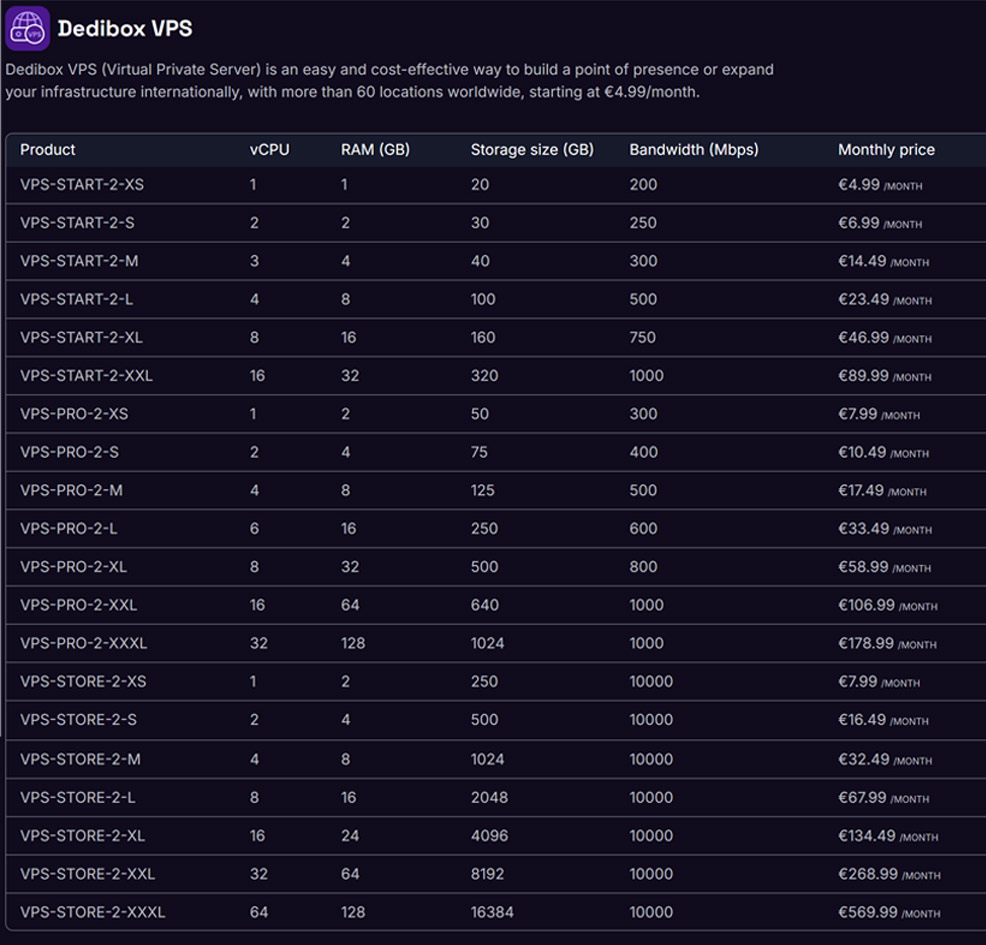
Scaleway’s fixed monthly VPS line starts with the VPS-START-2-XS plan at €4.99/month before tax, which includes 1 vCPU, 1 GB RAM, 20 GB NVMe storage, and 200 Mbps bandwidth. From there, the START range scales up through 16 vCPUs and 32 GB RAM, while the PRO range adds stronger resource allocations and the STORE range emphasizes large NVMe capacity for storage-heavy uses.
Some of the most relevant current Dedibox VPS prices include VPS-START-2-S at €6.99/month, VPS-PRO-2-XS at €7.99/month, VPS-PRO-2-M at €17.49/month, and VPS-STORE-2-M at €32.49/month. On the upper end, Scaleway’s STORE line runs all the way to VPS-STORE-2-XXXL with 64 vCPUs, 128 GB RAM, and 16,384 GB NVMe at €569.99/month before tax.
The fixed-price model is one of Scaleway’s biggest strengths. It gives buyers the predictability many people want from a VPS provider, without forcing them into the more usage-based complexity associated with large public-cloud billing models.
Virtual Instances Pricing
Scaleway’s Virtual Instances are a different product family and should not be confused with Dedibox VPS. These cloud VMs are typically billed hourly, with estimated monthly pricing shown on the pricing page, and they cover a much wider range of workloads.
At the low end, STARDUST1-S is listed at about €0.10/month, though it is an extremely small development-class instance intended only for ultra-light experimentation. More practical entry cloud options include DEV1-S at about €6.42/month, DEV1-M at about €14.45/month, and BASIC3-X2C-4G at about €27.95/month, with much larger instance families scaling into enterprise-level compute, memory, or networking footprints.
Scaleway notes that Virtual Instance list prices include egress and IPv6 addresses, while local or block storage and attached public IPv4 addresses are excluded. That is an important pricing detail because some buyers will focus only on base compute and overlook the fact that storage and IPv4 can materially affect the final monthly cost.
Bandwidth and Cost Transparency
Scaleway’s pricing pages are generally straightforward, which is a real advantage. For Virtual Instances, the company explicitly states that egress is included in list pricing, while storage and attached public IPv4 addresses are separate. For Dedibox VPS, pricing is easier to read because each plan is bundled as a fixed monthly product with a published bandwidth limit and storage allocation.
Scaleway also promotes savings plans for Virtual Instances that can reduce monthly compute costs by up to 25 percent. For users planning to run steady workloads over time, that can improve cost efficiency relative to pure on-demand billing.
Value Assessment
Scaleway’s value is strongest in two cases. First, it is attractive for buyers who want a low-cost fixed VPS in Europe or under a European provider. Second, it is appealing to technical users who want a broader cloud ecosystem without jumping immediately to AWS, Azure, or Google Cloud pricing and complexity.
The value is less clear-cut if your top priority is absolute best raw VPS price-to-performance regardless of ecosystem or if support quality is your top concern. In those situations, competitors such as Hetzner or OVHcloud may be stronger depending on workload, region, and support expectations. Still, Scaleway remains one of the more compelling mid-market infrastructure choices because it combines affordable entry plans with meaningful cloud depth.
| Plan / Resource Type | Typical Pricing Model | Key Resources | Best For |
|---|---|---|---|
| Dedibox VPS START | Fixed monthly pricing | Low-cost VPS bundles with NVMe storage and modest bandwidth allocations | Budget VPS hosting, small websites, dev servers, VPNs, lightweight self-hosting |
| Dedibox VPS PRO | Fixed monthly pricing | Premium CPU VPS bundles with more RAM and storage than START plans | Production VPS hosting, business apps, web servers, stronger small-to-mid workloads |
| Dedibox VPS STORE | Fixed monthly pricing | Premium CPU plus very large NVMe storage allocations and 10 Gbit/s networking | Storage-heavy workloads, backup nodes, mirrors, large self-hosted datasets |
| Development Virtual Instances | Hourly billing with monthly estimates | Very small to moderate cloud VMs such as STARDUST and DEV families | Testing, development, lightweight apps, labs, prototypes |
| General Purpose Virtual Instances | Hourly billing with monthly estimates | Balanced CPU/RAM cloud VMs across BASIC, STANDARD, POP2, PRO2, and GP1 families | Production apps, websites, APIs, general cloud workloads |
| Specialized Virtual Instances | Hourly billing with monthly estimates | Compute optimized, memory optimized, and network optimized shapes | Databases, CI/CD, analytics, high-throughput applications, specialized workloads |
| Storage / IP / Snapshots | Separate billing where applicable | Block storage, local storage, unified snapshots, and flexible IP resources | Persistent storage, backups, infrastructure add-ons, network requirements |
Pricing note: Scaleway can be very cost-effective, but buyers should not confuse Dedibox VPS pricing with Virtual Instances pricing. Dedibox VPS is the simpler flat-rate VPS option, while Virtual Instances are broader cloud VMs that may include additional costs for storage, IPv4, snapshots, or other services.
Ready to try Scaleway?
Scaleway is especially interesting if you want a European VPS provider with both flat-rate servers and a wider cloud platform behind them. Review the latest VPS and Virtual Instance prices directly on Scaleway’s site before deploying important workloads.
Performance and Speed
Scaleway’s performance profile depends heavily on which product family you choose. Dedibox VPS is designed to provide simple monthly virtual servers with defined specs, while Virtual Instances span lightweight development boxes through much larger general-purpose and specialized instance families. That means “Scaleway performance” is not one single experience; it varies by range, CPU class, storage model, and instance family.
On paper, the lineup is broad and modern enough to handle everything from small websites and homelab services to production applications, APIs, business workloads, and storage-heavy services. The Dedibox VPS range is especially practical for users who just want a predictable VPS with NVMe storage and published network limits, while the higher Virtual Instance families are more relevant for teams with cloud-native or application-level performance needs.
Public user commentary suggests that Scaleway is often seen as “good enough to strong” for general cloud and VPS use, but not always the undisputed value leader on raw performance. Some users compare it unfavorably with Hetzner on pure price-to-performance, while others value its broader service catalog and cloud flexibility more than benchmark leadership.
As with any infrastructure platform, real-world speed also depends on your own stack. A fast VPS can still feel slow if the database is poorly tuned, caching is missing, storage is misused, or your application is not optimized. Scaleway gives users solid infrastructure choices, but buyers remain responsible for tuning the software environment they deploy.
Ease of Use and Setup
Scaleway is easier to approach than a hyperscaler, but it is still not beginner shared hosting. Users familiar with developer-oriented VPS and cloud platforms should be comfortable after a short learning period, especially when working with Linux servers, SSH, console provisioning, DNS, and cloud networking basics.
For complete beginners, the experience may still feel technical. There is no default cPanel-style workflow, no “launch WordPress with all management included” consumer experience in the traditional sense, and no assumption that users want hand-held hosting setup. Even the act of choosing between Dedibox VPS and Virtual Instances introduces a layer of decision-making that simpler hosts avoid.
That said, Scaleway has a cleaner and more modern product presentation than many older infrastructure providers. If you are deciding between classic barebones VPS providers and more complex enterprise clouds, Scaleway sits in a useful middle ground. It is not beginner-first, but it also does not feel as intimidating as the largest cloud ecosystems.
The most practical way to think about Scaleway is this: it gives you infrastructure that is relatively accessible for technical users, not a polished beginner hosting package. If you want control and flexibility, that is a benefit. If you want simplicity above all else, it becomes a drawback.
Developer and Advanced Features
Developer flexibility is one of Scaleway’s strongest categories. Beyond basic VPS hosting, the platform includes Virtual Instances, bare metal, object storage, block storage, file storage, VPC-related networking, VPN, load balancing, domains and DNS, managed databases, Kubernetes, container tools, serverless functions and containers, messaging, and other cloud services.
This matters because many users start by renting a small VPS but later need more than a single server. Scaleway offers a more credible upgrade path than a basic budget VPS seller. A team can begin with a low-cost Dedibox VPS or development cloud VM, then grow into databases, private networking, load balancing, Kubernetes, object storage, and larger production infrastructure without leaving the ecosystem.
For developers and self-hosters, that makes Scaleway more interesting than a plain VPS provider. You are not just getting a server; you are getting access to a broader cloud platform that can support modern application architecture if your project grows beyond a single box.
At the same time, this breadth adds complexity. The deeper your infrastructure needs become, the more you will need to understand cloud networking, service boundaries, snapshots, IP management, storage billing, automation, and deployment design. Scaleway is most attractive to users who see that complexity as useful rather than intimidating.
Security, SSL, and Backups
Scaleway provides the basic ingredients you would expect from a real cloud and VPS platform: infrastructure controls, networking services, storage products, security-oriented account tools, and the ability to build a properly secured server environment. In practical terms, that means users can implement firewalls, restricted access patterns, TLS, backups, DNS controls, and infrastructure segmentation depending on the chosen product family.
However, security is still a shared responsibility. Scaleway provides the infrastructure, but users remain responsible for securing operating systems, patching services, restricting SSH access, managing keys and credentials, configuring SSL, and maintaining backups. This is a major difference between cloud/VPS hosting and fully managed consumer hosting plans.
SSL is not handled in the same beginner-friendly way as on many managed website hosts. You can absolutely use Let’s Encrypt, reverse proxies, or certificates on load-balanced environments, but configuration is your responsibility unless you layer on higher-level tooling. Likewise, backups should be deliberate, not assumed. Snapshot pricing, block storage choices, and off-platform backups all need attention.
If you are comfortable with infrastructure responsibility, this is normal. If you expected a turnkey hosting dashboard where everything is automated and bundled, Scaleway will feel less friendly. Its security foundation can be strong, but the user has to do the work.
Customer Support
Support is the most uncertain part of Scaleway’s reputation. The platform clearly offers meaningful documentation and cloud resources, and some users report positive experiences, but public sentiment is not consistently strong. Across review sites and public discussion threads, the most common complaints involve support speed, billing issues, cancellations, and frustration when something goes wrong.
That mixed support reputation is important because it changes the risk profile. If everything works as expected, Scaleway can look like a very strong value. If you need urgent issue resolution, account clarification, or billing help, public feedback suggests the experience may be less reassuring than with the most support-trusted competitors.
This does not mean Scaleway is unusable or inherently unreliable. Many users are satisfied and continue to recommend it, especially for European workloads or as a middle-ground cloud platform. But if your project is mission-critical and support quality is a deciding factor, you should test support expectations carefully rather than assuming the cheapest listed price tells the whole story.
For small developers and self-hosters, the practical advice is simple: keep backups, document your setup, and do not rely on a low-cost VPS platform as if it were a fully managed concierge hosting service. Scaleway can work well, but users should go in with realistic expectations.
Scalability and Flexibility
Scaleway is much more scalable than a typical budget VPS host. A user can start with a small fixed Dedibox VPS, move into Virtual Instances, add storage, attach networking services, use managed databases, deploy Kubernetes, or even move into dedicated and bare metal options depending on workload needs.
This is one of the provider’s biggest strategic strengths. It gives startups, agencies, and technical teams a path from simple server hosting into a broader cloud architecture without forcing an immediate jump to hyperscaler pricing or complexity. For businesses that care about European infrastructure positioning, that growth path is especially useful.
The Virtual Instances catalog is also broad enough to support more specialized needs. General-purpose, compute-optimized, memory-optimized, and network-optimized families make the platform viable for applications that go far beyond simple website hosting.
For ordinary small websites, that level of scalability may be more than necessary. But for developers and businesses that expect growth, Scaleway offers a more credible long-term platform than a basic low-end VPS provider with no surrounding ecosystem.
Scalability takeaway: Scaleway can take a user much farther than a standard budget VPS host. The key tradeoff is that more flexibility brings more product choices, more architecture decisions, and more responsibility.
Data Centers and Global Reach
Scaleway has a strong European identity, but it does not operate only as a small regional host. Its pricing and product materials position the company as a wider cloud platform with international reach, and its Dedibox VPS pages describe deployment availability across more than 60 locations worldwide.
For many buyers, Europe is the main attraction. Scaleway is especially relevant for users who want an EU-based provider, prefer European cloud branding, or care about hosting within a provider that emphasizes straightforward pricing and data-related trust positioning. That is one reason it frequently appears in “European cloud provider” discussions.
At the same time, the company’s location coverage is broad enough to support more distributed infrastructure planning than many people expect from a European-first brand. Buyers still need to verify exact region and product availability for the specific service they want, but Scaleway is not limited to one or two narrow deployment zones.
In practical terms, global reach is a plus here, though not necessarily the main reason to choose the platform. Most buyers considering Scaleway are drawn first by the combination of Europe-focused positioning, VPS affordability, and cloud feature depth.
Who Is Scaleway Best For?
Best For
- Developers who want a European cloud provider with both simple VPS plans and broader cloud services
- Self-hosters comfortable managing Linux servers, SSH, and cloud-style infrastructure decisions
- Startups and agencies that may begin with a VPS but want a longer-term upgrade path
- Businesses that prefer EU-hosted or European-branded infrastructure options
- Users who want fixed-price monthly VPS plans rather than fully usage-based cloud billing
- Storage-heavy workloads that can benefit from the Dedibox VPS STORE range
- Technical teams needing access to networking, storage, databases, Kubernetes, and serverless services in one ecosystem
- Buyers who want a middle ground between barebones VPS sellers and full hyperscale cloud platforms
Not Ideal For
- Beginners who want cPanel, beginner dashboards, bundled email hosting, and one-click website management
- Users who expect premium hand-holding support from a low-cost infrastructure provider
- Buyers who only care about maximum raw VPS price-to-performance and are willing to shop purely on benchmarks
- Site owners who do not want to manage backups, SSH access, patching, SSL, or server hardening
- Anyone who wants a very simple WordPress-first hosting experience
- Customers who are highly sensitive to billing friction or cancellation uncertainty
- Users who do not want to compare multiple product families before choosing a hosting plan
Ready to try Scaleway?
If you want a capable European VPS and cloud platform with affordable entry pricing and room to grow, Scaleway is one of the more interesting options in the market. If you want simplicity and highly polished consumer support, compare alternatives carefully first.
How We Evaluated Scaleway
For this review, we evaluated Scaleway from the perspective of a hosting and VPS buyer rather than a procurement team shopping only for enterprise cloud contracts. That means we focused most heavily on Dedibox VPS, Virtual Instances, pricing transparency, ease of deployment, infrastructure breadth, support expectations, user sentiment, and practical usability for websites, applications, and self-hosted services.
We also considered Scaleway’s official product and pricing pages, how the company structures its VPS and cloud VM offerings, and the gap between attractive published pricing and the real-world experience reflected in public reviews and forum discussions. Particular attention was paid to support reputation, product clarity, global reach, European positioning, and how well the platform serves both small deployments and larger technical teams.
Our scoring does not penalize Scaleway for failing to be a beginner shared host, because that is not what it is trying to be. However, we do account for the fact that many people shopping for “Scaleway hosting” are comparing it against simpler VPS and website hosting options, not only against larger cloud infrastructure platforms.
Scoring Breakdown
| Category | Score |
|---|---|
| Performance | 8.3/10 |
| Ease of Use | 7.4/10 |
| Pricing/Value | 8.8/10 |
| Features | 8.9/10 |
| Security/Backup | 8.0/10 |
| Support | 6.6/10 |
| Scalability | 8.7/10 |
| Overall | 8.1/10 |
Top Alternatives to Scaleway
If Scaleway does not seem like the right fit, you may also want to consider alternatives such as Hetzner, Vultr, DigitalOcean, Linode / Akamai Cloud, OVHcloud, and AWS Lightsail.
Hetzner is often the strongest alternative for buyers focused primarily on raw price-to-performance. It is especially appealing in Europe for users who want straightforward cloud servers or dedicated servers at aggressive prices, though it does not always match Scaleway’s broader managed-service positioning.
Vultr is a strong alternative for users who want simple VPS deployment, wide global coverage, predictable cloud compute options, and an easy path to higher-frequency or specialized virtual machines. It is often easier to grasp quickly than a broader cloud ecosystem while still giving developers meaningful flexibility.
DigitalOcean remains one of the best alternatives for users who want a cleaner developer experience, strong documentation, and an easier small-team workflow. It is often simpler than Scaleway for straightforward VPS and app deployments, though pricing may be less aggressive depending on workload.
Linode / Akamai Cloud is another good option for users who value predictable Linux VPS hosting, developer friendliness, and a long-established reputation in the cloud VPS market. It usually feels simpler than Scaleway, even if it may not always be cheaper.
OVHcloud is one of the most relevant alternatives for buyers who want another major European provider with strong VPS, dedicated, and cloud infrastructure options. For some EU-focused users, the real short list is often Scaleway versus OVHcloud versus Hetzner rather than against US-first cloud brands.
AWS Lightsail is useful for buyers who want a simplified VPS product connected to the broader AWS ecosystem. It is often easier for mainstream cloud adoption than full EC2, though Scaleway may look more attractive on pricing simplicity and European provider identity for certain workloads.
Final Verdict
Scaleway is one of the more interesting VPS and cloud hosting platforms for users who want affordable infrastructure under a European provider with room to grow. Its combination of flat-rate Dedibox VPS plans, broader Virtual Instances, storage and networking services, and cloud ecosystem depth gives it more long-term usefulness than many budget VPS sellers.
Its biggest strengths are pricing flexibility, ecosystem breadth, EU hosting appeal, and a reasonable middle-ground position between barebones VPS hosts and complex hyperscalers. Its biggest weaknesses are mixed public sentiment around support and billing, some product fragmentation, and a user experience that still assumes at least moderate technical comfort.
For developers, self-hosters, startups, agencies, and infrastructure-minded website owners, Scaleway can be a strong choice. It is especially attractive if you want a European cloud platform that can start small and scale outward. For beginners who simply want an easy website host with premium support and minimal setup work, it is usually not the best fit.
Overall, Scaleway earns a strong rating because it offers genuine value and capability without pretending to be a consumer-first beginner host. We would recommend it most confidently to technically comfortable users who can take advantage of its pricing and ecosystem while keeping realistic expectations about support and self-management.
Ready to try Scaleway?
If your priority is affordable cloud and VPS infrastructure from a European provider, Scaleway deserves a close look. If your priority is simplicity, premium support, and beginner-friendly hosting, compare alternatives before committing.
Frequently Asked Questions
Is Scaleway good for VPS hosting?
Yes, Scaleway is a solid VPS hosting option for developers, self-hosters, and technical businesses. Its biggest strengths are affordable entry pricing, a broad cloud ecosystem, and the choice between fixed-price Dedibox VPS plans and more flexible cloud Virtual Instances.
What is the difference between Scaleway Dedibox VPS and Virtual Instances?
Dedibox VPS is Scaleway’s simpler fixed-price monthly VPS product, while Virtual Instances are cloud virtual machines billed hourly with a much wider range of instance families and deeper integration into the broader cloud platform. Buyers who want predictable VPS billing usually start with Dedibox VPS, while cloud-oriented users may prefer Virtual Instances.
How much does Scaleway VPS cost?
Scaleway’s Dedibox VPS plans currently start at €4.99/month before tax for the VPS-START-2-XS plan with 1 vCPU, 1 GB RAM, and 20 GB NVMe storage. Higher plans scale through START, PRO, and STORE ranges into much larger resource bundles.
Does Scaleway offer cheap cloud servers?
Yes, Scaleway has several low-cost cloud VM options. Its Virtual Instances pricing includes very small development-class machines such as STARDUST1-S and practical entry instances such as DEV1-S, though buyers should remember that storage and attached public IPv4 pricing may be separate.
Is Scaleway beginner-friendly?
Scaleway is more approachable than many hyperscalers, but it is not really a beginner-first hosting platform. It is best for users who are comfortable with Linux servers, SSH, DNS, infrastructure choices, and managing their own applications.
Does Scaleway include cPanel or managed WordPress hosting?
Not by default. Scaleway is an infrastructure provider rather than a classic cPanel host, so users generally manage the server stack themselves unless they deploy their own control panel or use a higher-level service.
Is Scaleway a good alternative to Hetzner?
Yes, especially if you want a broader cloud ecosystem or prefer Scaleway’s product lineup and European positioning. Hetzner often has stronger raw price-to-performance, while Scaleway can be more appealing to buyers who want a larger surrounding platform rather than only low-cost servers.
What are the biggest downsides of Scaleway?
The biggest downsides are mixed support sentiment, possible billing or cancellation frustration, a more technical experience than beginner hosts, and the need to choose between multiple product families. It can be excellent for the right user, but it is not the simplest hosting provider.
Can I host WordPress on Scaleway?
Yes, you can host WordPress on Scaleway VPS or Virtual Instances, but you will generally be responsible for the server setup, web stack, SSL, updates, backups, and security unless you use your own control panel or automation tooling. It is better suited to technical users than to complete beginners.
Who should choose Scaleway?
Scaleway is best for developers, self-hosters, startups, agencies, and businesses that want affordable VPS or cloud infrastructure from a European provider. It is less ideal for users who want a fully managed shared-hosting experience with beginner support and minimal setup work.
Editorial note: Cloud plans, VPS specifications, pricing, support policies, and regional availability can change over time. Before signing up, always confirm the latest details directly on Scaleway’s official pricing and product pages.