
Our Linode (Akamai) Review & Analysis for 2026

 By:
By: Table of Contents
- Quick Facts
- What Is Linode?
- Plans, Pricing, and Overall Value
- Performance and Speed
- Ease of Use and Setup
- Developer and Advanced Features
- Security, SSL, and Backups
- Customer Support
- Scalability and Flexibility
- Data Centers and Global Reach
- Who Is Linode Best For?
- How We Evaluated Linode
- Scoring Breakdown
- Top Alternatives
- Final Verdict
- Frequently Asked Questions
Pros
- Clear hourly and monthly pricing that is easier to understand than many large cloud platforms
- Strong range of compute options, including shared CPU, dedicated CPU, high-memory, GPU, and Kubernetes services
- Good fit for developers, sysadmins, self-hosted apps, APIs, and custom web stacks
- Useful documentation and a generally approachable cloud platform for technically comfortable users
- Flexible resizing and upgrade paths as workloads grow
- Positive long-term reputation for reliability and straightforward infrastructure
Cons
- Not a traditional beginner web host, and not ideal for users who want everything managed for them
- Entry-level shared CPU instances can be limiting for sustained heavy workloads
- Backups, bandwidth overages, and add-on services can increase total cost
- Some users feel pricing is less aggressive than certain low-cost VPS competitors
- Post-acquisition support sentiment is somewhat mixed in parts of the community
Ready to try Linode?
If your priority is flexible cloud VPS hosting with predictable pricing and more control than shared hosting offers, Linode may be worth a serious look. Check the latest plans, regions, and features directly on the provider’s site before deploying.
Quick Facts
| Provider | Linode (Akamai Cloud) |
|---|---|
| Hosting Type | Cloud VPS, Shared CPU, Dedicated CPU, High Memory, GPU, Kubernetes, Object Storage, Managed Databases |
| Starting Price | $5/month for entry shared CPU plans |
| Renewal Price | No teaser renewal model in the traditional shared-hosting sense; usage-based pricing applies |
| Billing Style | Hourly billing with monthly caps |
| Storage | Plan-dependent local storage, plus block storage and S3-compatible object storage options |
| CPU/RAM | Ranges from small shared CPU instances to large dedicated CPU and memory-optimized plans |
| Control Panel | Cloud Manager web dashboard and API |
| Managed Hosting Available | Partially, through managed databases, Kubernetes options, and infrastructure services; not a classic managed shared host |
| Root Access | Yes, on compute instances |
| Data Center Locations | Global cloud regions across North America, Europe, Asia-Pacific, and other selected markets |
| Uptime SLA | Typically 99.9% for core infrastructure expectations, depending on service and configuration |
| Free SSL | Not bundled in the same way as shared hosting; users typically deploy SSL through their own web stack or services like Let’s Encrypt |
| Backups | Available as a paid add-on for instances |
| Support | Ticket-based and account support, documentation, guides, and platform resources |
| Best For | Developers, technical site owners, startups, web apps, APIs, self-managed hosting, and users who want infrastructure control |
Bottom line: Linode stands out as a capable cloud VPS platform that balances simplicity, flexibility, and transparent billing better than many larger cloud providers. Its biggest tradeoff is that it expects more technical ownership than beginner-focused web hosts, so it is best for users who are comfortable managing servers or cloud infrastructure.
What Is Linode?
Linode is a long-running cloud infrastructure provider best known for virtual machines and developer-friendly hosting. Now operating under Akamai, it offers compute instances, block storage, object storage, managed databases, Kubernetes, networking tools, and GPU-enabled infrastructure for users who want to build on cloud resources without navigating the complexity of hyperscale platforms.
Its core appeal is straightforward: Linode gives users cloud VPS and infrastructure services with pricing that is relatively simple, predictable, and easy to compare. Instead of focusing on traditional shared hosting bundles, it focuses on flexible Linux-based cloud resources for websites, applications, APIs, developer workloads, and self-managed projects.
Plans, Pricing, and Overall Value
Plan Types
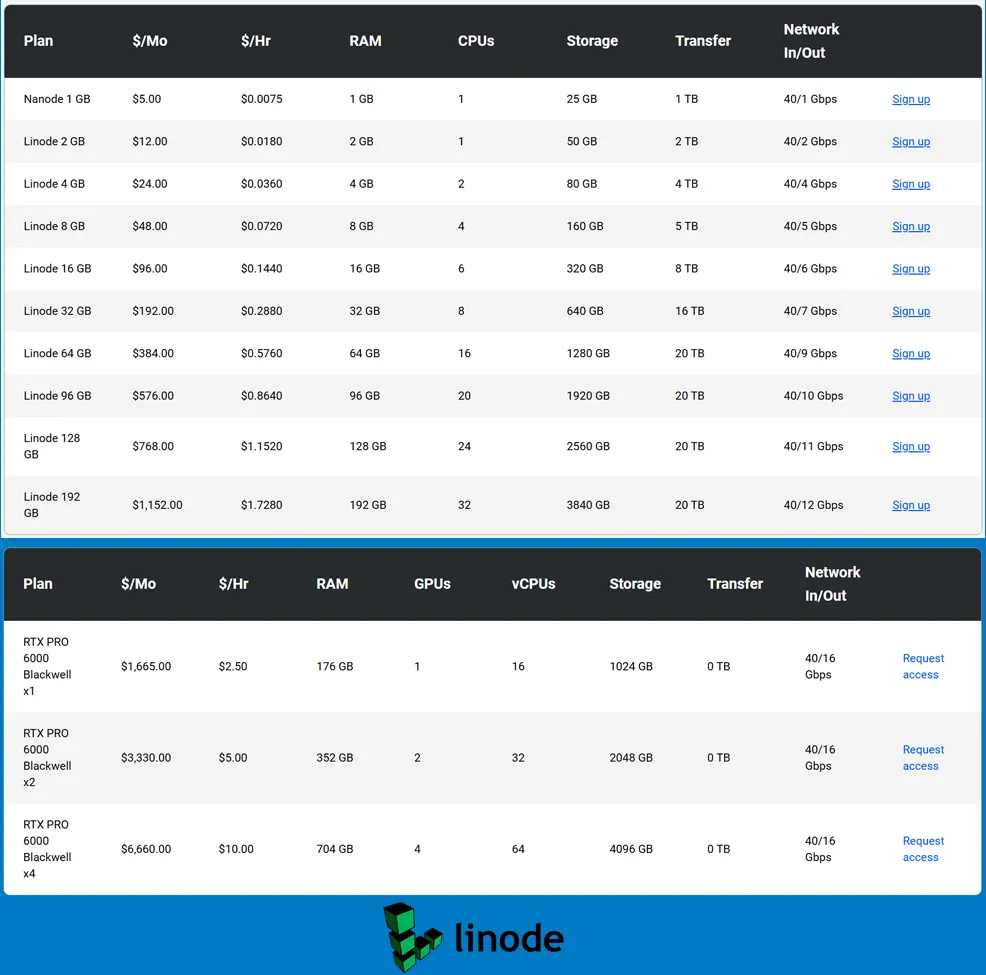
Linode offers multiple infrastructure tiers rather than simple shared hosting packages. The most accessible option is Shared CPU compute, which is aimed at lighter workloads, development environments, smaller web applications, and websites with more modest resource requirements. Above that are Dedicated CPU plans for more consistent production workloads, High Memory plans for memory-heavy databases and caching systems, GPU plans for specialized compute, and additional services such as Kubernetes, load balancing, object storage, and managed databases.
Entry-Level Pricing
Linode remains relatively accessible at the low end. Entry shared CPU instances start at $5/month, which keeps the platform approachable for hobby projects, test environments, small websites, and lightweight apps. Unlike many traditional hosts, pricing is usually presented with hourly rates and monthly caps, which makes it easier to understand the real operating cost of short-lived or experimental workloads.
Renewal Pricing and Hidden Costs
One of Linode’s advantages is that it does not rely on the classic bargain-hosting pattern of ultra-cheap introductory deals followed by steep renewal pricing. That said, shoppers still need to look closely at total cost. Backups cost extra, network transfer overages are billed separately, powered-off instances can still incur charges because resources remain reserved, and the total monthly bill can rise if you add managed databases, Kubernetes, load balancers, block storage, or higher-performance instance types.
In other words, Linode’s pricing is generally transparent, but it is still infrastructure pricing rather than all-inclusive website hosting pricing. That distinction matters. A small self-managed website may be inexpensive to run, but a production stack with backups, storage, databases, and traffic can cost meaningfully more than the headline entry plan suggests.
Value Assessment
For technical users, Linode offers strong value. You get a reasonably approachable cloud platform, transparent billing, good documentation, and several useful infrastructure services without the sprawl and pricing complexity that often frustrate smaller teams on larger clouds. For non-technical users, the value is less obvious because Linode gives you more responsibility rather than more convenience. Overall, Linode tends to offer very good value for developers and self-hosters, but only moderate value for beginners looking for a bundled website-hosting experience.
| Plan Tier | Starting Price | Key Resources | Best For |
|---|---|---|---|
| Shared CPU | $5/mo | Entry-level cloud VM resources, Linux server flexibility, hourly billing with monthly cap | Small sites, dev/test servers, low-traffic apps, personal projects |
| Dedicated CPU | $36/mo | Dedicated CPU resources, stronger consistency under load, more production-ready performance | Production websites, APIs, databases, heavier business workloads |
| High Memory | $60/mo | Memory-optimized configurations for cache-heavy or RAM-intensive applications | In-memory databases, analytics workloads, heavier backend services |
| GPU / Specialized | $350+/mo | Dedicated GPU resources and specialized compute options | AI workloads, rendering, parallel compute, specialized technical use cases |
Pricing note: Linode pricing is usually more transparent than discount-first shared hosting, but total cost still depends on backups, bandwidth usage, storage, databases, and any added cloud services.
Ready to try Linode?
If your priority is flexible cloud VPS hosting with predictable pricing and more control than shared hosting offers, Linode may be worth a serious look. Check the latest plans, regions, and features directly on the provider’s site before deploying.
Performance and Speed
Performance is one of the main reasons people consider Linode in the first place. For typical VPS-style hosting, the platform has long been regarded as dependable and capable enough for websites, APIs, SaaS applications, self-hosted tools, and many developer workloads. Its Dedicated CPU options are especially relevant for production environments that need more predictable performance than shared compute plans can provide.
The main nuance is that not all Linode plans behave the same way. Shared CPU plans are designed for cost efficiency and variable workloads, which means they can be perfectly fine for lighter websites and short bursts of activity, but they are not the best fit for consistently CPU-heavy applications. Dedicated CPU and higher-tier plans make more sense for workloads where latency consistency, heavier concurrency, or database performance matter more.
For brochure sites, blogs, dashboards, low-to-medium traffic apps, and many containerized projects, Linode can perform very well when properly configured. For enterprise-scale or highly performance-sensitive systems, it is still important to size carefully and compare against alternatives that may offer faster storage, more aggressive networking, or more specialized hardware.
Ease of Use and Setup
Linode is easier to use than many large cloud providers, but it is still a cloud platform rather than a beginner shared host. The Cloud Manager interface is relatively clean, and it is more approachable than the sprawling consoles used by AWS, Azure, or Google Cloud. Creating an instance, selecting a region, choosing an image, setting SSH access, and deploying a basic server is generally straightforward for anyone with moderate technical comfort.
That said, ease of use depends heavily on your expectations. If you are used to one-click site builders, email hosting bundles, and managed WordPress dashboards, Linode will feel more hands-on. You are usually responsible for configuring the server, securing the stack, deploying your application, and maintaining the environment over time.
For developers and technical operators, this is often a feature rather than a problem. Linode gives you a cleaner path to self-managed infrastructure without overwhelming you with endless enterprise-level menus and billing traps.
Developer and Advanced Features
This is where Linode is strongest. It is built for people who want server access, API-based infrastructure, flexible deployment choices, and room to architect their own environment. You can deploy raw Linux instances, use object storage, attach block volumes, set up managed databases, run Kubernetes clusters, add load balancers, and integrate the platform into custom workflows.
Root access on compute instances makes Linode far more flexible than ordinary website hosting plans. Developers can run custom stacks, reverse proxies, Docker containers, VPNs, Git-based deployment pipelines, staging environments, worker nodes, and application-specific dependencies that would be awkward or impossible on shared hosting. This is one reason Linode remains attractive to technical users even when budget-first competitors are cheaper on paper.
At the same time, Linode is not trying to be every kind of cloud for every kind of enterprise. It is more focused and streamlined than hyperscalers, which is part of its appeal, but it may not match them on breadth of managed services, edge-native tooling, or ultra-specialized enterprise integrations.
Security, SSL, and Backups
Linode gives users a solid infrastructure foundation, but security is much more of a shared responsibility here than it is with managed website hosting. Users can implement firewalls, SSH keys, backups, network controls, private networking, and their own preferred SSL setup, but these protections often require deliberate configuration rather than being bundled into a beginner package.
SSL is not a standout bundled selling point in the same way it is with shared hosts because Linode assumes you are building and managing your own web stack. In practice, many users install Let’s Encrypt certificates or configure TLS at the application, reverse proxy, or load-balancer level. Backups are available, but they are generally a paid add-on rather than an included standard feature across the board.
For serious production use, the right mindset is to treat Linode as capable infrastructure, not an all-in-one security solution. Strong security still depends on patching discipline, access control, proper firewall rules, monitoring, and off-platform contingency planning where appropriate.
Customer Support
Support is one of the more nuanced parts of the Linode story. Historically, Linode built a strong reputation for being more approachable and more human than some larger cloud providers. Its documentation and tutorials are still among its biggest strengths, and many users continue to value the platform’s practical knowledge base.
However, community sentiment is not uniformly glowing. Some users remain positive about reliability and overall usability, while others have expressed frustration around support responsiveness, billing issues, or changes in the experience since the Akamai acquisition. That does not make support poor across the board, but it does mean buyers should view it as good infrastructure support rather than luxury managed-hosting support.
For technical users who are comfortable solving many issues themselves, Linode support can be perfectly sufficient. For beginners who expect extensive hand-holding, real-time coaching, or white-glove migration help, it may feel less accommodating than a premium managed host.
Scalability and Flexibility
Linode scales more naturally than most beginner website hosts because it starts from an infrastructure mindset. A user can begin with a low-cost shared CPU instance, move to a larger VM, shift to dedicated CPU, attach storage, deploy a managed database, or adopt Kubernetes as the application becomes more demanding. That makes the platform appealing for projects that start small but may evolve into something much more substantial.
Its flexibility also helps teams avoid early platform lock-in. Because Linode centers around standard cloud building blocks, users can design their own architecture instead of being boxed into a rigid website-hosting product line. This is especially useful for startups, internal tools, SaaS products, custom APIs, and self-managed ecommerce or content applications.
The caveat is that scalability on Linode still assumes technical competence. The platform gives you room to grow, but it also expects you to make the right architectural decisions as that growth happens.
Scalability takeaway: Linode is a good fit for projects that may outgrow a simple starter server and need a practical path toward stronger compute, storage, databases, and more advanced cloud architecture.
Data Centers and Global Reach
Linode benefits from a broad regional footprint that helps users deploy infrastructure closer to their audiences. Its cloud regions span multiple parts of North America, Europe, and Asia-Pacific, which is valuable for reducing latency and giving users more flexibility when placing production workloads.
This matters for web hosting because location still affects responsiveness, especially for dynamic sites, APIs, and apps with geographically concentrated traffic. For users serving international audiences, Linode’s regional presence is a meaningful advantage over smaller VPS companies that offer only one or two realistic deployment regions.
As always, buyers should verify the exact region availability for the specific service they want, since not every compute family or managed service is always available in every location.
Who Is Linode Best For?
Best For
- Developers who want straightforward cloud VPS hosting without hyperscaler complexity
- Technical users deploying custom websites, web apps, APIs, and self-hosted services
- Startups and small teams that need infrastructure flexibility on a manageable budget
- Projects that may need to scale from a single VM into a broader cloud stack over time
- Users who value transparent pricing, Linux control, and documentation over hand-holding
Not Ideal For
- Absolute beginners who want shared hosting, drag-and-drop site building, or bundled convenience
- Users who do not want to manage operating systems, patches, security, or server configuration
- Buyers focused only on finding the absolute cheapest VPS provider available
- Organizations that need the deepest enterprise cloud ecosystem or highly specialized managed services
Ready to try Linode?
If your priority is flexible cloud VPS hosting with predictable pricing and more control than shared hosting offers, Linode may be worth a serious look. Check the latest plans, regions, and features directly on the provider’s site before deploying.
How We Evaluated Linode
For this review, we considered Linode’s plan structure, published pricing model, instance families, infrastructure flexibility, ease of deployment, developer tooling, backups and security posture, support model, upgrade path, and overall suitability for the kinds of users most likely to consider cloud VPS hosting.
We also considered broader user sentiment and review patterns, including recurring praise around documentation, simplicity, and reliability, as well as recurring concerns around support responsiveness, pricing competitiveness against some VPS rivals, and the fact that Linode is inherently more hands-on than beginner-friendly hosting products.
Scoring Breakdown
| Category | Score |
|---|---|
| Performance | 8.8/10 |
| Ease of Use | 8.1/10 |
| Pricing/Value | 8.8/10 |
| Features | 9.0/10 |
| Security/Backup | 8.2/10 |
| Support | 7.9/10 |
| Scalability | 9.1/10 |
| Overall | 8.7/10 |
Top Alternatives to Linode
If Linode does not seem like the right fit, you may also want to consider alternatives such as Cloudways, ScalaHosting, and SiteGround. Cloudways is often a better fit for users who want cloud power with more management layered on top, ScalaHosting can appeal to buyers who want VPS-oriented growth with stronger support and a more hosting-centric feel, and SiteGround is better for users who prefer a polished managed experience over raw infrastructure control.
Final Verdict
Linode is a strong option for developers, technical site owners, startups, and businesses that want cloud VPS hosting with transparent pricing, practical flexibility, and a cleaner experience than many hyperscale cloud platforms.
Its biggest strengths are straightforward billing, useful infrastructure options, solid documentation, and a practical scaling path from small self-managed workloads to more capable production deployments. Its biggest weaknesses are that it is more hands-on than traditional web hosts, some add-ons raise total cost, and support sentiment is not as consistently strong as the platform’s technical reputation.
For many technically comfortable users, that tradeoff will be worth it. If your goal is to deploy and control your own infrastructure without diving into the full complexity of AWS or Azure, Linode remains one of the more appealing platforms in its category. If your top priority is beginner simplicity, bundled convenience, or fully managed hosting, you may want to compare alternatives before committing.
Ready to try Linode?
If your priority is flexible cloud VPS hosting with predictable pricing and more control than shared hosting offers, Linode may be worth a serious look. Check the latest plans, regions, and features directly on the provider’s site before deploying.
Frequently Asked Questions
Is Linode good for beginners?
Linode can work for beginners with some technical comfort, but it is not the easiest option for first-time website owners. It is better suited to users who are comfortable managing a server, deploying software, and handling their own maintenance.
Does Linode offer shared hosting?
Not in the traditional consumer hosting sense. Linode mainly offers cloud infrastructure and VPS-style compute rather than classic shared hosting plans with a bundled website management experience.
Is Linode expensive?
Linode is often reasonably priced for cloud infrastructure and starts at a low monthly cost, but the total bill depends on the services you use. Backups, storage, transfer overages, managed databases, and higher-performance plans can raise costs meaningfully.
Does Linode include free SSL and backups?
Not in the same way traditional shared hosts do. SSL is usually configured by the user within their own web stack, and backups are commonly offered as a paid add-on rather than a universal included feature.
Who should choose Linode over competitors?
Linode is a strong choice for developers and technical users who want a simpler cloud VPS platform with transparent pricing, flexible Linux infrastructure, and room to scale without the complexity of a hyperscale provider.
Editorial note: Hosting plans, pricing, features, and policies can change over time. Before signing up, always confirm the latest details directly on the provider’s site.