
Our Hostinger Review & Analysis for 2026
 By:
By: Table of Contents
- Quick Facts
- What Is Hostinger?
- Plans, Pricing, and Overall Value
- Performance and Speed
- Ease of Use and Setup
- Developer and Advanced Features
- Security, SSL, and Backups
- Customer Support
- Scalability and Flexibility
- Data Centers and Global Reach
- Who Is Hostinger Best For?
- How We Evaluated Hostinger
- Scoring Breakdown
- Top Alternatives
- Final Verdict
- Frequently Asked Questions
Pros
- Excellent introductory pricing for shared hosting and strong overall value
- Clean, beginner-friendly hPanel instead of a confusing legacy dashboard
- Good feature set for the price, including free SSL, free domain on qualifying plans, and backups
- Broad hosting lineup with shared, cloud, managed WordPress, and VPS options
- Strong fit for bloggers, small businesses, affiliate sites, and first-time site owners
- Positive reviewer sentiment and generally strong user ratings
Cons
- Renewal pricing is much higher than the introductory rate
- Phone support is not available
- Lowest prices usually require a long multi-year commitment
- Entry-level shared plans are not ideal for demanding or highly customized workloads
- Some users report billing confusion or frustration with certain AI tools
Ready to try Hostinger?
If your priority is affordable hosting with a smooth setup experience and solid features for the price, Hostinger may be worth a closer look. Review the latest plans, features, and pricing directly on the provider’s site before signing up.
Quick Facts
| Provider | Hostinger |
|---|---|
| Hosting Type | Shared, Cloud, VPS, Managed WordPress, Website Builder |
| Starting Price | $1.99/month (Premium shared, long-term term pricing) |
| Renewal Price | $10.99/month for Premium shared; higher on upper tiers |
| Billing Style | Monthly and multi-year plans, with the best prices tied to long commitments |
| Storage | SSD on lower shared tiers; NVMe on higher shared/business plans; larger scalable resources on cloud/VPS |
| CPU/RAM | Abstracted on shared plans; scalable dedicated allocations on cloud and VPS plans |
| Control Panel | Custom hPanel |
| Managed Hosting Available | Yes |
| Root Access | Yes, on VPS plans |
| Data Center Locations | North America, South America, Europe, and Asia |
| Uptime SLA | 99.9% |
| Free SSL | Yes |
| Backups | Weekly on lower shared tiers; daily and on-demand on higher tiers like Business |
| Support | 24/7 live chat and ticket/email-style support; no phone support |
| Best For | Beginners, small businesses, WordPress users, bloggers, and budget-conscious site owners |
Bottom line: Hostinger stands out for pairing low entry pricing with a polished experience and unusually strong features for the money, making it a compelling choice for beginners, WordPress users, and small business owners. The main tradeoff is that renewal pricing rises sharply, and users who want premium hand-holding or phone support may prefer a more premium host.
What Is Hostinger?
Hostinger is a global web hosting company that offers shared hosting, managed WordPress hosting, cloud hosting, VPS hosting, domain registration, business email, and an AI-driven website builder. It is designed primarily for users who want an easier and more affordable way to launch and manage websites without giving up too many modern features.
Its core appeal is simple: Hostinger tries to deliver beginner-friendly hosting at aggressive introductory prices while still offering enough performance, tools, and upgrade paths for growing websites. That combination is what has made it one of the most frequently recommended budget-friendly hosts in recent reviews.
Plans, Pricing, and Overall Value
Plan Types
Hostinger offers several distinct product tiers. Its shared hosting plans are the most beginner-friendly and price-sensitive, while its managed WordPress plans target WordPress users who want an easier setup and maintenance experience. Above that, Hostinger offers cloud hosting for users who need more resources and smoother scaling, and VPS hosting for developers or power users who need more control, dedicated allocations, and root access.
Entry-Level Pricing
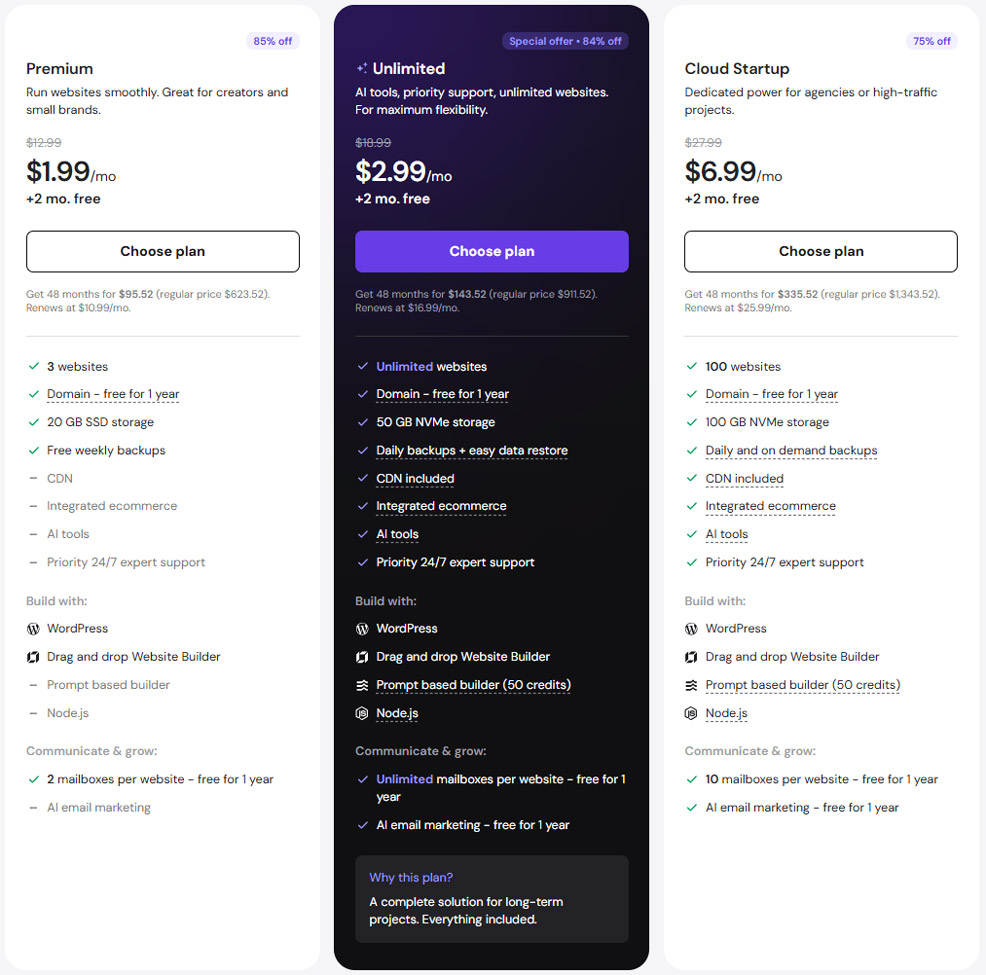
One of Hostinger’s biggest selling points is its low advertised entry price. At the time of writing, the Premium shared hosting plan starts at about $1.99/month on a long-term 48-month commitment. That makes Hostinger look extremely attractive for new site owners, especially compared with many competitors that charge more upfront for similar beginner plans.
Renewal Pricing and Hidden Costs
This is where readers need to pay attention. Hostinger’s introductory rates are excellent, but renewals are much higher. For example, the Premium shared plan renews at $10.99/month, while Business shared renews at $16.99/month. Like many hosting companies, Hostinger uses deep introductory discounts to win new customers, so the long-term cost is meaningfully higher than the sticker price shown in ads and comparison tables.
There are other details to understand as well. Some benefits vary by tier, such as backup frequency, number of websites, email allowances, storage type, and included performance or AI tools. In other words, Hostinger is competitively priced, but shoppers still need to read the plan details carefully rather than focusing only on the headline price.
Value Assessment
For beginners and small businesses, Hostinger offers very strong value. You get a polished dashboard, free SSL, useful onboarding, a free domain for qualifying terms, and a decent feature stack at a very low starting cost. For agencies, developers, or high-growth sites, the value depends more on whether Hostinger’s cloud or VPS tiers match your needs better than a premium managed host or more developer-centric cloud platform. Overall, Hostinger delivers some of the best value in the low-cost hosting segment, but its biggest value advantage is at signup, not necessarily at renewal.
| Plan Tier | Starting Price | Key Resources | Best For |
|---|---|---|---|
| Premium Shared | $1.99/mo | Up to 3 websites, 20 GB SSD storage, free SSL, free domain for 1 year on qualifying terms, weekly backups | Personal sites, blogs, starter business websites |
| Business Shared | $2.99/mo | Up to 50 websites, 50 GB NVMe storage, free SSL, free domain, daily and on-demand backups, CDN, more AI/WordPress tools | Growing sites, business use, higher-value WordPress projects |
| Cloud Startup | $6.99/mo | More isolated resources and stronger performance than shared hosting, cloud environment, more headroom for growth | Growing businesses, ecommerce, sites that need more performance stability |
Pricing note: Many hosting providers advertise low introductory prices that rise substantially at renewal. Hostinger is a strong value at signup, but readers should compare renewal rates before deciding.
Ready to try Hostinger?
If your priority is affordable hosting with a smooth setup experience and solid features for the price, Hostinger may be worth a closer look. Review the latest plans, features, and pricing directly on the provider’s site before signing up.
Performance and Speed
Performance is one of the most important parts of any hosting review, and Hostinger generally performs well for a budget-friendly provider. Independent reviewers have consistently described it as fast enough for most small and medium websites, especially in the shared hosting segment where expectations should be realistic. It is not positioned as the absolute highest-end performance host, but it tends to outperform what many shoppers expect at its price point.
Part of that comes from Hostinger’s infrastructure choices and product design. The company promotes speed-focused hosting features and uses more modern architecture than many older bargain hosts that still feel stuck in the past. On higher tiers, Hostinger also improves the storage and resource profile, which can make a meaningful difference for traffic spikes, ecommerce stores, and more demanding WordPress installs.
For a personal blog, business brochure site, niche content site, affiliate site, or standard WordPress install, Hostinger’s performance should be more than adequate. For truly high-traffic or business-critical applications, cloud or VPS tiers make more sense than the entry shared plans, and some users may still prefer more premium managed hosting if performance consistency is the top priority.
Ease of Use and Setup
Ease of use is one of Hostinger’s clearest strengths. Instead of relying on traditional cPanel for its main shared hosting experience, Hostinger uses its own custom hPanel. That may initially sound like a negative to experienced users who are attached to cPanel, but in practice hPanel is one of the better custom control panels in the industry. It is cleaner, more modern, and easier for new users to understand than many older hosting dashboards.
Setup is generally straightforward. Users can register a domain, connect an existing domain, install WordPress, manage email, configure SSL, monitor usage, and access account tools without digging through a cluttered interface. That matters a lot because many first-time hosting customers are not comparing raw specs as much as they are asking, “Can I actually get my site online without getting lost?” Hostinger usually scores well on that front.
The main caution is that beginners can still get nudged toward longer terms, upsells, or higher tiers during checkout, which is common across the hosting industry. But once inside the platform, Hostinger is generally one of the easier mainstream hosts to navigate.
Developer and Advanced Features
Hostinger is not just for total beginners, though that remains its strongest audience. It also offers a useful ladder for more advanced users. Developers who outgrow shared hosting can move into VPS plans, where they get more control, root access, and a more flexible environment. That makes Hostinger a reasonable stepping-stone for projects that begin small and later need more technical customization.
That said, Hostinger is still more of a usability-first host than a developer-first cloud platform. If you want fully custom infrastructure, container-first workflows, highly specialized deployment pipelines, or enterprise-grade cloud orchestration, there are better fits. But for freelancers, agencies, WordPress professionals, and technically comfortable site owners, Hostinger covers a lot of ground for the price.
Its growing AI feature set is also worth mentioning. Some users will find the AI website-building and automation tools genuinely helpful for getting started quickly, while others may view them as less essential than the core hosting itself. Either way, Hostinger is clearly trying to position itself as a modern platform rather than just a low-cost commodity host.
Security, SSL, and Backups
Hostinger includes core security basics that most site owners now expect, such as free SSL on hosting plans. That is important because SSL is no longer optional for a credible website. Beyond that, backup policies vary by plan tier. Lower shared plans typically include weekly backups, while higher tiers like Business include daily and on-demand backups, which can be a meaningful upgrade for websites where content changes frequently or downtime is costly.
As with most shared hosting, users should not assume every security feature is equal across every plan. The exact backup frequency, advanced monitoring, and feature bundle depend on the plan you buy. Still, Hostinger’s baseline security/value package is generally better than what many very cheap hosts used to offer years ago.
For serious business use, the best mindset is this: Hostinger provides a respectable built-in security foundation, but you should still treat site security as a shared responsibility. That means using strong passwords, keeping WordPress/plugins updated, and maintaining off-platform backups for mission-critical websites.
Customer Support
Customer support is a meaningful part of Hostinger’s appeal, but it is also one of the areas where expectations matter. Hostinger offers 24/7 live chat and support resources, and many users praise the company for responsive help and a broad knowledge base. This is one reason its user sentiment remains strong, especially among beginners who need help with setup, email, domains, or basic website issues.
However, Hostinger does not offer phone support, and that will be a deal-breaker for some buyers. If you strongly prefer calling someone when things go wrong, Hostinger may not be your best option. Some users also report that the initial support flow can feel automated before escalating to a human, which is increasingly common in hosting but not universally loved.
Overall, support sentiment is positive, especially relative to Hostinger’s price range, but it is best described as strong digital support rather than premium concierge-style support.
Scalability and Flexibility
One of Hostinger’s strengths is that it gives users a relatively clear upgrade path. A small site can start on shared hosting, move into a higher shared tier like Business, then graduate to Cloud Startup or a VPS if it needs more power and flexibility. That makes Hostinger more scalable than bargain hosts that trap users in a shallow product lineup.
Still, Hostinger’s scalability is best viewed as practical rather than enterprise-grade. It is very good for users moving from “first site” to “growing business website” and reasonably useful for moving into more advanced hosting. But if you already know you need highly customized cloud infrastructure, complex compliance requirements, or enterprise managed services, Hostinger is probably not the right long-term platform.
Scalability takeaway: Hostinger is best suited for small sites and growing businesses that want an easy path from low-cost shared hosting to stronger cloud or VPS plans without leaving the ecosystem.
Data Centers and Global Reach
Hostinger has a broader geographic footprint than many budget-first hosting brands. Its server locations span North America, South America, Europe, and Asia, with locations listed for countries and regions including the United States, Brazil, France, Germany, Lithuania, the Netherlands, the United Kingdom, India, Indonesia, Malaysia, and Singapore, depending on product type.
That matters because closer server proximity can improve page speed and latency for your visitors. For website owners targeting audiences outside the United States, Hostinger’s distribution can be a real advantage compared with hosts that have only one or two practical location choices.
As always, readers should verify the exact locations available for the specific product they want, since the list differs somewhat between shared/cloud plans and VPS offerings.
Who Is Hostinger Best For?
Best For
- Beginners launching a first website
- Bloggers, affiliate marketers, and niche site builders
- Small businesses that want low upfront cost and easy management
- WordPress users who want a clean dashboard and useful built-in tools
- Site owners who want a budget-friendly host with room to upgrade later
Not Ideal For
- Users who want phone support or white-glove onboarding
- Projects needing enterprise compliance or highly specialized infrastructure
- Shoppers who focus more on renewal pricing than introductory pricing
- Highly customized developer workloads better suited to more advanced cloud platforms
Ready to try Hostinger?
If your priority is affordable hosting with a smooth setup experience and solid features for the price, Hostinger may be worth a closer look. Review the latest plans, features, and pricing directly on the provider’s site before signing up.
How We Evaluated Hostinger
For this review, we considered Hostinger’s plan structure, introductory and renewal pricing, available resources, infrastructure, ease of use, developer flexibility, support options, backup/security posture, upgrade path, and overall value for the types of users most likely to shop in this price range.
We also considered broader reviewer sentiment and user-review patterns to identify where Hostinger appears strongest in practice, and where common complaints tend to cluster, such as renewal pricing, billing clarity, and support preferences.
Scoring Breakdown
| Category | Score |
|---|---|
| Performance | 8.7/10 |
| Ease of Use | 9.4/10 |
| Pricing/Value | 9.2/10 |
| Features | 8.9/10 |
| Security/Backup | 8.4/10 |
| Support | 8.2/10 |
| Scalability | 8.6/10 |
| Overall | 8.9/10 |
Top Alternatives to Hostinger
If Hostinger does not seem like the right fit, readers may also want to consider alternatives such as SiteGround, Cloudways, and ScalaHosting. SiteGround is often a better fit for users who want more premium support and a more polished managed experience, Cloudways is attractive for users who want stronger cloud flexibility without managing everything themselves, and ScalaHosting can appeal to users who want strong support and VPS-oriented growth options.
Final Verdict
Hostinger is a strong option for beginners, bloggers, WordPress users, and small businesses, particularly if you value low introductory pricing, a clean custom dashboard, and a better-than-expected feature set for the money.
Its biggest strengths are ease of use, affordability at signup, and a practical upgrade path into stronger plans as your site grows. Its biggest weaknesses are sharply higher renewals, lack of phone support, and the reality that entry-level shared plans still have the limits you would expect from budget hosting.
For many readers, that tradeoff will be worth it. If your goal is to get online quickly without overspending, Hostinger is one of the better choices in the low-cost hosting market. If your priority is premium support, simpler long-term pricing, or more specialized infrastructure, you may want to compare alternatives before committing.
Ready to try Hostinger?
If your priority is affordable hosting with a smooth setup experience and solid features for the price, Hostinger may be worth a closer look. Review the latest plans, features, and pricing directly on the provider’s site before signing up.
Frequently Asked Questions
Is Hostinger good for beginners?
Yes. Hostinger is one of the better beginner-friendly hosts because it combines low introductory pricing with an easy-to-use custom control panel, guided setup, and a fairly approachable overall experience.
Does Hostinger offer VPS or cloud hosting?
Yes. In addition to shared and managed WordPress hosting, Hostinger also offers cloud hosting for users who need more resources and VPS hosting for users who want greater control and root access.
Is Hostinger expensive?
At signup, no. Hostinger is one of the more affordable mainstream hosts. The bigger issue is renewal pricing, which is substantially higher than the heavily discounted introductory rate.
Does Hostinger include free SSL and backups?
Yes, free SSL is included. Backups are also included, but the frequency depends on the plan. Lower shared tiers typically include weekly backups, while higher tiers like Business include daily and on-demand backups.
Who should choose Hostinger over competitors?
Hostinger is a strong choice for users who want to keep upfront costs low while still getting a polished dashboard, decent performance, and room to grow into stronger plans later. It is especially appealing for first websites, blogs, affiliate sites, and small business WordPress projects.
Editorial note: Hosting plans, pricing, features, and policies can change over time. Before signing up, always confirm the latest details directly on the provider’s site.