
Our SiteGround Review & Analysis for 2026

 By:
By: Table of Contents
- Quick Facts
- What Is SiteGround?
- Plans, Pricing, and Overall Value
- Performance and Speed
- Ease of Use and Setup
- Developer and Advanced Features
- Security, SSL, and Backups
- Customer Support
- Scalability and Flexibility
- Data Centers and Global Reach
- Who Is SiteGround Best For?
- How We Evaluated SiteGround
- Scoring Breakdown
- Top Alternatives
- Final Verdict
- Frequently Asked Questions
Pros
- Fast, consistently strong performance for shared and WordPress hosting
- Very strong support reputation, especially for chat-based help
- Excellent WordPress and WooCommerce tooling, including staging on higher plans
- Generous included features such as free SSL, CDN, email, and daily backups
- Custom Site Tools dashboard is cleaner and more modern than older cPanel-first experiences
- Good fit for business websites, agencies, WordPress users, and growing content sites
Cons
- Renewal pricing is much higher than the introductory promo rate
- No traditional bargain VPS lineup; cloud hosting starts at a much higher price point
- Entry plan is limited to one website and lower storage allowances
- Long-term affordability is weaker than lower-cost competitors like Hostinger
- Some negative reviews still cluster around billing friction, support access flow, or occasional email issues
Ready to try SiteGround?
If your priority is fast hosting, strong WordPress support, and a more premium support experience than many budget hosts offer, SiteGround is worth a serious look. Review the latest plans, features, and pricing directly on the provider’s site before signing up.
Quick Facts
| Provider | SiteGround |
|---|---|
| Hosting Type | Shared Hosting, Managed WordPress, WooCommerce Hosting, Cloud Hosting, Reseller/Agency Tools |
| Starting Price | $2.99/month (StartUp shared hosting, introductory annual pricing) |
| Renewal Price | Starts at $17.99/month on StartUp; higher on GrowBig and GoGeek |
| Billing Style | Monthly and prepaid terms, with the best promotional pricing generally tied to annual signup |
| Storage | 10 GB to 100 GB on shared plans; SSD-based cloud plans start at 40 GB |
| CPU/RAM | Abstracted on shared plans; dedicated allocations on cloud plans |
| Control Panel | Custom Site Tools dashboard |
| Managed Hosting Available | Yes |
| Root Access | No traditional VPS/root-access offering; cloud is managed rather than raw VPS-style hosting |
| Data Center Locations | Global infrastructure with Google Cloud-backed hosting and CDN support |
| Uptime SLA | High reliability is emphasized, though plan-specific guarantees should be confirmed directly |
| Free SSL | Yes |
| Backups | Daily backups included; on-demand backups on higher tiers |
| Support | 24/7 expert support |
| Best For | WordPress users, businesses, agencies, and site owners who want premium shared hosting with strong support |
Bottom line: SiteGround is one of the stronger premium shared hosting platforms on the market because it blends speed, polished tooling, good included features, and unusually positive support sentiment. The biggest tradeoff is that its renewal pricing can climb sharply, and its cloud offering is priced more like a managed premium product than a budget VPS replacement.
What Is SiteGround?
SiteGround is a long-established hosting company focused on web hosting, managed WordPress and WooCommerce hosting, reseller and agency workflows, email hosting features, and managed cloud hosting. Its main appeal is not that it is the cheapest host online, but that it tries to offer a more premium day-to-day experience through better tooling, stronger performance tuning, and more reliable support than many low-cost competitors.
That positioning has made SiteGround especially visible in the WordPress ecosystem. It is widely known for its custom Site Tools panel, caching and optimization features, Google Cloud-backed infrastructure, and a support reputation that is generally stronger than what you see from many entry-level hosts.
Plans, Pricing, and Overall Value
Plan Types
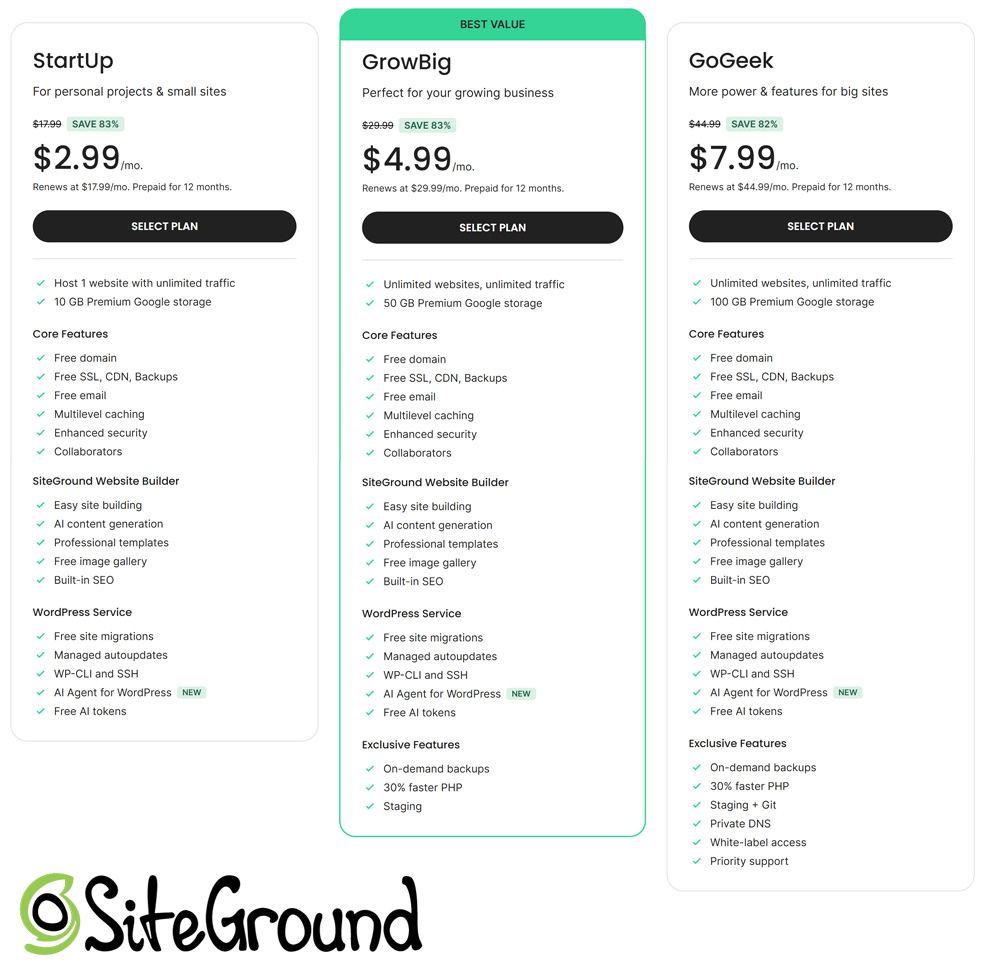
SiteGround’s lineup is narrower than some mainstream competitors, but also more focused. Its shared hosting tiers are StartUp, GrowBig, and GoGeek, with WordPress and WooCommerce hosting largely mapped onto that same general ecosystem. Above that, SiteGround offers managed cloud hosting rather than a traditional low-cost VPS lineup, which means its upgrade path is aimed more at businesses and serious projects than at bargain-minded experimenters.
Entry-Level Pricing
At signup, SiteGround is more affordable than many people expect. The promotional entry price for StartUp is attractive, and GrowBig in particular often looks compelling because it adds meaningful features without immediately pushing buyers into enterprise territory. Relative to some budget hosts, though, SiteGround positions itself as a premium shared option rather than a rock-bottom deal.
Renewal Pricing and Hidden Costs
This is where buyers should pay close attention. SiteGround’s promotional rates are heavily discounted, and its renewal pricing rises sharply once the initial term ends. That renewal jump is one of the most common complaints in independent reviews and user discussions, even among people who otherwise like the platform.
For that reason, SiteGround often feels like strong value if you care about performance and support, but less like a bargain if your main goal is the lowest long-term bill. Readers should compare total expected cost over several years, not just the introductory rate shown on the sales page.
Value Assessment
For small businesses, agencies, e-commerce stores, and WordPress users who care about site speed and operational smoothness, SiteGround often justifies its premium positioning better than many mass-market hosts. For hobby users or ultra-budget buyers, the value story is more mixed. In short, SiteGround is usually strongest when judged as a quality-first shared host, not as a cheapest-possible hosting option.
| Plan Tier | Starting Price | Key Resources | Best For |
|---|---|---|---|
| StartUp | $2.99/mo | 1 website, 10 GB storage, free SSL/CDN/backups/email, caching, managed WordPress tools | Personal sites, blogs, portfolios, and smaller business websites |
| GrowBig | $4.99/mo | Unlimited websites, 50 GB storage, on-demand backups, staging, stronger performance feature set | Growing businesses, multi-site users, and more serious WordPress projects |
| GoGeek | $7.99/mo | Unlimited websites, 100 GB storage, staging + Git, private DNS, white-label access, priority support | Agencies, advanced WordPress users, and larger or more demanding business sites |
| Cloud | $100/mo | Dedicated CPU/RAM, SSD storage, automated scaling, premium managed environment | High-traffic sites, agencies, and businesses that need more headroom than shared hosting provides |
Pricing note: SiteGround looks reasonable at signup, but the renewal jump is substantial. If you are comparing long-term value, always price out what you expect to pay after the promo period ends.
Ready to try SiteGround?
If your priority is fast hosting, strong WordPress support, and a more premium support experience than many budget hosts offer, SiteGround is worth a serious look. Review the latest plans, features, and pricing directly on the provider’s site before signing up.
Performance and Speed
Performance is one of SiteGround’s clearest strengths. The company leans heavily into speed-focused positioning, and independent testing frequently places it among the stronger mainstream shared hosts for uptime, response time, and overall page delivery. That is part of why SiteGround is so often recommended for WordPress users who want better-than-average shared hosting performance without jumping immediately to a much more expensive managed WordPress platform.
Its performance appeal comes from a combination of factors: Google Cloud-backed infrastructure, built-in caching, WordPress-specific optimization tools, CDN integration, and a generally more polished performance stack than you get from many bargain hosts. For typical blogs, business websites, online stores, and agency-managed WordPress installations, that often translates into a noticeably more capable baseline environment.
As always, shared hosting still has shared-hosting limits. But relative to the audience SiteGround targets, performance is a major reason to choose it rather than a weak point you are forced to tolerate.
Ease of Use and Setup
SiteGround is fairly approachable, though its style is a bit different from ultra-beginner-first brands. Instead of leaning on old cPanel conventions, it uses its own Site Tools interface, which generally feels cleaner, more modern, and easier to manage once you are inside the platform. That can be especially appealing to users who want a polished dashboard without dealing with outdated control-panel clutter.
The company also does a good job smoothing out common setup tasks such as launching WordPress, managing SSL, handling CDN settings, and creating email accounts. For many users, it lands in a sweet spot: more sophisticated than bare-bones budget hosts, but not so technical that ordinary site owners feel lost.
The main caution is that SiteGround can feel slightly more premium and feature-dense than pure beginner hosts, so absolute first-timers may need a bit of orientation. Still, for most users, the setup experience is one of the better ones in mainstream hosting.
Developer and Advanced Features
SiteGround is more developer-friendly than many mass-market hosts, especially on GrowBig, GoGeek, and cloud plans. Staging, Git support on higher tiers, WP-CLI, SSH access, collaborator tools, white-label options, and solid WordPress management features make it attractive to freelancers, agencies, and technically comfortable site owners.
That said, SiteGround is not trying to be a raw infrastructure playground. Its cloud product is managed and premium-priced, not a cheap unmanaged VPS meant for maximum low-level control. Users who want container-heavy deployment workflows, ultra-custom server management, or bargain cloud compute may still prefer a more cloud-native platform such as DigitalOcean, Vultr, or Cloudways.
For a large middle group of professionals, though, SiteGround strikes a good balance. It offers enough advanced functionality to be useful, without forcing users to manage everything from scratch.
Security, SSL, and Backups
SiteGround includes the baseline security features most users now expect, including free SSL certificates, backup coverage, and a more security-conscious overall environment than many bargain hosts. The platform also emphasizes enhanced security measures, anti-bot protection, and managed maintenance features in its marketing, especially around WordPress hosting.
Backups are one of SiteGround’s better included features. Daily backups are standard, and higher-tier plans add on-demand backup functionality, which is genuinely useful for sites that change often or need safer testing workflows. That gives SiteGround a stronger out-of-the-box safety profile than many low-cost alternatives.
Even so, businesses with revenue-critical websites should still maintain independent backups and sensible security practices. SiteGround provides a good foundation, but no host should be the only layer of your protection plan.
Customer Support
Support is one of SiteGround’s strongest differentiators. Across review platforms and independent commentary, the company is repeatedly praised for fast, knowledgeable, and helpful support interactions, especially through chat. That positive reputation is a major reason many customers are willing to tolerate the higher renewal pricing.
At the same time, no large provider gets universal praise. Some negative reviews still mention friction around billing, the support-access flow, or occasional dissatisfaction with complex issue resolution. But compared with most mainstream shared hosts, SiteGround’s support sentiment remains unusually positive overall.
That matters because support quality is one of the hardest hosting features to evaluate from a sales page alone. In SiteGround’s case, the public sentiment here is a real competitive advantage, not just marketing language.
Scalability and Flexibility
SiteGround scales reasonably well within its intended ecosystem. A small project can start on StartUp, move to GrowBig or GoGeek as traffic and complexity increase, and eventually transition to managed cloud hosting if the project needs more dedicated resources. That gives users a cleaner growth path than hosts that only compete at the low end.
Still, SiteGround’s scalability should be understood on its own terms. It scales from premium shared hosting into premium managed cloud hosting, not from shared hosting into a cheap, flexible developer VPS ladder. For some users that is perfect; for others it means the upgrade path becomes expensive faster than expected.
Scalability takeaway: SiteGround is a strong option for users who want to grow within a polished managed environment, but its long-term upgrade path is better for businesses and agencies than for budget-conscious power users.
Data Centers and Global Reach
SiteGround emphasizes global reach through its infrastructure design and CDN support, and its use of Google Cloud helps strengthen its international performance story. For businesses serving visitors across multiple regions, that is a meaningful advantage over smaller or more localized hosts.
In practice, many site owners will benefit most not from obsessing over raw server geography, but from the combination of a solid underlying network, caching, and CDN delivery. SiteGround is generally well-positioned on all three fronts, which is part of why it performs so well in real-world hosting comparisons.
As always, shoppers with strict regional requirements should confirm the exact options available for the product they want. But overall, SiteGround is better described as globally capable than locally constrained.
Who Is SiteGround Best For?
Best For
- WordPress users who want better-than-average performance and support
- Small businesses running professional websites or online stores
- Agencies and freelancers managing multiple client sites
- Users who value daily backups, caching, staging, and polished management tools
- Site owners willing to pay more long term for a smoother premium shared hosting experience
Not Ideal For
- Users who care most about the cheapest renewal pricing
- Projects looking for a true low-cost VPS or unmanaged cloud server
- Very small hobby sites that do not benefit much from premium hosting features
- Developers who want maximum infrastructure control at the lowest possible cost
Ready to try SiteGround?
If your priority is fast hosting, strong WordPress support, and a more premium support experience than many budget hosts offer, SiteGround is worth a serious look. Review the latest plans, features, and pricing directly on the provider’s site before signing up.
How We Evaluated SiteGround
For this review, we considered SiteGround’s plan structure, introductory and renewal pricing, included resources, performance reputation, support access, WordPress positioning, developer tooling, security and backup features, and overall fit for the types of users most likely to consider a premium shared hosting provider.
We also weighed broader reviewer sentiment and user-review patterns to identify where SiteGround appears strongest in practice, and where common complaints tend to cluster, especially around renewal pricing, billing friction, and the higher cost of moving into cloud hosting.
Scoring Breakdown
| Category | Score |
|---|---|
| Performance | 9.2/10 |
| Ease of Use | 8.8/10 |
| Pricing/Value | 8.0/10 |
| Features | 9.0/10 |
| Security/Backup | 9.0/10 |
| Support | 9.3/10 |
| Scalability | 8.7/10 |
| Overall | 8.9/10 |
Top Alternatives to SiteGround
If SiteGround does not seem like the right fit, readers may also want to consider alternatives such as Hostinger, Bluehost, and Cloudways.
Hostinger is often a better fit for readers who want lower long-term pricing and a strong custom dashboard, Bluehost can appeal more to first-time users who want a familiar mainstream brand with a wider traditional hosting ladder, and Cloudways is often more attractive to users who want flexible cloud infrastructure without managing everything entirely on their own.
Final Verdict
SiteGround is one of the stronger premium hosting choices for WordPress users, businesses, agencies, and site owners who want fast shared hosting, good built-in tools, and a support experience that is usually better than what budget hosts provide.
Its biggest strengths are performance, support reputation, WordPress friendliness, and a polished overall platform. Its biggest weaknesses are the steep renewal jump and the fact that its cloud offering is priced more like a premium managed service than a casual step up from shared hosting.
For many readers, that tradeoff will make sense. If your goal is to run a professional site on a host that feels more refined and support-oriented than entry-level competitors, SiteGround remains a very credible option. If your priority is the lowest long-term cost or cheap developer infrastructure, compare alternatives before committing.
Ready to try SiteGround?
If your priority is fast hosting, strong WordPress support, and a more premium support experience than many budget hosts offer, SiteGround is worth a serious look. Review the latest plans, features, and pricing directly on the provider’s site before signing up.
Frequently Asked Questions
Is SiteGround good for beginners?
Yes. SiteGround is beginner-friendly enough for most users, though it feels a bit more premium and feature-rich than some absolute entry-level hosts. Its dashboard and setup flow are generally very approachable.
Does SiteGround offer VPS hosting?
Not in the traditional bargain VPS sense. Instead, SiteGround offers managed cloud hosting, which provides dedicated resources and scaling but starts at a much higher price than entry-level VPS products from budget cloud providers.
Is SiteGround expensive?
It is reasonably priced at signup, but renewal pricing is definitely on the expensive side compared with many mainstream competitors. That long-term cost is the biggest pricing drawback.
Does SiteGround include free SSL and backups?
Yes. SiteGround commonly includes free SSL and daily backups, with on-demand backups available on higher-tier plans.
Who should choose SiteGround over competitors?
SiteGround is a strong choice for users who care about support quality, WordPress performance, polished management tools, and a more premium shared hosting experience, even if that means paying more at renewal time.
Editorial note: Hosting plans, pricing, features, and policies can change over time. Before signing up, always confirm the latest details directly on the provider’s site.