
Our Liquid Web Review & Analysis for 2026
 By:
By: Table of Contents
- Quick Facts
- What Is Liquid Web?
- Plans, Pricing, and Overall Value
- Performance and Speed
- Ease of Use and Setup
- Developer and Advanced Features
- Security, SSL, and Backups
- Customer Support
- Scalability and Flexibility
- Data Centers and Global Reach
- Who Is Liquid Web Best For?
- How We Evaluated Liquid Web
- Scoring Breakdown
- Top Alternatives
- Final Verdict
- Frequently Asked Questions
Pros
- Strong managed hosting lineup spanning VPS, cloud, dedicated, WordPress, WooCommerce, and Magento
- Better support reputation than most low-cost hosts, with real technical help available around the clock
- Performance-oriented infrastructure with more serious resources than typical shared hosting
- Good fit for agencies, growing businesses, and business-critical sites that need reliability
- Multiple control panel, management, and server configuration options for more advanced users
- Generally positive sentiment for uptime, support responsiveness, and managed-service value
Cons
- Much more expensive than beginner-oriented shared hosting providers
- Can feel unnecessarily powerful and costly for small personal sites or hobby blogs
- Some users, especially on Reddit, report frustration about pricing, billing, or declining support quality
- The product catalog is broader and more complex than budget hosts, so comparison shopping takes more effort
- Managed app hosting now routes heavily through Nexcess, which may feel slightly fragmented to some buyers
Ready to try Liquid Web?
If your priority is stronger infrastructure, better support, and room to scale beyond entry-level hosting, Liquid Web may be worth a closer look. Review the latest plans, features, and pricing directly on the provider’s site before signing up.
Quick Facts
| Provider | Liquid Web |
|---|---|
| Hosting Type | Managed VPS, Cloud VPS, Cloud Metal, Dedicated Servers, Managed WordPress, Managed WooCommerce, Managed Magento |
| Starting Price | $4.00/month for managed WordPress and managed WooCommerce; cloud VPS starts around $5/month; managed VPS starts around $33/month |
| Renewal Price | Varies by product and term; many plans show discounted first-term pricing followed by higher standard rates |
| Billing Style | Monthly, annual, and multi-year options depending on product, with larger discounts tied to longer commitments |
| Storage | SSD and RAID-backed storage depending on plan type, with larger allocations on VPS, Cloud Metal, and dedicated products |
| CPU/RAM | Allocated or dedicated resources depending on plan, ranging from light cloud instances to large bare metal and dedicated servers |
| Control Panel | cPanel, Plesk, and InterWorx options depending on product line |
| Managed Hosting Available | Yes |
| Root Access | Yes, on VPS and dedicated/server products where applicable |
| Data Center Locations | Broad global footprint across Liquid Web and its family of brands, with multiple U.S. facilities and international options |
| Uptime SLA | 99.99% on many core product pages, with some managed WordPress materials marketing up to 99.999% uptime |
| Free SSL | Yes on managed application hosting; server environments vary by stack and setup |
| Backups | Included or bundled depending on product; daily backups and Acronis backup allocations appear on many plans |
| Support | 24/7/365 support through chat, tickets/cases, and contact channels for sales, billing, and technical help |
| Best For | Businesses, agencies, ecommerce sites, developers, and higher-stakes projects that need managed infrastructure |
Bottom line: Liquid Web is not designed to be the cheapest host on the market. Its main appeal is that it gives businesses and more serious site owners access to stronger infrastructure, more capable support, and better scaling options than basic shared hosting typically offers.
What Is Liquid Web?
Liquid Web is a long-established hosting company that specializes in premium managed infrastructure. Instead of competing primarily in low-cost shared hosting, it focuses on managed VPS hosting, cloud hosting, Cloud Metal, dedicated servers, and managed application hosting for platforms like WordPress, WooCommerce, and Magento.
That distinction is important because Liquid Web occupies a very different part of the hosting market than budget-first brands. Its goal is not simply to get a first site online as cheaply as possible. Rather, it is meant for users who care more about uptime, technical assistance, control, and long-term scalability than about minimizing the monthly bill. That makes it much more attractive for business use than for casual personal projects.
Plans, Pricing, and Overall Value
Plan Types
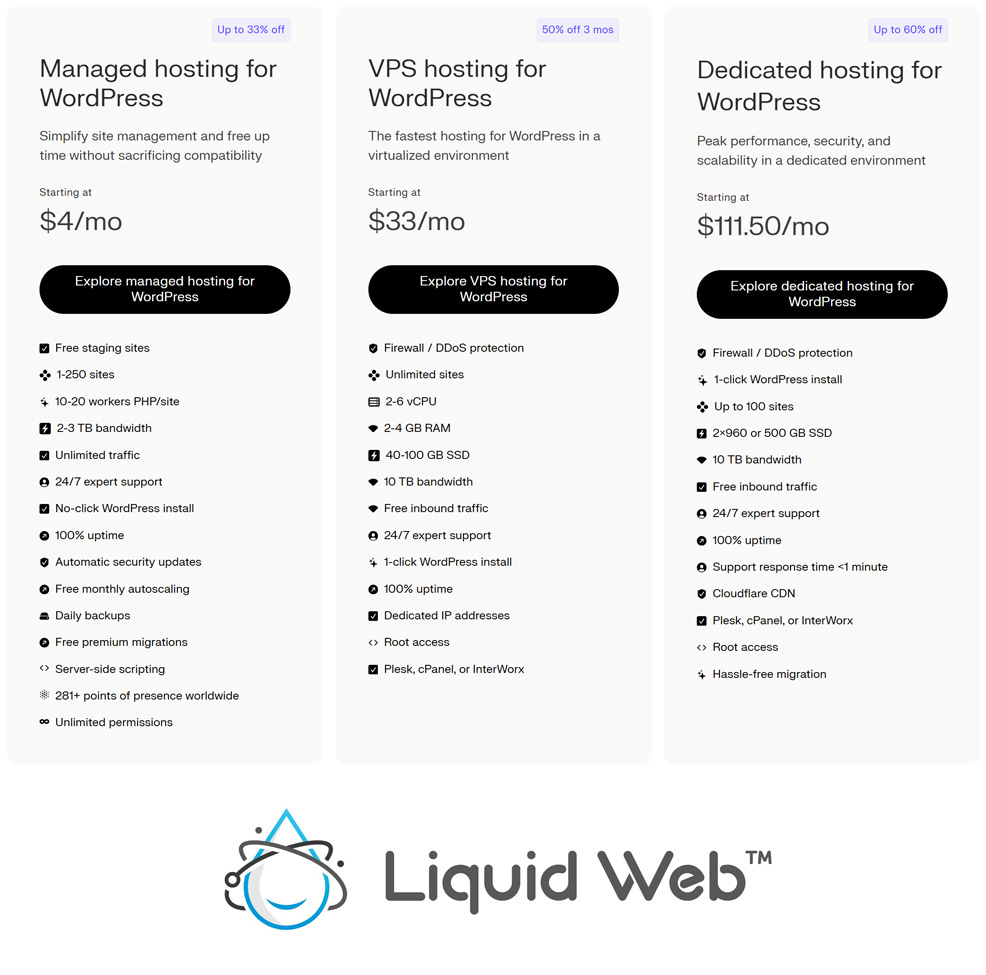
Liquid Web offers several product families rather than one simple shared-hosting ladder. On the managed application side, it offers managed WordPress, managed WooCommerce, and managed Magento hosting through the Nexcess platform. On the infrastructure side, it offers cloud VPS, managed VPS, Cloud Metal, and dedicated servers for buyers who need more resources, control, and support.
Entry-Level Pricing
The lowest advertised price points currently sit on the managed application and cloud VPS side of the lineup. Managed WordPress and managed WooCommerce are marketed from about $4/month, while cloud VPS starts at around $5/month. Those are legitimate entry points, but they do not fully represent what Liquid Web is best known for. The brand’s stronger identity is in higher-value managed hosting tiers where support, performance, and operational reliability matter more than low introductory pricing.
Representative Business-Class Pricing
Once you move into the products that better reflect Liquid Web’s core identity, pricing rises quickly. Managed VPS plans currently start around $33/month for a 2 vCPU, 2 GB RAM, 40 GB SSD Linux configuration on a 2-year commitment. Dedicated servers currently start a little above $200/month, while Cloud Metal plans begin around $289/month for a 32 GB configuration. Magento hosting through Nexcess also starts much higher than WordPress or WooCommerce because it is designed for more demanding ecommerce environments.
Renewal Pricing and Hidden Costs
Liquid Web is often more straightforward than bargain hosts that rely on ultra-low teaser pricing, but shoppers still need to read carefully. Many current product pages show promotional first-term discounts and then list the standard post-promo price afterward. Add-ons and plan customizations can also meaningfully affect cost, especially when you select different management levels, control panels, backup amounts, security tools, or Windows-based configurations.
Value Assessment
For agencies, businesses, ecommerce operators, and developers who would otherwise spend time maintaining their own infrastructure, Liquid Web can represent strong value. You are paying more, but you are also buying better support, stronger resources, and a platform that is better aligned with serious hosting needs. For a tiny blog or simple brochure site, that extra spend often will not be justified. So the value story depends heavily on whether your site is important enough to benefit from premium managed hosting.
| Plan Tier | Starting Price | Key Resources | Best For |
|---|---|---|---|
| Managed WordPress | $4.00/mo | Managed environment, daily backups, staging, autoscaling, premium migrations, WordPress-focused tooling | Business WordPress sites, agencies, owners who want simpler maintenance |
| Managed WooCommerce | $4.00/mo | WooCommerce-optimized stack, daily backups, plugin updates, autoscaling, ecommerce-focused features | Stores that want managed WooCommerce hosting without running everything themselves |
| Managed VPS | $33.00/mo | 2 vCPU, 2 GB RAM, 40 GB SSD, 10 TB bandwidth on the entry Linux configuration | Growing business sites, agencies, and users who need more control and server resources |
| Cloud Metal | $289/mo | 32 GB memory, RAID storage, DDoS protection, backup allocation, and dedicated-style performance | Demanding workloads, sensitive business sites, larger applications, and serious scaling needs |
Pricing note: Liquid Web spans products that start around the price of low-cost hosting and others that move deep into business-infrastructure territory. Compare like-for-like plans, because Liquid Web is best understood as a premium managed host rather than a bargain shared hosting brand.
Ready to try Liquid Web?
If your priority is stronger infrastructure, better support, and room to scale beyond entry-level hosting, Liquid Web may be worth a closer look. Review the latest plans, features, and pricing directly on the provider’s site before signing up.
Performance and Speed
Performance is one of Liquid Web’s clearest strengths because the company is built around VPS, cloud, dedicated, and managed application hosting instead of oversold entry-level shared plans. Its platform is designed for users who need stronger resource allocation, better uptime assurances, and more headroom for demanding WordPress, WooCommerce, Magento, or custom business workloads.
That does not mean every Liquid Web plan will automatically outperform every competing host in every benchmark, but it does mean the company’s infrastructure is aimed at a more serious use case. The current product pages emphasize uptime, DDoS protection, server-grade resources, and performance-focused configurations rather than just low pricing. That tends to translate into a more stable experience for growing businesses, client sites, and online stores.
For small personal sites, this performance headroom may be unnecessary. For dynamic sites with revenue implications, customer traffic, or agency deliverables, it is much easier to justify.
Ease of Use and Setup
Liquid Web is easier to use than many raw infrastructure providers, but it is not as simple or beginner-guided as a low-cost shared host. That is partly because you are often choosing among hosting categories, management types, operating systems, and control panels rather than just selecting one of three basic shared plans.
For more advanced buyers, that flexibility is a real advantage. For first-time site owners, it can feel more intimidating. The managed application side of the catalog, especially WordPress and WooCommerce, is the more approachable path for non-technical users who still want premium hosting. The server-oriented side of the business makes more sense for users who already know why they need VPS, cloud, or dedicated resources.
Overall, Liquid Web is best described as accessible for intermediate users, well supported for less technical business owners, and more configurable than most budget hosts, but not as beginner-friendly as the cheapest mainstream options.
Developer and Advanced Features
This is one of Liquid Web’s strongest categories. The platform gives developers and more advanced users access to root-capable environments, multiple control panel options, different operating systems, backup tooling, server security add-ons, and a clear path into more powerful hosting classes. That matters for agencies, freelancers, and technical teams who want more control without moving all the way into a totally unmanaged environment.
Another advantage is portfolio breadth. A project can start in managed WordPress, move into a managed VPS as traffic or complexity grows, and eventually step into Cloud Metal or dedicated hosting if needed. That kind of internal upgrade path is useful because it allows businesses to stay with a familiar provider rather than replatforming at each growth stage.
Liquid Web is not the same thing as a hyperscale developer cloud platform, and it is not trying to be. But for users who want a balance between server control and managed support, it remains one of the more compelling options in the premium hosting market.
Security, SSL, and Backups
Security is a meaningful part of Liquid Web’s value proposition. The company’s current product pages highlight DDoS protection, firewalling, monitoring, managed security tooling on some plans, backup options through Acronis on many VPS and dedicated bundles, and daily backups on managed application hosting. PCI-oriented language also appears prominently on the ecommerce side of the lineup, especially for Magento and WooCommerce hosting.
As always, the exact mix of security features depends on the product you choose. Managed WordPress, managed WooCommerce, managed Magento, managed VPS, and dedicated servers all package security a little differently. So shoppers should pay close attention to what is included by default versus what requires an add-on or a higher tier.
Even so, Liquid Web’s baseline security posture is stronger and more business-oriented than what you usually get from cheap shared hosting. For buyers who care about backups, DDoS protection, or platform-level hardening, that is a real point in its favor.
Customer Support
Support is arguably Liquid Web’s signature differentiator. The company markets 24/7/365 support and emphasizes access to certified technicians who can help with hosting environments, server administration, control panels, and managed applications. That stronger support model is one of the biggest reasons people choose Liquid Web over cheaper alternatives in the first place.
Consumer sentiment is generally favorable here. Mainstream review sources and many long-term customers tend to praise response speed, technical competence, and the feeling that support can address real infrastructure issues rather than merely handling basic account questions.
That said, Reddit sentiment is more mixed than Liquid Web’s premium reputation might suggest. Many users still praise uptime and support quality, but there are also recurring complaints about price increases, policy changes, billing friction, or the feeling that support is not as exceptional as it once was. So support remains a major strength, but it is best understood as strong overall rather than universally beloved.
Scalability and Flexibility
Liquid Web is built for users who either already need more than shared hosting or expect to outgrow simple hosting quickly. That gives it a much clearer growth story than many low-cost providers. Customers can move across managed app hosting, cloud VPS, managed VPS, Cloud Metal, and dedicated environments as their needs change.
This is particularly useful for agencies, growing ecommerce stores, and businesses whose sites become increasingly mission-critical over time. Different management levels and control panel options also make it easier to tailor the platform to your team’s skills and workflow.
The main caveat is cost. Liquid Web’s flexibility is real, but the platform remains priced like business infrastructure. That means the upgrade path is valuable, but rarely inexpensive.
Scalability takeaway: Liquid Web is best suited for projects that need a realistic path from managed application hosting into more serious VPS, cloud, or dedicated infrastructure over time.
Data Centers and Global Reach
Liquid Web markets a large infrastructure footprint across its broader platform and family of brands. Its data center pages emphasize a global hosting footprint, while the company’s about materials reference 22 data centers. Publicly highlighted U.S. facilities include locations in Lansing, Southfield, and Phoenix, and Liquid Web has also promoted broader regional reach for different product lines and deployment options.
For customers, the practical takeaway is that Liquid Web offers stronger geographic flexibility than many smaller hosts. That can matter for latency, redundancy, compliance planning, disaster recovery, and hosting closer to your users. It is especially relevant for agencies or businesses serving customers across more than one region.
As always, buyers should verify which locations are available for the exact product they want, since region choices can differ between managed applications, cloud VPS, Cloud Metal, and dedicated servers.
Who Is Liquid Web Best For?
Best For
- Businesses running revenue-generating or otherwise important websites
- Agencies managing multiple client sites and needing stronger support
- Developers who want more control than shared hosting without going fully DIY
- Ecommerce sites that need better infrastructure than bargain hosts usually provide
- Growing sites that may eventually need VPS, cloud, or dedicated server resources
Not Ideal For
- Beginners who just want the absolute cheapest first website host
- Small personal blogs or simple brochure sites with very low stakes
- Users who do not need managed support and would rather minimize monthly cost
- Shoppers who prefer a very simple catalog and the easiest possible checkout flow
Ready to try Liquid Web?
If your priority is stronger infrastructure, better support, and room to scale beyond entry-level hosting, Liquid Web may be worth a closer look. Review the latest plans, features, and pricing directly on the provider’s site before signing up.
How We Evaluated Liquid Web
For this review, we considered Liquid Web’s current product structure, entry and mid-tier pricing, management model, infrastructure depth, support positioning, security posture, upgrade path, and overall suitability for the types of buyers most likely to consider a premium managed host.
We also considered broader reviewer sentiment and user-discussion patterns to identify where Liquid Web appears strongest in practice, and where complaints most often cluster, including price sensitivity, billing or policy concerns, and the perception among some long-term users that the support experience has changed over time.
Scoring Breakdown
| Category | Score |
|---|---|
| Performance | 9.1/10 |
| Ease of Use | 8.0/10 |
| Pricing/Value | 7.7/10 |
| Features | 9.1/10 |
| Security/Backup | 8.9/10 |
| Support | 9.0/10 |
| Scalability | 9.2/10 |
| Overall | 8.8/10 |
Top Alternatives to Liquid Web
If Liquid Web does not seem like the right fit, readers may also want to consider alternatives such as Cloudways, ScalaHosting, and SiteGround. Cloudways may appeal to users who want cloud flexibility with a different management model, ScalaHosting is often a strong fit for users who want solid support and VPS-oriented value, and SiteGround can work well for smaller businesses that want a polished managed experience without stepping quite as far into premium server territory.
Final Verdict
Liquid Web is a strong option for businesses, agencies, ecommerce operations, and developers who need more than basic hosting and are willing to pay for better support, stronger infrastructure, and a more credible upgrade path.
Its biggest strengths are support, scalability, performance-oriented hosting, and its overall focus on serious workloads rather than bargain-bin shared hosting. Its biggest drawbacks are price, product complexity, and the fact that some users no longer see the service experience as dramatically ahead of competitors as it once was.
For the right buyer, however, Liquid Web still makes a lot of sense. If your site or store matters enough that uptime, support, and operational stability are worth paying for, it remains one of the more compelling premium hosting brands in the market. If your project is small, low-stakes, or highly price-sensitive, a cheaper provider will usually make more sense.
Ready to try Liquid Web?
If your priority is stronger infrastructure, better support, and room to scale beyond entry-level hosting, Liquid Web may be worth a closer look. Review the latest plans, features, and pricing directly on the provider’s site before signing up.
Frequently Asked Questions
Is Liquid Web good for beginners?
It can work for beginners through its managed WordPress or WooCommerce offerings, but it is generally better suited to business users and growing sites than to someone who simply wants the cheapest and simplest first host.
Does Liquid Web offer shared hosting?
Liquid Web is not primarily a shared hosting provider. Its focus is on managed application hosting, VPS, cloud, Cloud Metal, and dedicated server solutions.
Is Liquid Web expensive?
Compared with mainstream budget hosts, yes. Liquid Web is a premium managed provider, and its stronger infrastructure and support come with materially higher pricing once you move beyond the smallest plans.
Does Liquid Web include backups and security features?
Yes, though the exact mix depends on the product. Many current plans include or support daily backups, DDoS protection, security tooling, and other managed features, especially on managed application hosting and higher-end server products.
Who should choose Liquid Web over competitors?
Liquid Web is best for users who care more about uptime, support quality, and infrastructure depth than about getting the absolute cheapest monthly rate. It is especially appealing for agencies, ecommerce operations, and business-critical sites.
Editorial note: Hosting plans, pricing, features, and policies can change over time. Before signing up, always confirm the latest details directly on the provider’s site.