
Our HostGator Review & Analysis for 2026
 By:
By: Table of Contents
- Quick Facts
- What Is HostGator?
- Plans, Pricing, and Overall Value
- Performance and Speed
- Ease of Use and Setup
- Developer and Advanced Features
- Security, SSL, and Backups
- Customer Support
- Scalability and Flexibility
- Data Centers and Global Reach
- Who Is HostGator Best For?
- How We Evaluated HostGator
- Scoring Breakdown
- Top Alternatives
- Final Verdict
- Frequently Asked Questions
Pros
- Broad hosting lineup with shared, WordPress, VPS, dedicated, and ecommerce options
- Familiar cPanel environment that many site owners and freelancers already know
- Free SSL, free domain on qualifying longer terms, and unmetered bandwidth on shared plans
- Phone and live chat support, which some budget competitors do not offer
- Reasonably easy setup for beginners and small business websites
- Generally positive sentiment around support interactions and ease of use on major review platforms
Cons
- Renewal pricing is much higher than the low introductory offers
- Long-term value is weaker than some newer budget competitors
- Backups are not as generous or as prominently included as on some rival hosts
- Recent Reddit sentiment is notably more skeptical than mainstream review-platform sentiment
- VPS pricing is not especially competitive for developers shopping on value alone
Ready to try HostGator?
If you want a recognizable hosting brand with a traditional control panel, broad plan options, and beginner-friendly setup, HostGator may be worth a closer look. Review the latest plans, features, and pricing directly on the provider’s site before signing up.
Quick Facts
| Provider | HostGator |
|---|---|
| Hosting Type | Shared, WordPress, VPS, Dedicated, Ecommerce, Website Builder |
| Starting Price | $3.75/month (introductory shared hosting promotional rate) |
| Renewal Price | $10.99/month for Hatchling shared; higher on Baby and Business tiers |
| Billing Style | Monthly and multi-year plans, with the deepest discounts tied to longer commitments |
| Storage | 10 GB SSD, 20 GB SSD, or 50 GB SSD on shared plans; larger NVMe allocations on VPS |
| CPU/RAM | Abstracted on shared plans; dedicated allocations on VPS and dedicated servers |
| Control Panel | cPanel on shared hosting; optional cPanel licensing on VPS |
| Managed Hosting Available | Yes, including WordPress-focused plans and managed elements on shared hosting |
| Root Access | Yes, on VPS plans |
| Data Center Locations | Primarily U.S.-centric infrastructure, with broader platform reach depending on product type and CDN usage |
| Uptime SLA | 99.9% |
| Free SSL | Yes |
| Backups | Not a major included strength; many users will want an add-on or independent backup solution |
| Support | 24/7 live chat and phone support |
| Best For | Beginners, small businesses, traditional cPanel users, and websites that want a simple mainstream host |
Bottom line: HostGator remains a usable, approachable hosting option for beginners and smaller sites, especially for people who prefer a familiar cPanel-style setup and want phone support. The bigger tradeoff is that its strongest value is usually at signup, while renewals, add-ons, and overall long-term competitiveness are less impressive than the headline pricing suggests.
What Is HostGator?
HostGator is one of the older and more recognizable names in web hosting. Over time, it has expanded into a broad platform that includes standard shared hosting, WordPress hosting, VPS, dedicated servers, domain registration, ecommerce tooling, and website-building options. Its appeal has long been centered on accessibility: it aims to make hosting straightforward for people who want to get online without piecing together a more technical stack.
That wide appeal is still a major part of the brand. HostGator is not the most modern or developer-centric host in its category, but it continues to cover the basics well enough for many small websites and first-time users. For shoppers who want a recognizable, all-in-one provider with a traditional dashboard and a broad upgrade path, that still matters.
Plans, Pricing, and Overall Value
Plan Types
HostGator’s lineup is broader than many beginner-focused hosts. At the entry level, there are shared hosting plans for simple websites and WordPress installs. It also offers WordPress-branded hosting, ecommerce packages, VPS plans for users who need more control and dedicated resources, and dedicated servers for larger or more specialized workloads. In other words, it gives users a familiar starting point and then multiple ways to move up without leaving the platform.
Entry-Level Pricing
HostGator often advertises very low introductory rates, which is a major part of its sales pitch. In practice, that makes the service look quite attractive for a first website, side project, or small business launch. Compared with premium hosts, the upfront cost can feel comfortably low, especially if you commit to a longer term.
Renewal Pricing and Hidden Costs
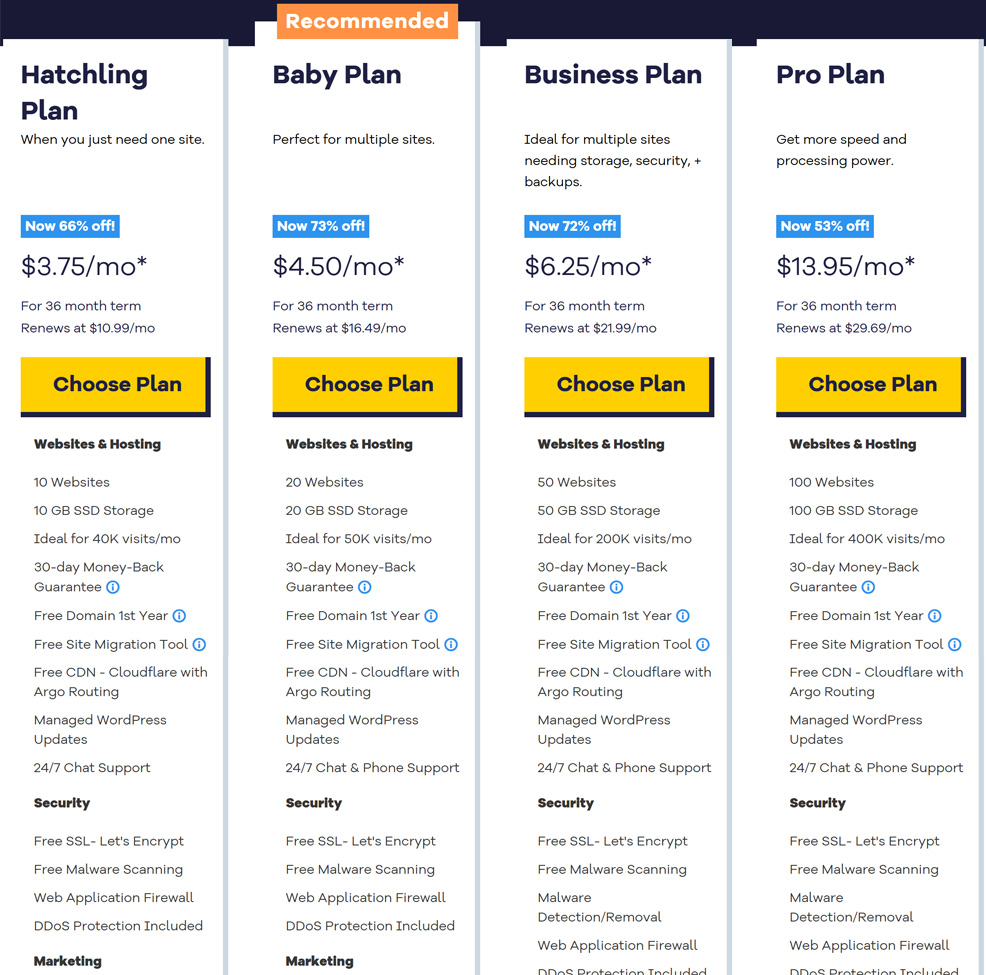
This is the part shoppers need to evaluate more carefully. HostGator’s regular pricing is much higher than its promotional entry pricing, and the gap is significant enough that long-term cost can look very different from the number highlighted in ads. The Hatchling shared plan, for example, renews at $10.99/month, while Baby renews at $16.49/month and Business renews at $21.99/month on regular pricing.
There are also plan-level differences to watch for. The number of websites, storage allotments, staging features, security extras, and premium add-ons vary meaningfully across tiers. Some shoppers will also want to budget for add-ons such as advanced backups, security, or upgraded services that are either limited or not especially strong out of the box.
Value Assessment
HostGator’s value proposition is strongest for buyers who want a low-friction entry into hosting and are comfortable with the reality of renewal pricing later. If your site is modest in size and you care more about familiarity and convenience than maximum performance-per-dollar, it can still make sense. But if you are comparing long-term value, richer included features, or stronger modern infrastructure, several competitors are more compelling.
| Plan Tier | Starting Price | Key Resources | Best For |
|---|---|---|---|
| Hatchling Shared | $3.75/mo | 10 websites, 10 GB SSD storage, unmetered bandwidth, free SSL, free domain for qualifying longer terms | Starter sites, personal sites, simple blogs |
| Baby Shared | $4.50/mo | 20 websites, 20 GB SSD storage, unmetered bandwidth, added features such as staging | Users hosting multiple small sites or wanting more headroom |
| Business Shared | $6.25/mo | 50 websites, 50 GB SSD storage, unmetered bandwidth, more business-oriented extras | Small businesses, higher-value brochure sites, growing WordPress installs |
| Snappy 2000 VPS | Varies by term | 2 AMD EPYC vCPU cores, 4 GB DDR5 RAM, 100 GB NVMe storage, unmetered bandwidth | Projects outgrowing shared hosting and needing more control |
Pricing note: HostGator frequently uses promotional pricing for new customers. Compare both the signup rate and the regular renewal rate before deciding.
Ready to try HostGator?
If you want a recognizable hosting brand with a traditional control panel, broad plan options, and beginner-friendly setup, HostGator may be worth a closer look. Review the latest plans, features, and pricing directly on the provider’s site before signing up.
Performance and Speed
HostGator’s performance profile is decent, but it is not the main reason most people choose the service. Recent third-party reviews generally describe it as fast enough for typical small and medium sites, with solid enough shared-hosting performance for blogs, brochure sites, affiliate projects, and ordinary WordPress installs. That makes it a viable mainstream option, especially if your expectations are grounded in the realities of budget shared hosting rather than premium managed infrastructure.
Where HostGator is less impressive is in relative differentiation. Some newer and more aggressively optimized competitors offer stronger speed-focused stacks, more modern caching strategies, or better included performance tooling. So while HostGator is usually good enough for everyday use, it is rarely the host people point to as the clear performance leader in its price band.
For most first sites and smaller business websites, that will not be a deal-breaker. But if your project is traffic-sensitive, ecommerce-heavy, or performance-critical, moving up the stack or looking at a more speed-focused host is usually the smarter path.
Ease of Use and Setup
Ease of use remains one of HostGator’s strongest practical advantages. Unlike hosts that push users into unfamiliar proprietary dashboards, HostGator leans on a more traditional cPanel-centered experience. That is useful both for true beginners and for users who have worked with hosting before and do not want to relearn everything from scratch.
The onboarding is generally straightforward. You can register a domain, point an existing domain, install WordPress, manage email, enable SSL, and access standard hosting functions without a lot of guesswork. That familiarity is a major reason HostGator still appeals to freelancers, agencies managing simple client sites, and users who just want a predictable interface.
The main caveat is that the sales flow can still involve upsells and decision points that less technical buyers may not fully understand on first pass. Once inside the platform, though, HostGator is usually easier to navigate than many shoppers expect.
Developer and Advanced Features
HostGator is not a cutting-edge developer platform, but it does offer enough flexibility for many intermediate users. Shared hosting includes cPanel access and standard tools for common site-management tasks, while VPS plans add root access and more control for users who need their own environment. That makes HostGator workable for developers, freelancers, and agencies running relatively conventional web projects.
Its newer NVMe VPS lineup is more interesting than the shared plans from a technical perspective. Those plans use AMD EPYC CPUs, DDR5 RAM, and NVMe storage, giving HostGator a more modern hardware story than some of its older brand perception might suggest. Still, the overall platform is better described as practical and mainstream than especially advanced or cloud-native.
If you need container-first workflows, highly customizable cloud deployment, or enterprise-grade infrastructure design, HostGator is probably not your best match. But if you mainly need a familiar stepping-stone between shared hosting and something more powerful, it can cover that middle ground reasonably well.
Security, SSL, and Backups
HostGator includes the security basics most users now expect, including free SSL. It also promotes malware scanning, a web application firewall, DDoS protection, and related security features on shared hosting pages, especially on stronger tiers. That means the baseline security story is not bad for an entry-level host.
Where the platform feels less generous is backups. HostGator is not usually praised for having especially strong included backup coverage compared with some competitors, and many users will want either a paid backup add-on or an off-platform backup routine for peace of mind. That is particularly important for business sites, stores, or any project where content changes frequently.
In practical terms, HostGator gives you a decent starting layer of security, but it should not be treated as a complete risk-management solution. Site owners still need to stay disciplined about plugin updates, strong credentials, and independent backup strategy.
Customer Support
Support is one of the more nuanced parts of the HostGator story. On mainstream review platforms, many users still speak positively about HostGator’s support responsiveness, especially for live chat interactions, basic site problems, SSL issues, and general account help. That helps explain why the company retains a fairly solid reputation among newer and less technical customers.
At the same time, more skeptical users, especially on Reddit and in some recent complaint-style reviews, describe a different experience: slower escalation, less impressive technical depth, more friction around billing or renewals, and a sense that the brand is not as strong as it once was. That split matters because it suggests HostGator support may be perfectly fine for routine needs while being more frustrating in edge cases or higher-stakes situations.
Overall, support is best described as broadly available and often helpful, but not consistently premium. The fact that HostGator still offers phone support is a real plus for some buyers, even if the depth of help is not always exceptional.
Scalability and Flexibility
HostGator does offer a reasonably clear upgrade path. A user can begin on shared hosting, move into a higher shared tier, then step up into VPS or dedicated hosting if the site grows or becomes more resource-intensive. That is useful for website owners who want continuity and do not want to migrate providers every time their requirements change.
Still, this is not the same as saying HostGator is the best long-term scaling platform. It is better thought of as a mainstream ladder rather than a modern cloud ecosystem. For many small businesses, that is enough. For advanced teams, agencies running demanding client stacks, or businesses expecting aggressive scaling, other platforms will likely offer more flexibility and better performance economics.
Scalability takeaway: HostGator gives smaller sites a workable path from shared hosting to VPS or dedicated hosting, but it is more of a practical upgrade ladder than a high-end cloud growth platform.
Data Centers and Global Reach
HostGator has historically been known more for mainstream U.S.-oriented hosting than for an unusually broad global server footprint. That does not mean it cannot serve international audiences, especially when paired with CDN usage, but it is not usually the host people choose specifically because they want the widest selection of global regions.
For many small businesses and content sites targeting North American visitors, that may be perfectly acceptable. But if location flexibility and global server choice are a major part of your buying criteria, some competitors have a stronger story here.
As always, readers should verify the exact server-location and product availability details for the specific plan they are considering, especially for VPS and more specialized hosting products.
Who Is HostGator Best For?
Best For
- Beginners launching a first website
- Users who prefer a traditional cPanel-based hosting experience
- Small businesses building brochure sites or simple WordPress installs
- Site owners who want phone support in addition to chat
- People who value a mainstream, familiar host over a more specialized platform
Not Ideal For
- Shoppers heavily focused on long-term renewal value
- Users who want the most generous backup and security bundle included by default
- Developers seeking the strongest VPS bang-for-the-buck
- Projects that need highly optimized, globally distributed, or enterprise-style infrastructure
Ready to try HostGator?
If you want a recognizable hosting brand with a traditional control panel, broad plan options, and beginner-friendly setup, HostGator may be worth a closer look. Review the latest plans, features, and pricing directly on the provider’s site before signing up.
How We Evaluated HostGator
For this review, we considered HostGator’s current plan structure, introductory and regular pricing, shared-hosting resource limits, VPS hardware details, support options, control panel experience, security posture, upgrade path, and overall value for the kinds of users most likely to shop in this segment.
We also considered broader reviewer sentiment and user-review patterns, including mainstream review platforms and Reddit discussions, to identify where HostGator seems strongest in everyday use and where complaints cluster most consistently, such as renewals, upsells, support quality variation, and long-term value concerns.
Scoring Breakdown
| Category | Score |
|---|---|
| Performance | 7.8/10 |
| Ease of Use | 8.7/10 |
| Pricing/Value | 7.5/10 |
| Features | 7.9/10 |
| Security/Backup | 7.3/10 |
| Support | 7.8/10 |
| Scalability | 7.6/10 |
| Overall | 7.8/10 |
Top Alternatives to HostGator
If HostGator does not seem like the right fit, readers may also want to consider alternatives such as Hostinger, SiteGround, and Cloudways.
Hostinger is often the stronger choice for shoppers focused on value and a more modern budget-hosting experience, SiteGround is usually more appealing for users who want a more premium-feeling managed environment, and Cloudways makes more sense for users who want stronger cloud flexibility without managing an entire stack themselves.
Our GreenGeeks review is also worth mentioning here; they have a similar shared hosting audience, and is a more eco-friendly, cleaner, and modern alternative.
Final Verdict
HostGator is still a reasonable hosting option for beginners, small business sites, bloggers, and users who want a recognizable platform built around a familiar cPanel workflow.
Its biggest strengths are broad product coverage, approachable setup, and the fact that it still offers the kind of traditional hosting experience many users prefer. Its biggest weaknesses are the usual ones: sharp renewal increases, mixed long-term sentiment, and a value story that is not as strong as some newer competitors once you look past the intro offer.
For some buyers, that tradeoff will still work. If you want a simple, mainstream host and feel comfortable checking the fine print before checkout, HostGator can do the job. But if your top priorities are the best long-term pricing, more generously included features, or stronger VPS economics, it is worth comparing alternatives before committing.
Ready to try HostGator?
If you want a recognizable hosting brand with a traditional control panel, broad plan options, and beginner-friendly setup, HostGator may be worth a closer look. Review the latest plans, features, and pricing directly on the provider’s site before signing up.
Frequently Asked Questions
Is HostGator good for beginners?
Yes. HostGator is still beginner-friendly, especially for users who want a familiar control panel, standard hosting tools, and support via chat or phone.
Does HostGator offer VPS hosting?
Yes. HostGator offers VPS hosting in addition to shared, WordPress, ecommerce, and dedicated hosting. Its newer VPS plans use NVMe storage and AMD EPYC-based hardware.
Is HostGator inexpensive?
At signup, it often looks inexpensive. The bigger issue is that regular renewal pricing is much higher than the introductory promotional rates, so long-term cost deserves close attention.
Does HostGator include free SSL and a free domain?
Yes, free SSL is included, and a free domain is available on qualifying 12-, 24-, or 36-month shared, WordPress, and cloud-style plans. The domain renews at the regular rate after the first year.
Who should choose HostGator over competitors?
HostGator makes the most sense for users who want a large, familiar hosting brand, a cPanel-based experience, and phone support, and who are comfortable comparing the renewal pricing before purchase.
Editorial note: Hosting plans, pricing, features, and policies can change over time. Before signing up, always confirm the latest details directly on the provider’s site.