
Our DreamHost Review & Analysis for 2026
 By:
By: Table of Contents
- Quick Facts
- What Is DreamHost?
- Plans, Pricing, and Overall Value
- Performance and Speed
- Ease of Use and Setup
- Developer and Advanced Features
- Security, SSL, and Backups
- Customer Support
- Scalability and Flexibility
- Data Centers and Global Reach
- Who Is DreamHost Best For?
- How We Evaluated DreamHost
- Scoring Breakdown
- Top Alternatives
- Final Verdict
- Frequently Asked Questions
Pros
- Competitive introductory pricing on shared hosting and a generally solid value profile
- Broad hosting ladder that includes shared hosting, DreamPress, VPS, dedicated servers, and cloud hosting
- Custom panel is clean, capable, and less cluttered than older cPanel-first experiences
- Free SSL, daily backups, free domain on eligible annual terms, and strong privacy positioning
- Good fit for WordPress users, small businesses, and developers who may want room to grow
- Generally positive long-term reputation for reliability, transparency, and overall ease of ownership
Cons
- Standard web hosting plans now have a limited free email period rather than permanently included email
- Support is available around the clock, but some users still prefer more direct phone-first assistance
- Shared hosting performance is usually solid, though not always the very fastest in independent comparisons
- DreamPress and higher-end VPS tiers get expensive faster than bargain shoppers may expect
- Some negative reviews still cluster around support workflow, billing annoyances, or email-related friction
Ready to try DreamHost?
If your priority is a stable host with good WordPress support, reasonable pricing, and a clearer upgrade path into VPS or cloud hosting, DreamHost is worth serious consideration. Review the latest plans, features, and pricing directly on the provider’s site before signing up.
Quick Facts
| Provider | DreamHost |
|---|---|
| Hosting Type | Shared Hosting, Managed WordPress Hosting, VPS Hosting, Dedicated Hosting, Cloud Hosting |
| Starting Price | $2.89/month (Launch web hosting, introductory annual pricing) |
| Renewal Price | Launch renews at $10.99/month after 1 year |
| Billing Style | Monthly and prepaid terms, with the strongest promotional pricing generally tied to longer signup periods |
| Storage | 25 GB NVMe SSD on Launch shared hosting; higher storage on VPS and other plans |
| CPU/RAM | Abstracted on shared hosting; defined resources on VPS, cloud, and dedicated plans |
| Control Panel | Custom DreamHost panel |
| Managed Hosting Available | Yes |
| Root Access | Available on cloud and dedicated products; DreamHost also offers managed VPS plans for users who prefer a more guided experience |
| Data Center Locations | U.S.-based infrastructure with CDN support and broader cloud/network reach |
| Uptime SLA | 100% uptime guarantee is prominently advertised |
| Free SSL | Yes |
| Backups | Daily automated backups included on major hosting tiers |
| Support | 24/7 support |
| Best For | WordPress users, small businesses, bloggers, developers, and site owners who want a flexible hosting ladder |
Bottom line: DreamHost stands out because it combines affordable shared hosting, a custom management experience, strong WordPress support, and a more complete upgrade path than many budget hosts. Its biggest tradeoffs are that entry-level email is no longer bundled indefinitely on standard web hosting and some competing hosts can be faster or more globally distributed.
What Is DreamHost?
DreamHost is one of the older and more recognizable independent hosting brands in the market. It offers standard web hosting, managed WordPress through DreamPress, VPS hosting, dedicated servers, and cloud infrastructure, giving it broader appeal than hosts that stop at basic shared plans.
What makes DreamHost especially interesting is that it sits in a middle ground between beginner-friendly mainstream hosting and more flexible developer-oriented infrastructure. It is approachable enough for typical WordPress and business users, but it also offers enough depth to serve people who may eventually want more resources, more control, or a more advanced stack.
Plans, Pricing, and Overall Value
Plan Types
DreamHost has a more complete product ladder than many entry-level web hosts. Buyers can start with standard web hosting, step up into DreamPress for managed WordPress, move into VPS hosting for isolated resources, and eventually go to dedicated or cloud hosting if they need more control or headroom. That broader range gives DreamHost a more flexible feel than brands built almost entirely around bargain shared hosting.
Entry-Level Pricing
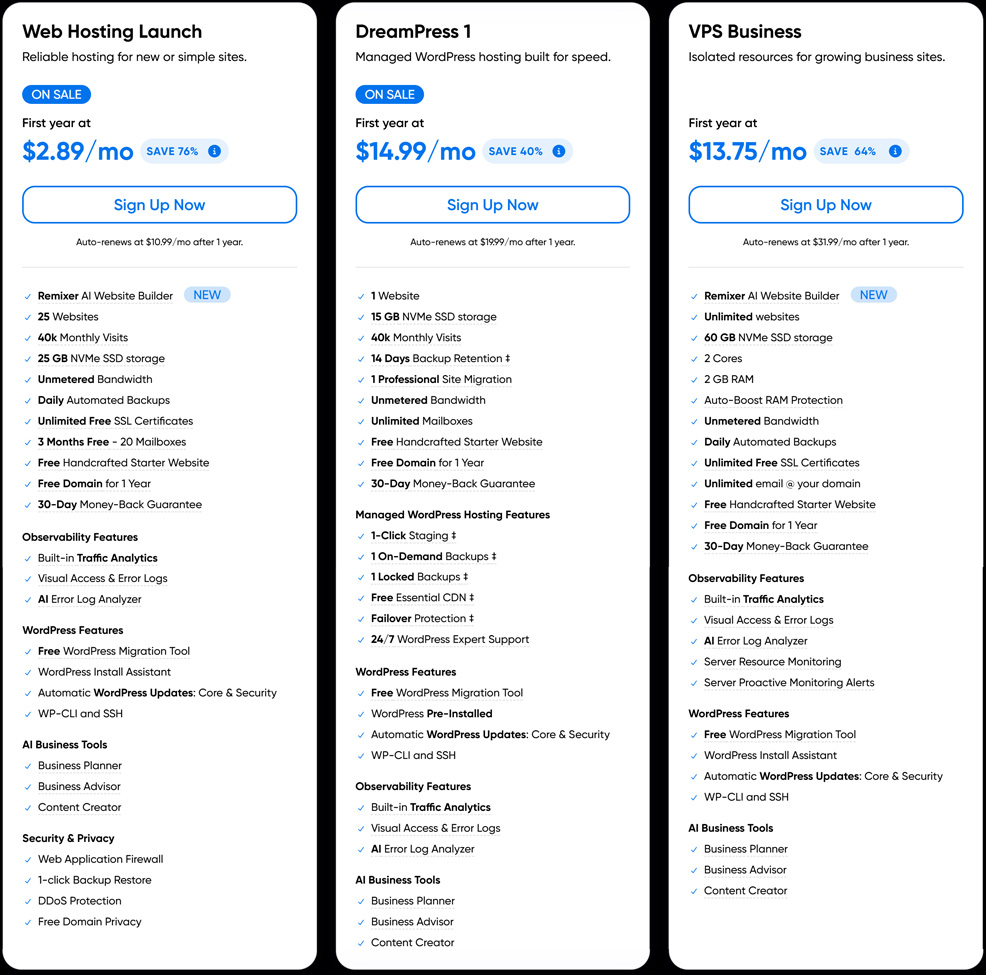
At the low end, DreamHost remains competitively priced. The Launch shared plan is inexpensive at signup and includes useful basics such as free SSL, daily backups, and a free domain on eligible annual terms. That makes it a sensible option for new sites, small business projects, blogs, and many typical WordPress installs.
Renewal Pricing and Hidden Costs
As with most mainstream hosts, buyers should look beyond the initial promo rate. DreamHost’s entry pricing is attractive, but the renewal rate is notably higher than the signup price. Another important detail is that standard web hosting includes a limited email trial rather than permanently bundled email on the entry tier, so users who want mailbox hosting should factor that into total cost.
That said, DreamHost’s value story is still fairly strong because the platform includes a good baseline feature set and a wider hosting ladder than many similarly priced competitors. In other words, it is often less about being the absolute cheapest and more about offering a sensible balance of affordability, usability, and growth potential.
Value Assessment
DreamHost is usually strongest for buyers who want a host they can start with and keep using as their needs become more serious. It is compelling for WordPress users, business sites, and technical users who appreciate having both managed and more advanced options available under one roof. If your only goal is the absolute lowest long-term bill, there are cheaper options, but DreamHost often presents a better overall ownership experience than the bargain-basement field.
| Plan Tier | Starting Price | Key Resources | Best For |
|---|---|---|---|
| Launch | $2.89/mo | Up to 25 websites, 25 GB NVMe SSD storage, unmetered bandwidth, daily backups, free SSL, limited free email period | New sites, blogs, portfolios, and smaller business websites |
| DreamPress 1 | $14.99/mo | 1 website, 15 GB NVMe SSD storage, managed WordPress features, backup retention, migration help, WordPress-focused support | Users who want managed WordPress hosting with less maintenance overhead |
| VPS Business | $13.75/mo | Unlimited websites, 60 GB NVMe SSD storage, 2 cores, 2 GB RAM, isolated resources, daily backups, free SSL | Growing business sites, stores, and projects that need more resources than shared hosting |
| Cloud / Dedicated | Varies | More control, more resources, and stronger infrastructure options depending on the product selected | Developers, high-traffic projects, and businesses that need more flexibility or server-level power |
Pricing note: DreamHost’s entry pricing is competitive, but you should still compare full renewal costs and any email-related add-ons before committing long term.
Ready to try DreamHost?
If your priority is a stable host with good WordPress support, reasonable pricing, and a clearer upgrade path into VPS or cloud hosting, DreamHost is worth serious consideration. Review the latest plans, features, and pricing directly on the provider’s site before signing up.
Performance and Speed
Performance is one of DreamHost’s better qualities, though it is not always marketed as aggressively around speed as some premium competitors. In real-world terms, that means many users will find DreamHost reliably fast enough for normal business sites, blogs, and WordPress projects, especially when the site itself is reasonably optimized.
Its stronger performance story appears when you consider the broader platform rather than only the cheapest shared plan. DreamPress adds a more managed WordPress experience, while VPS and higher-end products give users a more obvious path toward isolated resources and improved consistency. For site owners who expect to grow beyond a simple starter site, that matters more than a flashy homepage speed claim.
DreamHost is therefore best understood as a host with solid baseline performance and good upgrade flexibility, rather than a provider that wins every comparison on raw entry-level shared speed alone.
Ease of Use and Setup
DreamHost is generally easy to use, even though it does not rely on cPanel. Its custom management panel is one of the platform’s more distinctive strengths: it feels cleaner than many legacy dashboards and does a respectable job handling common tasks such as installing WordPress, managing domains, enabling SSL, setting up email, and monitoring your account.
That custom approach can be a plus or a minus depending on your background. Newer users often appreciate the simpler and less cluttered interface, while experienced users who are deeply attached to cPanel may need a little time to reorient themselves. In practice, though, most people adapt quickly.
For the typical small business owner or WordPress user, DreamHost lands in a practical sweet spot. It is not overly technical, but it also does not feel stripped down or toy-like.
Developer and Advanced Features
DreamHost has long appealed to users who want more than just basic shared hosting. Its lineup includes VPS, dedicated servers, and cloud hosting, which immediately gives it more developer credibility than hosts that stop at beginner plans. Depending on the product, users can work with more advanced tools and frameworks, and the platform is better positioned than many mainstream competitors for people who may want to grow into a more custom setup.
That does not mean every DreamHost plan is meant for deep infrastructure tinkering. Standard web hosting is still designed for simplicity first. But compared with mainstream budget brands, DreamHost usually feels more accommodating to technically comfortable users, agencies, and small teams that may eventually need more control over how their stack is deployed.
In short, DreamHost is one of the stronger all-around choices for users who want an easier on-ramp today without closing the door on more advanced hosting later.
Security, SSL, and Backups
DreamHost includes the security basics most site owners expect, such as free SSL certificates and daily automated backups. The company also emphasizes privacy, secure hosting practices, multi-factor authentication, and secure access standards, which helps reinforce its reputation as a more thoughtful long-term hosting platform.
Backups in particular are a welcome inclusion because too many lower-cost hosts still treat backup quality as an upsell or a weak point. With DreamHost, the baseline protection story is better than what you get from many low-end competitors, especially for users who want a simpler default safety net.
Even so, it is still smart to maintain your own off-site backups for any business-critical website. DreamHost offers a solid foundation, but no host should be treated as your only recovery plan.
Customer Support
DreamHost offers 24/7 support and generally has a better reputation than many low-cost hosts, especially among users who have stayed on the platform for years. Public sentiment tends to describe it as a dependable and relatively honest host rather than one that overwhelms users with aggressive upsells or erratic service quality.
That said, support sentiment is not universally glowing. Some user complaints still revolve around support workflow, the absence of a more traditional phone-first model, and occasional billing or email frustrations. Those themes appear often enough in reviews that they are worth acknowledging, even if the overall tone remains more favorable than many mainstream alternatives.
For most buyers, the support story is probably best described as reassuring rather than exceptional: not flawless, but usually more trustworthy than what you find at the very low end of the hosting market.
Scalability and Flexibility
Scalability is one of DreamHost’s more meaningful advantages. A user can begin with standard shared hosting, move to DreamPress for a more managed WordPress workflow, transition into VPS when resource isolation matters, and then scale into dedicated or cloud hosting if needed. That creates a more natural growth ladder than you see from hosts whose “upgrade” path is mostly just a pricier version of the same shared environment.
This matters because many websites do not stay static. A hobby blog can turn into a business property, a business site can add e-commerce, and a WordPress installation can become resource-heavy over time. DreamHost does a fairly good job of supporting that kind of progression without forcing an immediate move to a completely different provider.
Scalability takeaway: DreamHost is especially appealing for users who want to start with something simple but keep a credible path open toward VPS, dedicated, or cloud hosting later on.
Data Centers and Global Reach
DreamHost’s infrastructure story is stronger than a basic shared host, but it is not usually the first name people mention when talking about the broadest global server footprint. For many U.S.-focused websites, that will not matter much. For international projects, CDN use and overall site optimization will often matter just as much as the provider itself.
Where DreamHost does improve the conversation is through the availability of multiple product tiers, cloud options, and CDN support. That gives users more flexibility than they would get from a shared-only host with a narrow footprint and limited growth path.
Still, shoppers with strict regional latency requirements should confirm the current infrastructure options for the exact plan they want. DreamHost can absolutely support many real-world use cases well, but it is not best described as the most globally expansive hosting platform in its class.
Who Is DreamHost Best For?
Best For
- WordPress users who want a reliable host with both standard and managed options
- Small businesses that want an affordable start without giving up room to grow
- Developers and technical users who may eventually want VPS, dedicated, or cloud hosting
- Site owners who value a custom panel, good baseline security, and a generally privacy-friendly brand
- Users who prefer a host with a longer track record and a more complete hosting ladder
Not Ideal For
- Users who want permanently bundled email on the cheapest standard web hosting plan
- Buyers who only care about the absolute lowest possible price over time
- Projects that need the most globally distributed infrastructure from day one
- Users who strongly prefer a traditional cPanel and phone-first support experience
Ready to try DreamHost?
If your priority is a stable host with good WordPress support, reasonable pricing, and a clearer upgrade path into VPS or cloud hosting, DreamHost is worth serious consideration. Review the latest plans, features, and pricing directly on the provider’s site before signing up.
How We Evaluated DreamHost
For this review, we considered DreamHost’s plan structure, introductory and renewal pricing, included resources, custom management experience, WordPress positioning, developer and upgrade options, security and backup features, support access, and overall fit for the types of users most likely to shop for a shared host that can also scale into more advanced products.
We also weighed broader reviewer sentiment and user-review patterns to identify where DreamHost appears strongest in real use, and where complaints tend to cluster, especially around email bundling changes, support workflow preferences, and pricing differences between entry-level hosting and more advanced managed products.
Scoring Breakdown
| Category | Score |
|---|---|
| Performance | 8.4/10 |
| Ease of Use | 8.8/10 |
| Pricing/Value | 8.7/10 |
| Features | 8.8/10 |
| Security/Backup | 8.8/10 |
| Support | 8.2/10 |
| Scalability | 8.9/10 |
| Overall | 8.6/10 |
Top Alternatives to DreamHost
If DreamHost does not seem like the right fit, you might also consider alternatives such as Hostinger, SiteGround, GreenGeeks, and Cloudways.
Hostinger is often a better fit for readers who want very aggressive pricing and a sleek custom dashboard, SiteGround can be more appealing for users who prioritize premium support and a more performance-forward shared hosting experience, GreenGeeks is a more eco-friendly alternative with similarly affordable shared hosting, and Cloudways is often more attractive to users who want flexible cloud infrastructure with a managed layer on top.
Final Verdict
DreamHost is a strong all-around hosting choice for WordPress users, small businesses, bloggers, and developers who want a dependable platform with more room to grow than the typical bargain shared host provides.
Its biggest strengths are overall value, a broader hosting ladder, a capable custom panel, strong baseline features, and a reputation that tends to feel steadier and more trustworthy than many entry-level competitors. Its biggest weaknesses are that standard email is no longer as generously bundled on basic web hosting, some users may want more direct support channels, and certain competitors can beat it on either raw speed or global footprint.
For many readers, though, DreamHost still hits a very practical middle ground. If your goal is to choose a host that is affordable, reasonably polished, WordPress-friendly, and capable of scaling into VPS or cloud products later, DreamHost remains a very credible option. If you want the absolute fastest premium shared host or the cheapest possible long-term setup, compare alternatives before signing up.
Ready to try DreamHost?
If your priority is a stable host with good WordPress support, reasonable pricing, and a clearer upgrade path into VPS or cloud hosting, DreamHost is worth serious consideration. Review the latest plans, features, and pricing directly on the provider’s site before signing up.
Frequently Asked Questions
Is DreamHost good for beginners?
Yes. DreamHost is generally approachable for beginners, especially if you are launching a standard website or WordPress site and want a cleaner custom dashboard instead of a more cluttered legacy control panel.
Does DreamHost offer VPS hosting?
Yes. DreamHost offers VPS hosting as part of its broader hosting ladder, alongside standard web hosting, managed WordPress, dedicated servers, and cloud hosting.
Is DreamHost expensive?
Its entry-level pricing is competitive, but costs increase at renewal and managed products such as DreamPress or higher VPS tiers can become significantly more expensive than the starter plan.
Does DreamHost include free SSL and backups?
Yes. DreamHost commonly includes free SSL certificates and daily backups across major hosting plans.
Who should choose DreamHost over competitors?
DreamHost is a strong choice for users who want a long-running host with a good balance of affordability, WordPress support, privacy-minded policies, and a credible path to more advanced hosting later on.
Editorial note: Hosting plans, pricing, features, and policies can change over time. Before signing up, always confirm the latest details directly on the provider’s site.