
The 5 Best 27-Inch Gaming Monitors for 2026
 By:
By: Table of Contents
- Our Top Picks at a Glance
- Which Pick Is Best for You?
- #1 Best Overall
- #2 Best Speed
- #3 Best Visuals (4K)
- #4 Best for Bright Rooms
- #5 Best Versatility
- How We Picked
- What to Look For in 2026
- Frequently Asked Questions
- Final Verdict
Disclosure: Most product links lead directly to an affiliate partner. For example, Digmodo participates in the Amazon Services LLC Associates Program, an affiliate advertising program providing a means for sites to earn advertising fees by linking to Amazon.com.
Quick recommendation: The Alienware AW2725DF is our top overall pick for its excellent balance of 360Hz QD-OLED performance, competitive pricing, and a reassuring 3-year burn-in warranty.
Our Top Picks at a Glance
| Rank | Product | Best For | Key Strength | Price |
|---|---|---|---|---|
| #1 | Alienware AW2725DF | Best Overall | 360Hz QD-OLED with best-in-class warranty | $650–$750 |
| #2 | ASUS ROG Swift PG27AQWP-W | Best Speed | 540Hz Tandem OLED with 720Hz Dual Mode | $1,000+ |
| #3 | MSI MPG 272URX QD-OLED | Best 4K | 4K UHD @ 240Hz with DisplayPort 2.1 | $900–$950 |
| #4 | LG 27" UltraGear (27GS95QE) | Best Brightness | 4th Gen WOLED reaching 1500 nits peak | $750–$850 |
| #5 | Samsung Odyssey G7 G70F | Best Versatility | Dual Mode: 4K 180Hz / FHD 360Hz IPS | $700–$800 |
Which Pick Is Best for You?
Choose the Alienware if...
You want a fast 360Hz QD-OLED with excellent image quality, strong value, and a reassuring 3-year burn-in warranty.
Choose the ASUS ROG Swift if...
You are a competitive esports player who demands the absolute lowest latency and the fastest refresh rate (540Hz) available.
Choose the MSI MPG 272URX if...
You want a future-proof 4K display for high-fidelity RPGs and creative work with stunning QD-OLED colors.
Choose the LG UltraGear if...
Your setup is in a brightly lit room and you need an OLED that can punch through glare with high peak brightness.
Choose the Samsung Odyssey if...
You switch between professional work and competitive gaming and prefer the reliability of a high-end IPS panel.
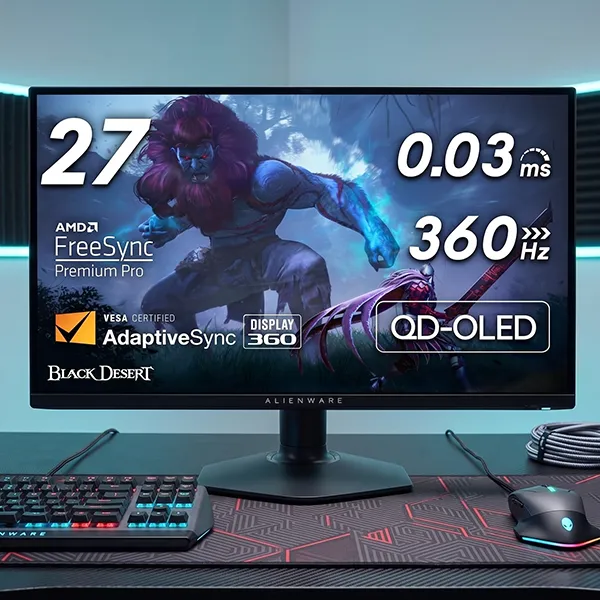
Alienware AW2725DF
Best OverallThe Alienware AW2725DF has become the "reliable veteran" of the high-refresh OLED market. It offers a blistering 360Hz refresh rate and is backed by Dell's famous 3-year burn-in warranty, making it the safest investment for heavy gamers who leave their screens on for hours.
What We Like
- Excellent 360Hz motion clarity with near-instantaneous OLED response times.
- QD-OLED panel delivers vivid colors, deep blacks, and strong HDR performance.
- Three-year warranty includes OLED burn-in coverage for added peace of mind.
Keep in Mind
- 1440p is less detailed than the 4K options in this roundup.
- The glossy screen can reflect lights in brighter rooms.
Best for: Competitive gamers who want a fast 360Hz QD-OLED with excellent picture quality and a reassuring three-year burn-in warranty, without paying the premium for newer 500Hz-plus models.

ASUS ROG Swift OLED PG27AQWP-W
Best SpeedThe ASUS ROG Swift OLED PG27AQWP-W is the speed-focused technological leader of 2026. Using "Tandem OLED" technology, it delivers 15% higher peak brightness than previous generations and a staggering 540Hz refresh rate. For ultra-competitive scenarios, its Dual Mode allows it to hit 720Hz at 720p resolution.
What We Like
- Industry-leading 540Hz motion clarity is game-changing for esports.
- Tandem OLED tech offers much better HDR brightness than older WOLEDs.
- DisplayPort 2.1 (UHBR20) supports full bandwidth without compression.
Keep in Mind
- Requires a top-tier GPU to actually utilize the 540Hz ceiling.
- Very high price point compared to standard 360Hz options.

MSI MPG 272URX QD-OLED
Best 4K VisualsFor those who value resolution, the MSI MPG 272URX is the benchmark. It features a 4th-gen QD-OLED panel that significantly improves text clarity, a major win for users who also use their gaming rig for work. With 98W USB-C power delivery and a KVM switch, it is as productive as it is powerful.
What We Like
- Sharp 4K resolution and 240Hz refresh rate balance detail and speed.
- Fourth-generation QD-OLED improves color, contrast, and text clarity.
- 98W USB-C power delivery and a built-in KVM make it highly versatile.
Keep in Mind
- Running modern games at 4K and high frame rates requires a powerful GPU.
- It costs considerably more than strong 1440p alternatives.
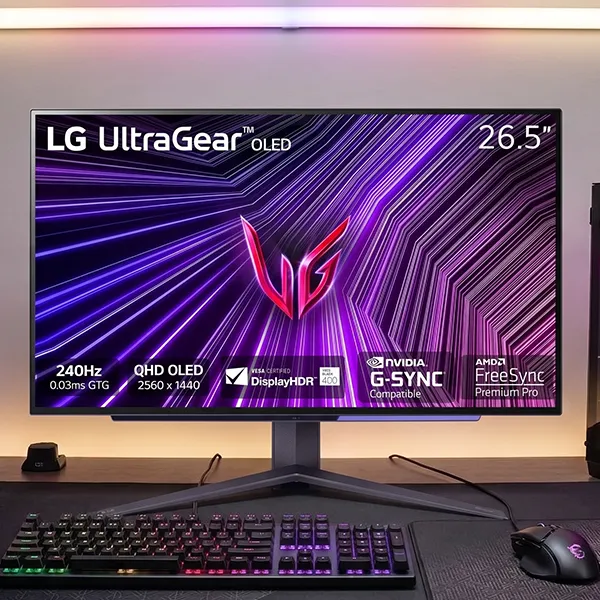
LG 27" UltraGear (27GS95QE)
Best for Bright RoomsLG's 2026 UltraGear solves the "OLED is too dim" complaint. Reaching 1500 nits peak, it delivers eye-searing HDR highlights while maintaining the infinite contrast OLED is known for. It’s an excellent all-rounder that provides a smooth 280Hz refresh rate.
What We Like
- High peak brightness makes HDR highlights more impactful than on older OLEDs.
- Fast 280Hz refresh rate works well for both competitive and cinematic games.
- WOLED contrast and response times provide clean motion and deep blacks.
Keep in Mind
- Peak-brightness claims apply to small HDR highlights, not the full screen.
- Its 1440p resolution is not as crisp as the MSI's 4K panel.

Samsung Odyssey G7 G70F
Best VersatilityIf you aren't ready for OLED, the Samsung Odyssey G7 G70F is the best IPS alternative. Its "Dual Mode" feature is its greatest strength, allowing you to run at 4K 180Hz for beauty or FHD 360Hz for speed, all on a panel with excellent viewing angles and no burn-in risk.
What We Like
- Dual Mode lets you prioritize 4K detail or 360Hz competitive speed.
- IPS technology avoids OLED burn-in concerns during long work sessions.
- Excellent viewing angles make it useful for gaming and productivity.
Keep in Mind
- Black levels and HDR contrast cannot match the OLED models above it.
- Switching to 360Hz requires dropping the resolution to 1080p.
How We Picked
We analyzed current benchmarks from 2026, focusing on three core metrics: motion clarity (GtG response times), color volume, and real-world peak brightness. We prioritized monitors that include DisplayPort 2.1 to ensure compatibility with next-gen graphics cards and excluded older models that do not meet the 240Hz standard for 2026.
What to Look For: Specs Explained
Frequently Asked Questions
Is 27 inches too small for 4K?
Not at all. While 32 inches is more immersive for 4K, 27 inches provides an incredibly high pixel density (PPI), making text look like it was printed on paper and making games look exceptionally crisp.
Do I need G-Sync if I have an AMD card?
In 2026, most monitors are "Adaptive Sync" compatible, meaning they work with both NVIDIA (G-Sync) and AMD (FreeSync). You generally don't need to match brands anymore.
Is IPS still better than OLED for work?
Yes. While OLED text clarity has improved in 2026, IPS panels remain superior for 8-hour workdays due to their consistent brightness and zero risk of permanent image retention (burn-in) from static taskbars.
Is 540Hz actually noticeable?
For most casual gamers, the jump from 240Hz to 540Hz is subtle. However, for professional esports players, the reduction in input lag and tracking blur is measurable and provides a competitive edge.
Should I worry about OLED burn-in in 2026?
Burn-in protection (like MSI's OLED Care 2.0) has become very advanced. While the risk isn't zero, most 2026 monitors are rated for 5+ years of heavy use without noticeable degradation.
Final Verdict
The Alienware AW2725DF is our top pick because it combines superb 360Hz QD-OLED performance, a competitive price, and one of the most reassuring OLED warranties available. If you want the absolute fastest option, the ASUS ROG Swift OLED PG27AQWP-W is the speed-focused runner-up, while the MSI MPG 272URX remains the best choice for 4K resolution.
Ready to upgrade your battle station?
Experience the peak of 2026 gaming technology with our top-rated OLED picks.
Editorial note: Prices and availability were verified as of April 2026. Specifications are based on current manufacturer data.