
Our Hetzner Review & Analysis for 2026
 By:
By: Table of Contents
- Quick Facts
- What Is Hetzner?
- Plans, Pricing, and Overall Value
- Performance and Speed
- Ease of Use and Setup
- Developer and Advanced Features
- Security, SSL, and Backups
- Customer Support
- Scalability and Flexibility
- Data Centers and Global Reach
- Who Is Hetzner Best For?
- How We Evaluated Hetzner
- Scoring Breakdown
- Top Alternatives
- Final Verdict
- Frequently Asked Questions
Pros
- Outstanding price-to-performance for cloud servers and infrastructure workloads
- Broad lineup including shared-resource cloud, dedicated-vCPU cloud, web hosting, and dedicated root servers
- Strong fit for developers, self-hosters, Docker users, and teams that want automation-friendly infrastructure
- Useful built-in features such as API access, private networking, firewalls, and one-click apps
- Good reputation for infrastructure value, uptime, and practical reliability
- European hosting footprint with additional US and Singapore cloud locations
Cons
- Can be less beginner-friendly than mainstream consumer web hosts
- Account verification and compliance checks are a recurring source of user frustration
- Support is not positioned as premium managed or concierge-style support
- Web hosting is less compelling for some users than Hetzner’s cloud and dedicated offerings
- 2026 price adjustments reduced some of the brand’s ultra-cheap advantage
Ready to try Hetzner?
If your priority is affordable infrastructure with strong technical flexibility and excellent value for the money, Hetzner may be worth a closer look. Review the latest plans, features, and pricing directly on the provider’s site before signing up.
Quick Facts
| Provider | Hetzner |
|---|---|
| Hosting Type | Cloud servers, VPS-style cloud instances, dedicated root servers, web hosting |
| Starting Price | Low-cost cloud entry plans available; pricing varies by shared vs dedicated resources and region |
| Renewal Price | Not an introductory-discount model in the same way many shared hosts use, but prices were increased effective April 1, 2026 |
| Billing Style | Transparent monthly and hourly-style cloud pricing, plus traditional hosting and dedicated server billing |
| Storage | SSD/NVMe-backed cloud storage depending on product family; scalable resources across cloud and dedicated tiers |
| CPU/RAM | Shared-resource cloud plans and dedicated-vCPU cloud plans available; larger dedicated hardware also offered |
| Control Panel | Hetzner Console / konsoleH depending on product |
| Managed Hosting Available | Limited compared with managed-first hosts; primarily infrastructure-oriented |
| Root Access | Yes, on cloud servers and dedicated root servers |
| Data Center Locations | Germany, Finland, United States, Singapore; web hosting primarily in Germany |
| Uptime SLA | 99.9% SLA stated for cloud |
| Free SSL | Available depending on product type and setup, especially for web-facing workloads |
| Backups | Available, but backup strategy depends on product and user configuration; users should verify details per service |
| Support | 24/7 email support for cloud; support reputation is mixed during account or verification issues |
| Best For | Developers, self-hosters, agencies, backend workloads, and budget-conscious teams that can self-manage infrastructure |
Bottom line: Hetzner stands out for delivering unusually strong infrastructure value, especially in cloud servers and dedicated hosting, making it one of the most appealing options for developers and cost-conscious technical users. The main tradeoff is that the platform can feel less forgiving than beginner-focused hosts, especially when it comes to onboarding, account verification, and support expectations.
What Is Hetzner?
Hetzner is a German hosting and infrastructure company that offers cloud servers, dedicated root servers, classic web hosting, networking features, and developer-friendly tooling for users who want to deploy and manage their own applications and websites. It has long been known in technical circles for pairing aggressive pricing with solid hardware and a more infrastructure-centric approach than many mainstream consumer hosting brands.
Its core appeal is straightforward: Hetzner tries to give customers low-cost access to real infrastructure value, whether that means a lightweight cloud instance for a side project, a dedicated-vCPU cloud node for production workloads, a dedicated server for heavier applications, or traditional web hosting for simpler websites. That mix has made it especially popular among self-hosters, developers, and small teams that want to keep costs under control without moving to an enterprise cloud platform.
Plans, Pricing, and Overall Value
Plan Types
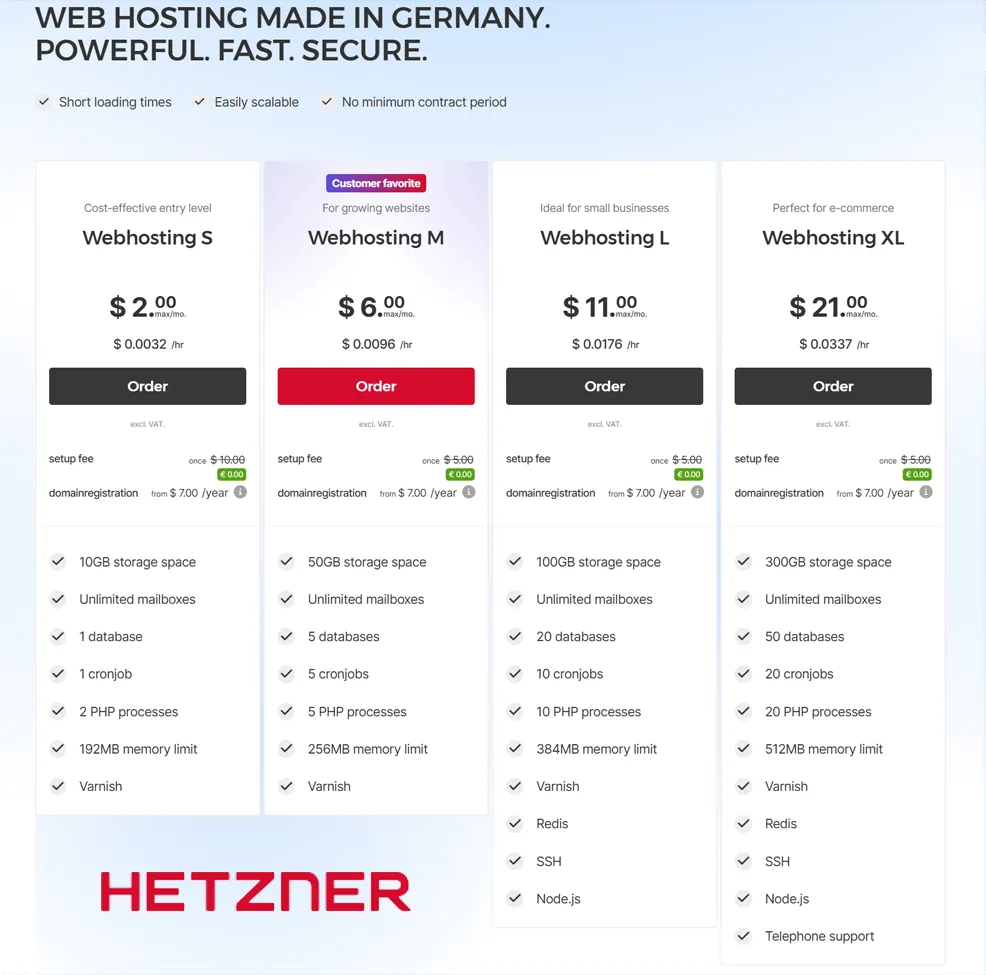
Hetzner’s lineup is broader than many people first assume. Its cloud platform includes shared-resource instances for lighter or cost-sensitive workloads and dedicated-vCPU plans for applications that need steadier CPU availability. Beyond cloud, Hetzner also offers dedicated root servers for users who want single-tenant hardware and classic web hosting for simpler site-and-email use cases.
Entry-Level Pricing
One of Hetzner’s biggest advantages is that it has historically priced cloud infrastructure very aggressively. Even after its 2026 price adjustments, it is still widely viewed as one of the best-value options in the VPS and cloud-server market, particularly for users comparing raw specs, bandwidth allowances, and practical compute value rather than polished beginner extras.
Renewal Pricing and Hidden Costs
Hetzner does not rely on the same “tiny signup price, much larger renewal” playbook used by many shared hosting brands, which is refreshing. However, readers should still pay attention to the total cost picture. The company announced broad price increases effective April 1, 2026 across both new and existing products, so older reviews may understate current pricing. Users should also watch for separate charges related to domains, backups, storage choices, IPv4, or optional add-ons depending on the product they select.
For web hosting specifically, domains are not included with the hosting package and must be purchased separately. That matters because some buyers compare only the headline hosting fee without realizing that domain-related functionality and real-world monthly cost may be higher than the base package suggests.
Value Assessment
For developers, self-hosters, and technical teams, Hetzner offers excellent value. You get low-cost infrastructure, private networking, APIs, one-click applications, multiple regional options, and strong price-to-spec positioning. For total beginners or businesses that want a deeply managed experience, the value proposition is more conditional because support style, setup expectations, and account verification friction can matter just as much as raw pricing. Overall, Hetzner delivers some of the strongest value in infrastructure hosting, but it is not the most hand-holding option in the market.
| Plan Tier | Starting Price | Key Resources | Best For |
|---|---|---|---|
| Cost-Optimized Cloud | Low-cost entry tier | Shared resources, affordable pricing, suitable for testing, small projects, and lighter workloads | Development environments, hobby projects, lightweight apps |
| Regular Performance Cloud | Budget-to-midrange | Shared resources with stronger general-purpose value, suitable for low to medium CPU use and moderate traffic | General web apps, personal sites, small production workloads |
| Dedicated-vCPU Cloud | Higher than shared cloud tiers | Dedicated vCPUs, more predictable performance, better suited for sustained workloads and high-traffic applications | Production apps, larger databases, business workloads, heavier compute use |
Pricing note: Hetzner remains a strong value provider, but its April 2026 price changes mean readers should verify current rates carefully rather than relying on older comparisons or forum posts.
Ready to try Hetzner?
If your priority is affordable infrastructure with strong technical flexibility and excellent value for the money, Hetzner may be worth a closer look. Review the latest plans, features, and pricing directly on the provider’s site before signing up.
Performance and Speed
Performance is one of the biggest reasons Hetzner gets recommended so often. Across user discussions and independent benchmarking coverage, it consistently earns praise for strong compute value, fast provisioning, solid disk performance, and especially compelling price-to-performance relative to larger mainstream VPS competitors. In practical terms, many buyers feel they get more usable server for their money here than they do from more heavily marketed providers.
Part of that comes from product design. Hetzner is not trying to be a flashy all-in-one beginner website platform first; it is trying to provide efficient infrastructure. Its cloud lineup separates shared-resource instances from dedicated-vCPU plans, which makes it easier for users to choose between lower-cost experimentation and more predictable production capacity. That structure tends to work well for technical buyers who care about resource behavior and upgrade paths.
For personal apps, blogs, APIs, Docker stacks, internal tools, staging environments, and many small-to-medium production workloads, Hetzner should be more than capable. For demanding workloads, users are usually better served by moving to dedicated-vCPU plans or dedicated root servers rather than squeezing too much out of the cheapest shared cloud instances.
Ease of Use and Setup
Hetzner is reasonably approachable for a technical provider, but it is not as beginner-smoothed as mainstream shared hosting brands. The company’s cloud console is clean and modern enough for deploying servers, managing networking, working with images, and handling core infrastructure tasks, but the overall experience assumes more comfort with self-management than a first-site-oriented host would.
Setup is generally fast once your account is active. Users can deploy servers quickly, choose Linux images, attach networking and firewalls, and launch common applications through one-click templates. That said, there is an important caveat: for some users, the hardest part of “setup” is not the server creation flow but the account approval process. Reddit and review sites include repeated complaints about verification delays, disabled accounts, or sparse explanations when signups trigger risk controls.
So the experience is split. Inside the platform, Hetzner is efficient and fairly straightforward. Before that point, it can feel less frictionless than some competitors, especially for brand-new customers or users in situations that trigger extra scrutiny.
Developer and Advanced Features
This is one of Hetzner’s clearest strengths. Its cloud platform includes API access, CLI tooling, integrations for tools and ecosystems such as Terraform, Ansible, and Kubernetes-adjacent workflows, plus private networks and reusable stateful firewalls. That makes it a strong fit for people who think in terms of infrastructure building blocks rather than a one-click website business package.
Hetzner also offers one-click apps for practical deployments such as Docker, WordPress, Nextcloud, GitLab, Grafana, Jitsi, Prometheus, WireGuard, and other common self-hosting or developer use cases. For many small teams and technical solo operators, that creates a useful middle ground: enough convenience to deploy quickly, but enough control to keep the environment flexible.
If your project needs root access, repeatable provisioning, private networking, and affordable compute, Hetzner is one of the more compelling options in its class. If you need deeply managed databases, enterprise orchestration layers, or a polished platform-as-a-service feel, you may find it more manual than ideal.
Security, SSL, and Backups
Hetzner makes a credible case on infrastructure security and compliance fundamentals. The company emphasizes GDPR compliance, operates its own data center parks in Europe, and highlights ISO/IEC 27001 certification for its data centers in Germany and Finland. Its cloud platform also includes stateful firewalls at no extra cost, which is a useful baseline feature for locking down server traffic.
For web hosting, the story is slightly different because the product is more traditional and domain-dependent. Security and backup expectations should be checked carefully by plan, and users should not assume that every product includes the same level of managed protection or backup convenience. This is especially important because Hetzner’s audience often includes users running their own infrastructure, where backup responsibility may be shared or mostly self-managed.
For serious business use, the safest mindset is to treat Hetzner as a solid security foundation rather than a complete hands-off protection layer. Use firewalls correctly, maintain your own backup policy, keep software updated, and verify exactly what your chosen product includes.
Customer Support
Customer support is one of the most nuanced parts of the Hetzner story. Many customers and reviewers say the infrastructure itself is reliable and that support is acceptable for a value-focused provider, especially when the issue is technical and clearly scoped. Cloud products are backed by 24/7 email support, and the company positions this as part of its professional reliability promise.
However, support sentiment becomes much more mixed when the discussion moves to account verification, billing risk controls, abuse handling, or disabled accounts. This shows up repeatedly in Reddit threads and customer-review platforms. In other words, users often like Hetzner more as an infrastructure provider than as a high-touch customer service brand.
Overall, support is best described as functional and serious rather than warm or premium. If you are comfortable troubleshooting and mainly want dependable infrastructure, that may be fine. If you want white-glove guidance and a very forgiving support culture, it may not be the best fit.
Scalability and Flexibility
Hetzner offers a clearer upgrade path than many people expect. A project can start on a low-cost shared-resource cloud instance, move to a stronger regular-performance plan, then graduate to dedicated-vCPU cloud or even a dedicated root server as traffic or workload demands increase. That makes the platform useful both for experimentation and for many serious production deployments.
Its flexibility is also one of its biggest strengths. You can use it for lightweight websites, databases, internal tools, media stacks, VPNs, CI jobs, staging environments, and more traditional application hosting. That breadth is a major reason technical communities recommend Hetzner so often.
Scalability takeaway: Hetzner is especially strong for users who want to begin cheaply and then move into more predictable or more powerful infrastructure without changing ecosystems too early.
Data Centers and Global Reach
Hetzner’s cloud footprint includes Germany, Finland, Singapore, and the United States, giving it a much more international reach than the brand’s old Europe-only reputation might suggest. In Europe, it operates its own data center parks in Falkenstein, Nuremberg, and Helsinki, while North American cloud capacity includes Hillsboro, Oregon and Ashburn, Virginia.
That matters because location options affect latency, data residency, and practical deployment planning. Hetzner remains especially attractive for European workloads, but it is no longer only a Europe-centric option. At the same time, users should verify product-specific location availability because classic web hosting is more geographically limited than the broader cloud platform.
For audiences that care about EU data protection standards, Hetzner’s German base and GDPR messaging can also be a meaningful differentiator.
Who Is Hetzner Best For?
Best For
- Developers deploying self-managed applications and services
- Self-hosters running Docker, Nextcloud, VPNs, media tools, and home-lab-adjacent workloads
- Small teams and SaaS projects that need low-cost but capable cloud infrastructure
- Agencies and technical freelancers who want strong server value without premium-cloud pricing
- Businesses that care about European hosting options, private networking, and predictable infrastructure costs
Not Ideal For
- Total beginners who want the smoothest possible all-in-one website setup
- Buyers who need phone-heavy or concierge-style support
- Users likely to be frustrated by strict verification or compliance-driven account processes
- Projects that need deeply managed application hosting rather than self-managed infrastructure
Ready to try Hetzner?
If your priority is affordable infrastructure with strong technical flexibility and excellent value for the money, Hetzner may be worth a closer look. Review the latest plans, features, and pricing directly on the provider’s site before signing up.
How We Evaluated Hetzner
For this review, we considered Hetzner’s product structure, current pricing posture, cloud and hosting lineup, data center footprint, infrastructure features, account setup experience, developer flexibility, support model, security positioning, and overall value for the types of users most likely to shop in this segment.
We also looked at broader reviewer sentiment and user discussion patterns, including recurring praise for price-to-performance and recurring complaints around verification, account closures, and support tone during edge-case or policy-related issues.
Scoring Breakdown
| Category | Score |
|---|---|
| Performance | 9.1/10 |
| Ease of Use | 7.8/10 |
| Pricing/Value | 9.4/10 |
| Features | 9.0/10 |
| Security/Backup | 8.5/10 |
| Support | 7.4/10 |
| Scalability | 8.9/10 |
| Overall | 8.8/10 |
Top Alternatives to Hetzner
If Hetzner does not seem like the right fit, readers may also want to consider alternatives such as:
DigitalOcean for a more polished developer cloud experience.
Vultr for broad regional choice and flexible instances.
Linode/Akamai for established VPS familiarity.
Final Verdict
Hetzner is a very strong option for developers, self-hosters, technical teams, and cost-conscious businesses that want affordable cloud infrastructure, dedicated resources, and a practical set of modern infrastructure tools without paying premium-cloud prices.
Its biggest strengths are value, flexibility, and technical usefulness. Its biggest weaknesses are that it can be less beginner-friendly, more policy-driven during onboarding, and less comforting than managed-first hosts when something unusual happens with an account.
For many readers, that tradeoff will absolutely be worth it. If your goal is to get reliable infrastructure at an unusually attractive price, Hetzner remains one of the most compelling providers in the market. If your priority is frictionless signup, high-touch support, or a simpler consumer-hosting experience, you may want to compare alternatives before committing.
Ready to try Hetzner?
If your priority is affordable infrastructure with strong technical flexibility and excellent value for the money, Hetzner may be worth a closer look. Review the latest plans, features, and pricing directly on the provider’s site before signing up.
Frequently Asked Questions
Is Hetzner good for beginners?
It can work for beginners with some technical comfort, but Hetzner is generally a better fit for users who are comfortable managing hosting and infrastructure themselves rather than expecting a highly guided consumer experience.
Does Hetzner offer VPS or cloud hosting?
Yes. Hetzner is especially well known for its cloud servers, including lower-cost shared-resource plans and dedicated-vCPU plans for heavier workloads. It also offers dedicated root servers and traditional web hosting.
Is Hetzner expensive?
No, not relative to many competitors. Hetzner is still widely viewed as a high-value provider, although its April 2026 price increases mean it is not quite as aggressively cheap as some older reviews suggest.
Does Hetzner include free SSL and backups?
Security and backup features vary by product. Hetzner includes useful infrastructure security features such as firewalls on cloud, while SSL and backup details depend more on the specific service and setup you choose. Always confirm plan-level details before signing up.
Who should choose Hetzner over competitors?
Hetzner is a strong choice for users who prioritize infrastructure value, self-managed flexibility, European hosting options, and affordable cloud or dedicated resources. It is especially appealing for developers, self-hosters, and technically comfortable teams.
Editorial note: Hosting plans, pricing, features, and policies can change over time. Before signing up, always confirm the latest details directly on the provider’s site.