
Our OVHcloud Review & Analysis for 2026

 By:
Table of Contents
- Quick Facts
- What Is OVHcloud?
- Plans, Pricing, and Overall Value
- Performance and Speed
- Ease of Use and Setup
- Developer and Advanced Features
- Security, SSL, and Backups
- Customer Support
- Scalability and Flexibility
- Data Centers and Global Reach
- Who Is OVHcloud Best For?
- How We Evaluated OVHcloud
- Scoring Breakdown
- Top Alternatives
- Final Verdict
- Frequently Asked Questions
Pros
- Excellent value on VPS plans, with high RAM and vCPU allocations at low entry prices
- Anti-DDoS protection and daily VPS backups are included by default
- Broad product lineup including shared hosting, VPS, public cloud, and dedicated infrastructure
- Strong fit for developers, self-managed projects, labs, app hosting, and multi-site workloads
- Global infrastructure footprint and strong network reputation
- Shared hosting pricing is also inexpensive for simple sites and brochure-style projects
Cons
- Support sentiment is mixed, and faster or more involved support may require paid support tiers
- The platform is less beginner-friendly than polished consumer-first hosts
- Billing, pricing changes, and account friction appear in a meaningful number of user complaints
- Shared hosting is less differentiated than OVHcloud’s stronger VPS and infrastructure offerings
- Some plans and features vary by region, including traffic limitations in certain Asia-Pacific locations
Ready to try OVHcloud?
If your priority is low-cost infrastructure, flexible VPS resources, and strong built-in DDoS protection, OVHcloud may be worth a closer look. Review the latest plans, features, and pricing directly on the provider’s site before signing up.
Quick Facts
| Provider | OVHcloud |
|---|---|
| Hosting Type | Shared Hosting, VPS, Public Cloud, Dedicated Servers, Domains |
| Starting Price | $1.67/month (Starter shared hosting) |
| Renewal Price | Varies by product; many OVHcloud plans are not marketed with the same heavy intro-discount model used by some mainstream hosts |
| Billing Style | Monthly billing is common, with pricing depending on product family and region |
| Storage | 1 GB to 500 GB on shared hosting; 75 GB to 400 GB on current VPS range, with NVMe on most VPS tiers |
| CPU/RAM | Shared hosting abstracts resources on lower tiers; VPS plans publish dedicated vCore and RAM allocations from 4 vCores / 8 GB up to 24 vCores / 96 GB |
| Control Panel | OVHcloud Control Panel |
| Managed Hosting Available | Partially, depending on product; core VPS offering is self-managed |
| Root Access | Yes, on VPS plans |
| Data Center Locations | Global footprint, with hosting and cloud infrastructure across multiple regions and countries |
| Uptime SLA | 99.9% on VPS |
| Free SSL | Yes, on web hosting plans |
| Backups | Daily backups included on VPS; file backup/restore points included on web hosting |
| Support | Standard support included; higher-tier support plans available at extra cost |
| Best For | Developers, sysadmins, agencies, infrastructure-minded users, and buyers focused on price-to-resource value |
Bottom line: OVHcloud stands out most when you want affordable infrastructure and are comfortable managing more of it yourself. Its strongest value is in VPS and adjacent infrastructure products, while the main tradeoffs are weaker beginner-friendliness and more mixed support sentiment than the best consumer-oriented hosts.
What Is OVHcloud?
OVHcloud is a long-running cloud and hosting company that offers shared hosting, VPS hosting, public cloud services, dedicated servers, domains, networking products, and related infrastructure services. It is designed less like a beginner website builder brand and more like a broad infrastructure platform for users ranging from small site owners to developers and businesses with more technical requirements.
Its core appeal is straightforward: OVHcloud tries to deliver more compute and infrastructure value per dollar than many better-known consumer hosting brands. That is especially visible in its VPS lineup, where the published RAM and vCore allocations are often aggressive for the price, and in its emphasis on anti-DDoS protection, network scale, and upgrade paths across a larger ecosystem.
Plans, Pricing, and Overall Value
Plan Types
OVHcloud offers several different product families rather than focusing only on beginner shared hosting. Its shared hosting plans are aimed at simpler websites and business sites, while VPS plans target users who want dedicated resources, root control, and a more flexible software stack. Above that, OVHcloud also offers public cloud and dedicated infrastructure for projects that need broader architecture options, stronger isolation, or more custom deployment choices.
Entry-Level Pricing
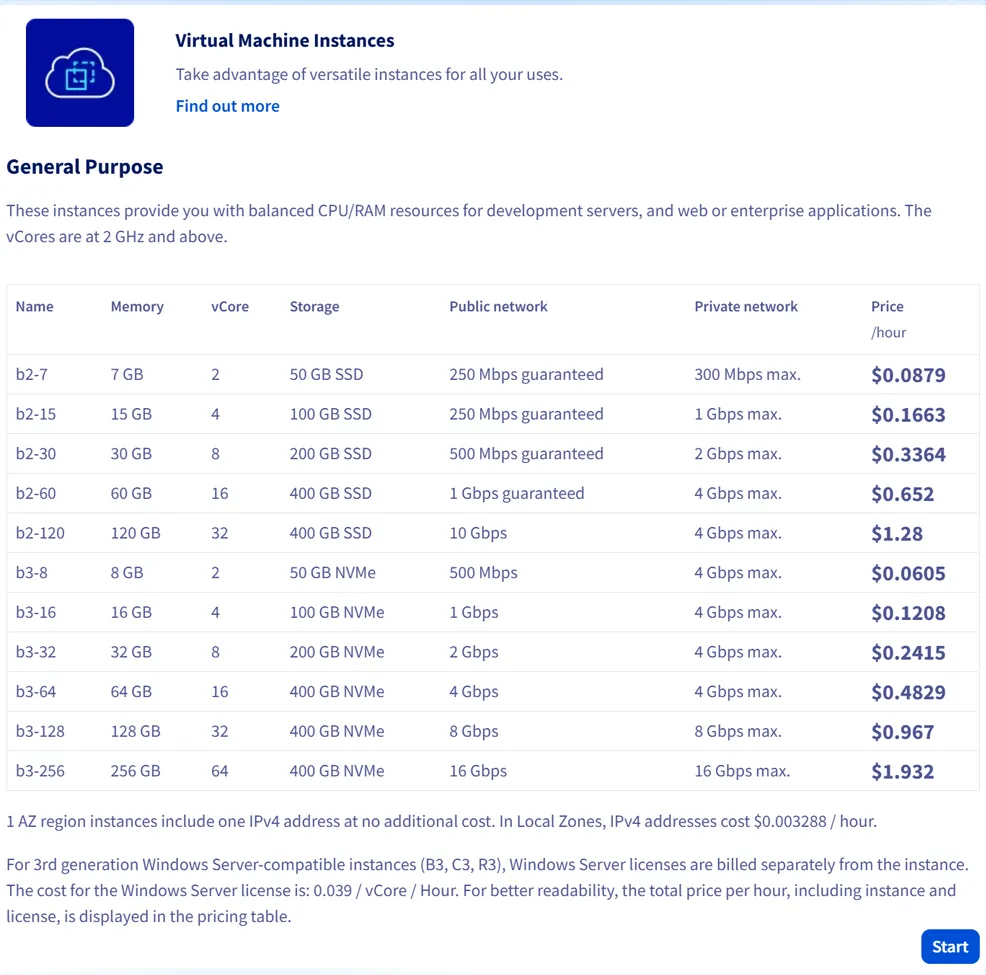
OVHcloud’s entry pricing is highly competitive. Shared hosting starts at $1.67/month for the Starter plan, while the current VPS range starts at $6.46/month for VPS-1 with 4 vCores, 8 GB RAM, 75 GB SSD storage, daily backups, and unlimited traffic. That makes OVHcloud particularly appealing to technical users who care more about raw resources and infrastructure economics than premium onboarding.
Renewal Pricing and Hidden Costs
OVHcloud is a bit different from hosts that rely mainly on very low teaser rates followed by massive renewals, but shoppers still need to read the details carefully. Pricing can vary by geography and product family, some add-ons cost extra, higher-touch support tiers are paid, and community discussion in 2026 also points to price increases on some low-cost cloud and VPS products.
There are other practical details to watch as well. Shared hosting tiers differ in storage, number of sites, email accounts, database limits, and whether resources are simply shared or more performance-oriented. VPS features also vary by location, and Local Zone plans have meaningful exclusions such as no Windows, no cPanel or Plesk, and limited compatibility with some surrounding services.
Value Assessment
For technical users, OVHcloud offers very strong value. You get a lot of resources for the price, anti-DDoS protection, daily VPS backups, and a broad path upward into larger infrastructure products. For complete beginners or users who want a polished all-in-one consumer experience, the value is less obvious because the product experience is more self-service and support is not one of OVHcloud’s strongest reputation points. Overall, OVHcloud is one of the more compelling value plays in hosting if your main priority is infrastructure per dollar.
| Plan Tier | Starting Price | Key Resources | Best For |
|---|---|---|---|
| Starter Shared | $1.67/mo | 1 GB storage, 1 website, 2 email accounts, free domain for 1 year | Simple landing pages, basic sites, very small web projects |
| Professional Shared | $7.69/mo | 250 GB storage, 10 sites, 100 email accounts, SSH access, 1-click CMS support | Business sites, brochure sites, small multi-site portfolios |
| VPS-1 | $6.46/mo | 4 vCores, 8 GB RAM, 75 GB SSD, daily backup, unlimited traffic, dedicated IPv4 | Developers, app hosting, small production workloads, self-managed users |
| VPS-2 | $9.99/mo | 6 vCores, 12 GB RAM, 100 GB SSD NVMe, daily backup, 1 Gbps bandwidth | Higher-value VPS buyers, multi-site hosting, labs, staging, growing apps |
| VPS-3 | $19.97/mo | 8 vCores, 24 GB RAM, 200 GB SSD NVMe, daily backup, 1.5 Gbps bandwidth | Heavier workloads, larger apps, game servers, more demanding deployments |
Pricing note: OVHcloud often looks strongest on paper when you compare raw VPS resources for the monthly cost, but you should still verify region-specific pricing, support coverage, and any feature exclusions before purchasing.
Ready to try OVHcloud?
If your priority is low-cost infrastructure, flexible VPS resources, and strong built-in DDoS protection, OVHcloud may be worth a closer look. Review the latest plans, features, and pricing directly on the provider’s site before signing up.
Performance and Speed
Performance is one of the more nuanced parts of the OVHcloud story. On one hand, the company offers impressive specs for the money, NVMe storage on most VPS tiers, and a broad infrastructure footprint. On the other hand, independent benchmark data suggests performance quality can vary meaningfully by plan family, with some low-end VPS plans scoring only modestly in web and CPU performance relative to stronger midrange offerings.
That means OVHcloud often makes the most sense for buyers who are comparing resource allocations and use-case fit rather than assuming every low-end VPS will behave like a premium compute instance. For many real-world tasks such as web hosting, development environments, internal tools, VPNs, and moderately demanding applications, it can be a very good value, but the cheapest plans should still be evaluated with realistic expectations.
For simple shared-hosting use cases, OVHcloud should be adequate for brochure sites, blogs, and standard CMS installs. For applications where performance consistency matters more than sheer paper specs, it is worth comparing plan-specific benchmarks, especially if you are deciding between OVHcloud and a more premium cloud or managed hosting provider.
Ease of Use and Setup
Ease of use is not OVHcloud’s clearest strength. The platform is workable, but it is generally better described as functional than delightfully beginner-friendly. Users who are already comfortable with hosting terminology, control panels, DNS, SSH, and server setup will likely adapt quickly, while first-time site owners may find the experience less intuitive than more consumer-oriented hosts.
That matters because OVHcloud does not position its VPS line as managed hosting. The company’s own documentation says users need basic server administration knowledge, and that is a meaningful distinction. If you are buying a VPS, you should expect to handle the operating system, hardening, software setup, updates, and troubleshooting yourself unless you bring outside help.
For shared hosting, the barrier is lower than on VPS, but the broader platform still feels more infrastructure-centric than beginner-guided. In other words, OVHcloud is easier to recommend to someone who already knows roughly what they are doing than to someone launching a first site and hoping the platform will do most of the thinking for them.
Developer and Advanced Features
This is where OVHcloud becomes much more compelling. The VPS platform includes root access, Linux and Windows options on standard VPS, API-based management, integrated KVM console access, dedicated IPv4, IPv6 support, one-click scaling upward, and optional extras such as additional IPs, load balancing, and premium backup. That makes it attractive for developers, technical consultants, agencies, and small businesses with in-house technical comfort.
OVHcloud also spans far beyond entry hosting. Users can move from shared hosting into VPS, then into broader cloud or dedicated offerings without leaving the ecosystem. For projects that may grow beyond simple website hosting into infrastructure, app deployment, database hosting, test environments, or game servers, that broader product range is a real advantage.
The biggest caution is that flexibility does not equal simplicity. OVHcloud gives you meaningful control, but it expects you to know what to do with it. That is great for technical buyers and less ideal for users who want something closer to managed WordPress or a guided small-business hosting experience.
Security, SSL, and Backups
OVHcloud’s bundled security story is stronger than many bargain-focused providers, especially on VPS. Anti-DDoS protection is included, dedicated IPv4 is standard, IPv6 is supported, and daily VPS backups are now included by default. That combination helps explain why OVHcloud continues to appeal to users running public-facing services, game servers, and workloads where DDoS resilience matters.
On shared hosting, the company includes free Let’s Encrypt SSL, anti-DDoS protection, ModSecurity, and multiple backup/restore points for files. That is a respectable baseline security package for basic websites and business hosting, particularly at the price points involved.
As always, no provider’s included features remove the need for operational discipline. For serious projects, you should still manage updates carefully, maintain your own off-platform backups when possible, and treat server security as a shared responsibility rather than something fully outsourced by the host.
Customer Support
Customer support is the area where OVHcloud draws the most criticism. Standard support is included, but OVHcloud also sells higher support tiers, which signals that the base experience is not intended to function like premium concierge hosting. Outside review aggregators and user discussions repeatedly show the same pattern: users like the pricing and infrastructure value, but many describe support as slow, inconsistent, or frustrating when something goes wrong.
That does not mean every support experience is poor. Some users report helpful interactions and a generally reliable platform. But if responsive, hand-holding support is a top buying criterion, OVHcloud is harder to recommend than hosts that invest more heavily in beginner-facing service and more immediate assistance at the base price.
The practical takeaway is simple: OVHcloud support is acceptable if you are relatively self-sufficient and mostly need infrastructure. It is a risk factor if you know you will rely heavily on support during setup, migration, billing disputes, or urgent outages.
Scalability and Flexibility
Scalability is one of OVHcloud’s genuine strengths. A user can start with low-cost shared hosting for a simple site, move into VPS for more control and dedicated resources, and then graduate to larger cloud or dedicated products as requirements grow. That creates a more credible infrastructure path than hosts that mostly stop at shared hosting and a handful of small VPS plans.
There are still tradeoffs. Upgrading a VPS upward is straightforward, but OVHcloud notes that downgrading generally requires moving to a new plan. In addition, some region-specific plans and Local Zone offerings have feature limitations that matter for more advanced deployments.
Scalability takeaway: OVHcloud is best suited for users who want a relatively inexpensive path from basic hosting into larger infrastructure products without leaving the same provider, especially if they are comfortable managing the technical side themselves.
Data Centers and Global Reach
OVHcloud has one of the larger infrastructure footprints in the hosting market. Its own web hosting materials say the company operates across five continents, 183 countries, and 32 datacentres, while product pages also emphasize multiple global VPS locations and Local Zone availability in more than 15 cities. That broader geographic reach is one reason OVHcloud remains relevant for latency-sensitive and internationally distributed workloads.
For shared hosting specifically, the comparison page lists Beauharnois, Canada as the datacentre location for the featured web hosting plans. For VPS, exact location and feature availability can vary by plan type and region, so buyers should confirm those details before ordering if data residency, local latency, or product compatibility matters to the project.
The broader point is that OVHcloud is not just a low-cost web host. It is a global infrastructure company, and that wider footprint is part of the appeal for businesses and technical users that may outgrow basic hosting over time.
Who Is OVHcloud Best For?
Best For
- Developers and sysadmins comfortable managing servers
- Agencies hosting multiple sites or client environments
- Budget-conscious buyers focused on VPS price-to-resource value
- Projects that benefit from built-in anti-DDoS protection
- Users who may later grow into broader cloud or dedicated infrastructure
Not Ideal For
- Beginners who want the easiest possible setup experience
- Buyers who expect premium support at entry-level prices
- Users who want a polished managed WordPress-style platform first and foremost
- Projects where billing friction or slow support would be especially costly
Ready to try OVHcloud?
If your priority is low-cost infrastructure, flexible VPS resources, and strong built-in DDoS protection, OVHcloud may be worth a closer look. Review the latest plans, features, and pricing directly on the provider’s site before signing up.
How We Evaluated OVHcloud
For this review, we considered OVHcloud’s plan structure, published pricing, available resources, infrastructure breadth, ease of use, developer flexibility, support options, security and backup posture, upgrade path, and overall value for the kinds of users most likely to compare it with other budget VPS and hosting providers.
We also considered broader reviewer sentiment and user-review patterns to identify where OVHcloud appears strongest in practice, and where common complaints tend to cluster, especially around support quality, account or billing friction, and differences between attractive on-paper specs and real-world user expectations.
Scoring Breakdown
| Category | Score |
|---|---|
| Performance | 8.1/10 |
| Ease of Use | 7.1/10 |
| Pricing/Value | 9.3/10 |
| Features | 8.7/10 |
| Security/Backup | 8.8/10 |
| Support | 6.8/10 |
| Scalability | 8.9/10 |
| Overall | 8.3/10 |
Top Alternatives to OVHcloud
If OVHcloud does not seem like the right fit, you might also want to consider alternatives such as:
Hetzner for similarly strong infrastructure value.
DigitalOcean for a more polished developer cloud experience.
Vultr for broad location choice and simple cloud instances.
Hostinger or SiteGround if the real priority is easier website-first hosting rather than infrastructure-led value.
Final Verdict
OVHcloud is a strong option for developers, technical users, agencies, and cost-conscious businesses that want inexpensive infrastructure, broad product depth, and especially compelling VPS value.
Its biggest strengths are pricing efficiency, included anti-DDoS protection, daily VPS backups, and a meaningful path into larger infrastructure products as needs grow. Its biggest weaknesses are a less beginner-friendly experience, mixed support sentiment, and the fact that some of its cheapest plans look better on paper than they may feel to users expecting premium consistency.
For many technically comfortable buyers, that tradeoff will be worth it. If your goal is to get more server resources for less money and you are comfortable managing the environment, OVHcloud is one of the more interesting providers in the market. If your priority is premium support, the easiest onboarding, or a highly polished managed hosting experience, you should compare alternatives before committing.
Ready to try OVHcloud?
If your priority is low-cost infrastructure, flexible VPS resources, and strong built-in DDoS protection, OVHcloud may be worth a closer look. Review the latest plans, features, and pricing directly on the provider’s site before signing up.
Frequently Asked Questions
Is OVHcloud good for beginners?
OVHcloud can work for beginners on shared hosting, but it is generally a better fit for users with at least some hosting or server experience. Its VPS products are self-managed and expect basic system administration knowledge.
Does OVHcloud offer cheap VPS hosting?
Yes. OVHcloud is one of the more aggressive VPS providers on paper for price-to-resource value, with entry VPS plans starting at low monthly prices and including features like daily backups, anti-DDoS protection, and dedicated IPv4.
Does OVHcloud include backups and DDoS protection?
Yes. OVHcloud includes anti-DDoS protection on VPS and web hosting products, and the current VPS range includes daily automatic backups by default. Shared hosting also includes backup and restore features.
Is OVHcloud managed hosting?
Not in the way many beginners mean it. OVHcloud’s core VPS offer is self-managed, which means you are responsible for configuring, securing, and maintaining the server unless you use outside help or a control panel that simplifies parts of the process.
Why do some users complain about OVHcloud?
The most common complaints are not usually about headline pricing. They are more often about support speed, billing or account friction, control-panel experience, and the gap between attractive low prices and the reality of managing infrastructure yourself.
Who should choose OVHcloud over competitors?
OVHcloud makes the most sense for buyers who want strong infrastructure economics, broad product depth, and built-in DDoS protection, and who are comfortable handling a more self-service experience than they would get from beginner-oriented hosts.
Editorial note: Hosting plans, pricing, features, and policies can change over time. Before signing up, always confirm the latest details directly on the provider’s site.