
Our Netcup Review & Analysis for 2026

 By:
By: Table of Contents
- Quick Facts
- What Is Netcup?
- Plans, Pricing, and Overall Value
- Performance and Speed
- Ease of Use and Setup
- Developer and Advanced Features
- Security, SSL, and Backups
- Customer Support
- Scalability and Flexibility
- Data Centers and Global Reach
- Who Is Netcup Best For?
- How We Evaluated Netcup
- Scoring Breakdown
- Top Alternatives
- Final Verdict
- Frequently Asked Questions
Pros
- Strong price-to-performance, especially on VPS and server products
- Web hosting prices are designed to remain valid for the full term rather than jump after an intro period
- VPS plans support hourly billing with no minimum contract term on that billing model
- Useful server features such as snapshots, remote console, API access, DDoS protection, and expandable block storage
- Solid fit for self-hosted apps, development environments, small business sites, and technically comfortable users
- Generally positive value-oriented sentiment across user reviews and Reddit discussions
Cons
- Support and billing experiences appear less consistent than with premium hosts
- The platform is more utilitarian than beginner-polished
- VPS plans do not include dedicated CPU resources or the same availability guarantees as root servers
- Windows is not offered as a standard, ready-made server product
- Some pricing details can be harder to compare because of VAT, setup fees, and varying plan generations
Ready to try Netcup?
If your priority is getting a lot of hosting resources for the money, Netcup is worth a closer look. Review the latest web hosting and VPS plans directly on the provider’s site before ordering.
Quick Facts
| Provider | Netcup |
|---|---|
| Hosting Type | Web Hosting, VPS, Root Server, Dedicated Server, Managed vServer |
| Starting Price | From about €2.17/month for web hosting; VPS pricing varies by generation and term |
| Billing Style | Web hosting on fixed-term pricing; VPS available with hourly billing or 12-month billing |
| Storage | SSD on web hosting; NVMe on VPS; optional Local Block Storage on eligible VPS plans |
| CPU/RAM | Guaranteed RAM tiers on web hosting; configurable VPS resources; root servers include dedicated CPU and RAM resources |
| Control Panel | Plesk for web hosting; customer/server control panels for server products |
| Managed Hosting Available | Yes, via managed vServer offerings |
| Root Access | Yes, on VPS and server products |
| Data Center Locations | Europe, United States, and Singapore depending on product/location selection |
| Uptime SLA | Web hosting marketed with 99.6% annual availability; root servers advertised with 99.9% guaranteed minimum annual availability |
| Free SSL | Yes |
| Backups | Snapshots on VPS; plan-specific backup behavior varies by product |
| Support | Support channels available, but user feedback on responsiveness is mixed |
| Best For | Developers, self-hosters, small businesses, and value-focused users who are comfortable managing hosting themselves |
Bottom line: Netcup is one of the more compelling low-cost hosting and VPS providers for users who care most about value, server flexibility, and self-managed infrastructure. Its tradeoff is that the experience is more technical and less polished than many beginner-first hosts, and support sentiment is not uniformly glowing.
What Is Netcup?
Netcup is a hosting and infrastructure company that offers low-cost web hosting, VPS products, root servers, dedicated servers, domains, and related add-ons. The company presents itself as a performance-focused, transparent, Germany-based provider that aims to deliver high-value hosting without relying on the kind of heavily discounted teaser pricing that is common across mainstream shared hosting.
The appeal of Netcup is straightforward: it tries to give customers a lot of server resources and flexibility at a low price. That makes it attractive for Linux users, developers, agencies, hobby projects, test environments, and site owners who care more about specs and control than about a highly polished beginner dashboard.
Plans, Pricing, and Overall Value
Plan Types
Netcup’s lineup is broader than many entry-level hosting brands. At the lower end, it offers cloud-based web hosting plans for standard websites, blogs, stores, and content management systems. Above that, it offers VPS plans for users who want more control and isolated server environments, root servers for workloads that need dedicated CPU and RAM resources, and dedicated servers for users who want hardware-level exclusivity. There is also a managed vServer option for people who want Linux server deployment with more provider assistance.
Entry-Level Pricing
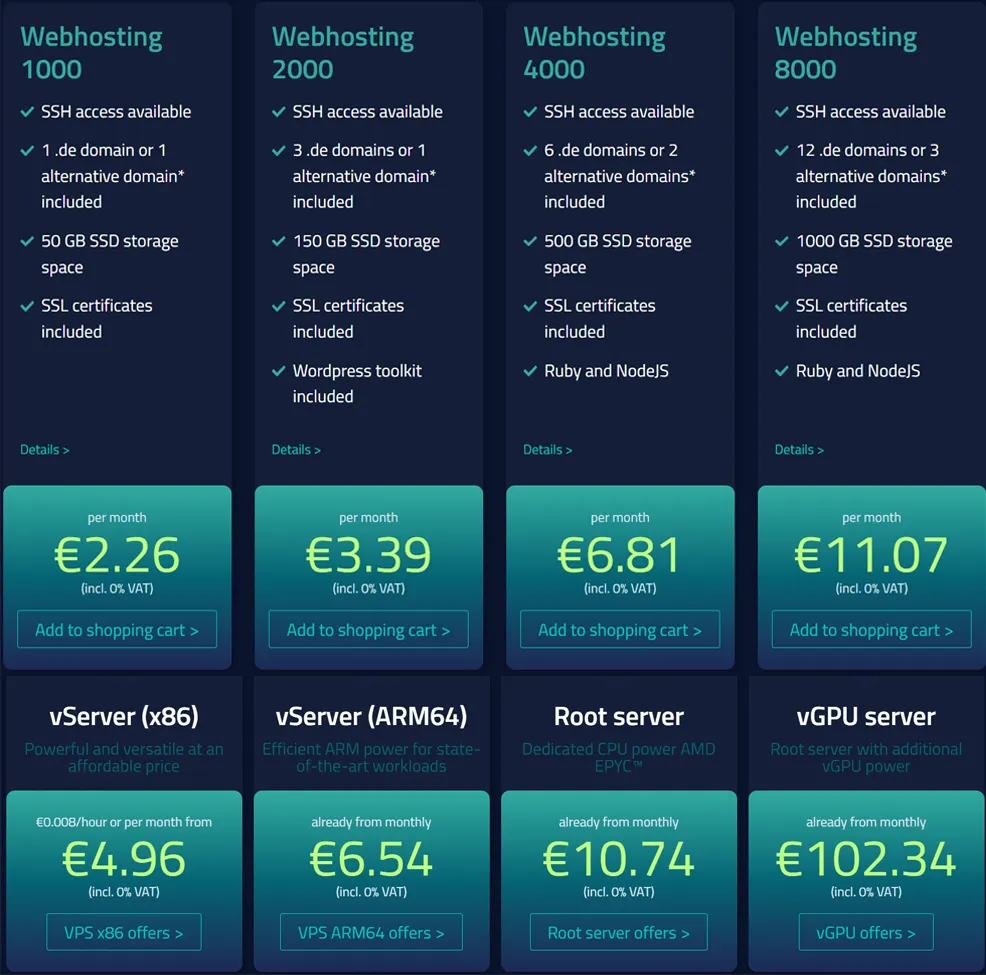
Netcup’s web hosting starts at a very low monthly price and is positioned as an affordable long-term option rather than a giant short-lived promotional discount. Its shared hosting range scales through Webhosting 1000, 2000, 4000, and 8000 tiers, with included storage, domains, and resource allowances increasing as you move up. On the server side, VPS plans are available in several resource brackets, starting with smaller configurations suitable for basic websites, development, and lightweight apps, then scaling into much larger plans intended for databases, company platforms, analytics, and demanding application workloads.
Pricing Complexity and What to Watch
Netcup’s pricing is attractive, but it is not always simple at a glance. Depending on the product, you may need to account for VAT treatment, setup fees on some offers, location-specific variants, and differences between product generations such as G11, G11s, and G12. VPS plans are easier to justify for technical buyers who understand what they are getting, but less transparent for casual shoppers who just want one clean all-in number without reading the details.
The upside is that Netcup does offer genuine flexibility in places where many competitors do not. VPS products can be billed hourly with no minimum term, or on a 12-month basis for users who want planning stability and lower long-run cost. That is a very different pricing posture from mainstream hosts that force buyers into long commitments just to get the advertised headline rate.
Value Assessment
For technically comfortable users, Netcup offers very strong value. Its web hosting is inexpensive, includes practical features such as SSL and SSH access, and avoids some of the dramatic renewal shock common elsewhere. Its VPS line is arguably even more compelling because it gives users snapshots, remote console access, DDoS protection, included traffic, and meaningful hardware resources at pricing that is frequently described as highly competitive in user communities.
| Plan Tier | Starting Price | Key Resources | Best For |
|---|---|---|---|
| Webhosting 1000 | About €2.17/mo | 50 GB SSD storage, SSL included, SSH access, 1 included domain depending on plan/location | Small websites, blogs, personal projects, simple CMS installs |
| Webhosting 2000 | Higher than entry tier | 150 GB SSD storage, SSL, SSH, more included domains and resources than 1000 | Small business sites, multiple basic websites, users hosting up to a few domains |
| Webhosting 4000 / 8000 | Mid to upper shared range | 500 GB to 1000 GB SSD, Ruby/NodeJS support, more domains, stronger resource profile | Larger websites, media-heavy projects, multi-site use, more advanced shared hosting needs |
| VPS 500 / 1000 | Varies by generation and billing model | From 2 vCores, 4 GB RAM, 128 GB NVMe upward, snapshots, remote console, DDoS protection | Dev environments, growing websites, small apps, email, lightweight stores |
| VPS 2000 / 4000 / 8000 | Higher but still value-oriented | Up to 16 vCores, 64 GB RAM, and 2048 GB NVMe on top-tier standard VPS listings | Large apps, company platforms, data-heavy backends, container workloads, analytics |
Pricing note: Netcup is often a strong value, but shoppers should still verify VAT treatment, setup fees, billing term, location, and whether the plan is VPS, root server, or a special promotional variant before checking out.
Ready to try Netcup?
If your goal is to maximize resources for the money, Netcup is worth reviewing directly. Check the current web hosting and VPS details on the provider’s site before ordering.
Performance and Speed
Netcup’s reputation for performance is generally strong relative to its price bracket. The company markets both its web hosting and server products around high-performance hardware, cloud-backed web hosting infrastructure, and fast NVMe storage on VPS plans. Independent review coverage and user commentary often describe the service as stable and impressively capable for the price, especially on the VPS side, where the specs are one of the main reasons buyers consider the brand in the first place.
That does not mean every product should be treated the same way. Shared web hosting is still shared hosting, so resource consistency will never look exactly like a more isolated environment. On VPS products, Netcup is explicit that you do not get dedicated CPU resources the way you do on root servers, which matters if you are planning highly latency-sensitive or business-critical workloads that need predictable resource isolation.
For ordinary websites, self-managed WordPress setups, staging environments, developer tools, side projects, and moderate application hosting, Netcup should offer more than enough performance for many buyers. If your project is especially demanding, the root server line is the more natural upgrade path than expecting ultra-cheap VPS plans to behave like premium dedicated infrastructure.
Ease of Use and Setup
Ease of use is not really Netcup’s main selling point. Its web hosting products do benefit from Plesk, app installation tools, and a feature set that is easier to understand than a bare server, but the overall brand experience is still more utilitarian and infrastructure-oriented than beginner-first. People who are comfortable with control panels, DNS, server terms, and self-service documentation will usually adapt fine, while first-time site owners may find the ecosystem less welcoming than heavily guided mainstream hosts.
That said, Netcup is not inaccessible. The web hosting line supports standard tasks such as setting up websites, creating email accounts, managing SSL, and installing apps like WordPress. Its VPS platform also includes practical self-service tools such as remote console access, snapshots, preconfigured images, and upgrade pathways within the same generation or price group.
The key difference is expectation-setting. Netcup feels more like a low-cost infrastructure provider with consumer-accessible products than a hand-holding website platform built primarily for absolute beginners.
Developer and Advanced Features
This is one of Netcup’s clearest strengths. Even its web hosting plans include SSH access, and higher web hosting tiers add support for technologies such as Ruby and NodeJS. On the VPS side, users get server-level flexibility, API access, remote console tools, image-based deployment options, expandable Local Block Storage on eligible plans, and the freedom to run a broad range of workloads from websites and databases to development environments and backend applications.
Netcup is particularly appealing for users who want to self-manage Linux infrastructure without paying premium cloud-provider prices. It is suitable for personal apps, lightweight SaaS backends, self-hosted services, dev/test stacks, game servers, and technical projects that outgrow shared hosting. The platform is much less attractive to users who want a highly abstracted managed developer platform with built-in deployment pipelines and extensive platform automation.
It is also worth noting that Windows support is limited in a way that some buyers may miss. Netcup does not sell prebuilt Windows VPS products in the standard way some competitors do, though users can install Windows themselves via the control panel using a limited test license.
Security, SSL, and Backups
Netcup checks the major baseline boxes most buyers now expect. Web hosting includes free Let’s Encrypt SSL certificates for domains and subdomains, and the company emphasizes GDPR-compliant, ISO 27001-certified infrastructure for its data center environment. VPS products also include DDoS protection and snapshots, which are especially useful for rollback and change management in self-managed server setups.
As always, the practical security posture depends on the product and on the customer. Shared hosting customers get a more packaged environment, while VPS customers get more control and therefore more responsibility. Netcup provides a respectable base, but serious production users should still handle patching, off-platform backups, account hygiene, and service hardening themselves.
One useful distinction is that root servers carry stronger availability assurances than VPS products. If uptime guarantees and resource commitments are central to your business case, that difference matters more than the low entry price alone.
Customer Support
Support is the main area where Netcup’s reputation is more mixed. The company promotes competent support, and there are certainly customers who speak positively about their experiences. Review platforms and community discussions often contain praise for pricing, uptime, and value, but they also contain a consistent cluster of complaints around response speed, billing friction, account handling, and the general feeling that support is not as polished as what buyers might get from a more premium host.
That does not automatically make support bad. It means Netcup appears to be strongest when the customer is relatively self-sufficient and only occasionally needs help, rather than when the customer expects frequent proactive guidance. Reddit sentiment reflects that same pattern: many technical users think Netcup is a very good low-cost option, while critics tend to focus on support interactions or problem resolution when things go wrong.
If support quality is your top priority, Netcup is probably not the safest choice in the market. If value and technical flexibility matter more, the support tradeoff may be worth it.
Scalability and Flexibility
Netcup gives users a practical ladder for growth. You can begin with low-cost web hosting, move to a higher shared tier if your site expands, then shift into VPS or root server products when you need more control, better isolation, or heavier compute resources. Within the VPS range, the company also allows upgrades inside the same generation or product family, which helps users grow without completely abandoning the platform.
Its infrastructure options are broad enough to cover a lot of use cases, from personal websites and blogs all the way to business applications and more demanding backend systems. The major limitation is not lack of raw product variety but rather that scaling on Netcup still assumes a degree of technical ownership. This is not the same as a fully managed business platform that abstracts most infrastructure decisions away from the customer.
Scalability takeaway: Netcup is a strong fit for users who want a low-cost path from basic hosting into self-managed VPS or stronger server products, but it is not the most beginner-friendly route to long-term growth.
Data Centers and Global Reach
Netcup is more international than some buyers initially assume, even though its brand identity is strongly tied to Germany and Europe. For VPS products, it lists Vienna, Nuremberg, Amsterdam, Manassas in the United States, and Singapore as available location options, plus a “No preference Europe” choice that assigns the server within Europe based on available capacity. That gives buyers a useful spread for European workloads, with additional reach into North America and Asia.
Its web hosting positioning is still very Europe-centered, and for many buyers that is actually part of the appeal. Users who care about hosting in Germany or about GDPR-oriented infrastructure may find Netcup especially attractive. As always, exact location availability can vary by product family, so buyers should verify the specific plan page rather than assume every hosting type has identical location options.
Who Is Netcup Best For?
Best For
- Developers and Linux users who want low-cost VPS resources
- Self-hosters running personal apps, dashboards, test environments, or side projects
- Small businesses that want affordable web hosting without dramatic intro-vs-renewal pricing games
- Agencies or technical users who can manage hosting themselves and prioritize value
- Buyers who want flexible billing, snapshots, and more server control than beginner hosts usually provide
Not Ideal For
- Complete beginners who want the smoothest possible onboarding and dashboard experience
- Customers who expect premium support or concierge-style assistance
- Users who need dedicated CPU guarantees but are shopping only the low-end VPS line
- Buyers who specifically want turnkey Windows hosting
Ready to try Netcup?
If your priority is affordable hosting with more control and stronger raw specs than many beginner-oriented hosts, Netcup may be worth a closer look. Review the latest plans and policies directly on the provider’s site before signing up.
How We Evaluated Netcup
For this review, we considered Netcup’s plan structure, pricing approach, web hosting and VPS feature sets, billing flexibility, infrastructure positioning, ease of use, developer controls, support reputation, security baseline, upgrade path, and overall value for the types of users most likely to compare it against budget and midrange hosting alternatives.
We also looked at broader user-review and community sentiment to identify where Netcup appears strongest in real-world use and where complaints repeatedly cluster. The clearest pattern was that users often praise value, uptime, and resource levels, while more negative experiences tend to center on support, billing questions, and account-management friction.
Scoring Breakdown
| Category | Score |
|---|---|
| Performance | 9.1/10 |
| Ease of Use | 7.6/10 |
| Pricing/Value | 9.4/10 |
| Features | 9.2/10 |
| Security/Backup | 8.3/10 |
| Support | 9.1/10 |
| Scalability | 9.0/10 |
| Overall | 8.8/10 |
Top Alternatives to Netcup
If Netcup does not seem like the right fit, you might also want to consider alternatives such as Hetzner, Contabo, OVHcloud, and IONOS.
Hetzner is probably the closest direct alternative to Netcup. It appeals to a similar audience of developers, self-hosters, and budget-conscious businesses that want strong server performance, flexible infrastructure, and very competitive pricing, but it is often seen as a bit more established and slightly easier to recommend for general-purpose server use.
Contabo is a logical option for users who care most about maximizing raw resources for the price. It is frequently compared with Netcup by shoppers looking for low-cost VPS or cloud VPS plans, though the decision often comes down to whether you value absolute resource volume, location options, or overall platform reputation more.
OVHcloud is a strong alternative for buyers who want a larger infrastructure provider with broad international reach and a wider range of hosting and server products. It can make more sense than Netcup for users who care about network scale, additional global footprint, or a provider with a bigger presence outside the German budget hosting niche.
IONOS is worth considering for users who want a more mainstream hosting company that still offers VPS and server products. It is not always the closest match on raw price-to-performance, but it can be appealing for small businesses and less technical buyers who prefer a more conventional hosting brand with a broad product catalog.
Final Verdict
Netcup is a strong choice for technically comfortable users who want low-cost hosting and VPS products with unusually competitive resources for the money.
Its biggest advantages are pricing efficiency, flexible VPS billing, practical server features, and a product range that scales from inexpensive web hosting into more serious infrastructure. Its biggest downsides are that the user experience is more functional than beginner-friendly, and support sentiment is not as consistently strong as the value proposition.
For many developers, self-hosters, and budget-conscious businesses, that tradeoff will be well worth it. If your main goal is getting a lot of capability at a low price, Netcup deserves serious consideration. If your main goal is premium support, maximum simplicity, or the smoothest first-time hosting experience, you may want to compare alternatives before committing.
Ready to try Netcup?
If your priority is value-rich hosting and flexible self-managed server options, Netcup may be worth a closer look. Review the latest plans, locations, and pricing directly on the provider’s site before signing up.
Frequently Asked Questions
Is Netcup better for web hosting or VPS?
For most buyers, Netcup is more compelling as a VPS and server provider than as a beginner-focused shared hosting brand. Its web hosting plans are affordable and capable, but the company’s strongest reputation is tied to price-to-performance on VPS, root servers, and other self-managed infrastructure products.
Does Netcup offer hourly billing on VPS plans?
Yes. One of Netcup’s more attractive VPS features is that certain plans can be billed hourly rather than only through a long fixed-term contract. That makes it useful for testing, short-term projects, temporary workloads, and users who want more flexibility before committing long term.
Does Netcup provide dedicated CPU resources on VPS?
No, not on its standard VPS line. Netcup’s VPS products are designed as lower-cost virtual servers and do not include dedicated CPU resources in the way its root server products do. Users who need more predictable resource isolation should look more closely at Netcup’s root server range instead.
Where are Netcup’s server locations?
Netcup is best known for its European presence, but it also offers broader location coverage on some server products. Depending on the product and configuration, buyers may see location options such as Germany, Austria, the Netherlands, the United States, and Singapore.
Is Netcup a good fit for beginners?
It can work for beginners, especially on the web hosting side, but it is usually a better fit for users who are at least somewhat comfortable with hosting terminology and self-service tools. Netcup is more practical and infrastructure-oriented than the most polished beginner-first hosting brands.
Does Netcup include SSL, snapshots, and backups?
Netcup includes free SSL on its web hosting plans, while its VPS products include snapshots and other self-service management tools. Buyers should still read the product details carefully, because backup behavior and disaster-recovery workflows are not identical across web hosting, VPS, and server products.
What is the main downside of using Netcup?
The main tradeoff is that Netcup is not as polished or support-heavy as some premium hosting providers. It tends to be strongest for users who value low pricing, flexibility, and strong raw specs more than concierge-style help or a highly guided user experience.
Editorial note: Hosting plans, pricing, features, and policies can change over time. Before signing up, always confirm the latest details directly on the provider’s site.