
Our Oracle Cloud Hosting Review & Analysis for 2026

 By:
By: Table of Contents
- Quick Facts
- What Is Oracle Cloud?
- Plans, Pricing, and Overall Value
- Performance and Speed
- Ease of Use and Setup
- Developer and Advanced Features
- Security, SSL, and Backups
- Customer Support
- Scalability and Flexibility
- Data Centers and Global Reach
- Who Is Oracle Cloud Best For?
- How We Evaluated Oracle Cloud
- Scoring Breakdown
- Top Alternatives
- Final Verdict
- Frequently Asked Questions
Pros
- One of the most generous Always Free tiers in cloud hosting, including Arm-based compute resources
- Free tier can support surprisingly capable VPS-style workloads when capacity is available
- Very competitive paid pricing for Arm and AMD compute
- 10 TB/month outbound data transfer allowance is far more generous than most mainstream cloud providers
- Strong enterprise infrastructure, global regions, private networking, load balancing, databases, and Kubernetes services
- Excellent fit for developers, Linux users, self-hosters, startups, and technical website owners
- Flexible instance sizing lets users configure CPU and memory more precisely than fixed-size VPS plans
- Good long-term upgrade path from free experiments to production cloud infrastructure
Cons
- Not beginner-friendly compared with shared hosting or simple VPS providers
- No standard cPanel-style hosting experience unless you install and manage it yourself
- Always Free capacity can be difficult to obtain in some regions
- Free and low-cost users often report frustration with account reviews, support limitations, and unclear issue resolution
- Idle Always Free compute instances may be stopped or reclaimed under Oracle’s usage policies
- Arm-based free instances require software compatibility awareness
- Billing, quotas, networking, security lists, and cloud terminology can overwhelm nontechnical users
- Not the best choice for users who simply want to launch a WordPress site with minimal configuration
Ready to try Oracle Cloud?
If you want a powerful cloud VPS platform with a generous free tier, flexible compute options, and unusually strong bandwidth value, Oracle Cloud is worth considering. Just make sure you understand the setup process, account limitations, and backup responsibilities before relying on it for important workloads.
Quick Facts
| Provider | Oracle Cloud Infrastructure (OCI) |
|---|---|
| Hosting Type | Cloud VPS, virtual machines, bare metal servers, storage, networking, Kubernetes, databases, serverless, and enterprise cloud services |
| Starting Price | Always Free resources available; paid compute billed hourly by OCPU and memory |
| Free Tier | Yes; includes Always Free compute, storage, networking, databases, and other services subject to limits and availability |
| Always Free Compute | Up to 4 Arm-based OCPUs and 24 GB RAM through Ampere A1 Flex, plus up to two small AMD-based micro instances |
| Always Free Storage | Up to 200 GB total block volume storage across eligible boot and block volumes |
| Outbound Bandwidth | Up to 10 TB/month outbound data transfer included before paid egress pricing applies |
| Billing Style | Pay-as-you-go, monthly Universal Credits, and enterprise contract options |
| Control Panel | Oracle Cloud Console, CLI, API, SDKs, Terraform, and infrastructure tools; no default cPanel |
| Managed Hosting Available | Not in the traditional shared-hosting sense; managed databases, Kubernetes, and platform services are available |
| Root Access | Yes, on virtual machine instances |
| Operating Systems | Oracle Linux, Ubuntu, Windows Server, and other supported images depending on instance type |
| Best Known For | Generous Always Free tier, Oracle databases, enterprise workloads, low egress pricing, and flexible compute |
| Support | Documentation, community resources, cloud support tiers, and enterprise support options; free-tier support is limited |
| Best For | Developers, Linux users, homelabs, cloud learners, startups, self-hosted apps, and cost-sensitive VPS workloads |
Bottom line: Oracle Cloud is one of the strongest value plays in cloud VPS hosting, especially because of its Always Free resources. However, it behaves like a real cloud platform, not a beginner web host. It rewards technical users and frustrates users who expect simple hosting, hand-holding, or guaranteed free-instance availability.
What Is Oracle Cloud?
Oracle Cloud Infrastructure is Oracle’s public cloud platform. It provides the core building blocks used to run websites, applications, databases, private networks, development environments, AI workloads, analytics pipelines, and enterprise systems. For hosting buyers, the most important OCI services are compute instances, block storage, object storage, virtual cloud networks, load balancers, DNS, databases, firewalls, and monitoring tools.
In ordinary VPS language, Oracle Cloud lets you create cloud servers with configurable resources. You choose an instance shape, region, operating system image, boot volume size, networking rules, SSH keys, and attached storage. Once the instance is created, you manage it like any other Linux or Windows server.
That flexibility is powerful, but it also changes the type of user Oracle Cloud is best for. A traditional host might ask, “Which WordPress plan do you want?” Oracle Cloud asks you to think about regions, availability domains, images, shapes, subnets, security lists, network security groups, boot volumes, reserved public IPs, IAM permissions, and billing limits. For developers and system administrators, that is normal. For first-time website owners, it can be a lot.
The reason many people still consider Oracle Cloud for VPS hosting is simple: the free and low-cost resources are unusually strong. The Always Free Arm allocation can be powerful enough to run real self-hosted services, development servers, game servers, VPNs, dashboards, lightweight websites, Docker containers, and testing environments. The challenge is getting capacity, configuring the environment properly, and understanding that free cloud resources are not the same as guaranteed managed hosting.
Plans, Pricing, and Overall Value
Plan Types
Oracle Cloud does not organize hosting the way shared hosting companies do. There are no “Basic,” “Plus,” and “Business” shared hosting plans with cPanel included. Instead, Oracle uses a cloud infrastructure model built around services and usage. The closest equivalent to VPS hosting is OCI Compute, where you create virtual machines using specific shapes.
The main compute options relevant to VPS buyers include:
- Ampere A1 Flex: Arm-based compute that is especially important because it powers Oracle’s most generous Always Free allocation.
- AMD E-series Flex shapes: General-purpose x86 compute for users who need broader software compatibility or stronger paid VPS-style infrastructure.
- Intel-based shapes: Useful for some compatibility-sensitive workloads, though AMD and Arm shapes are usually more relevant for value-focused users.
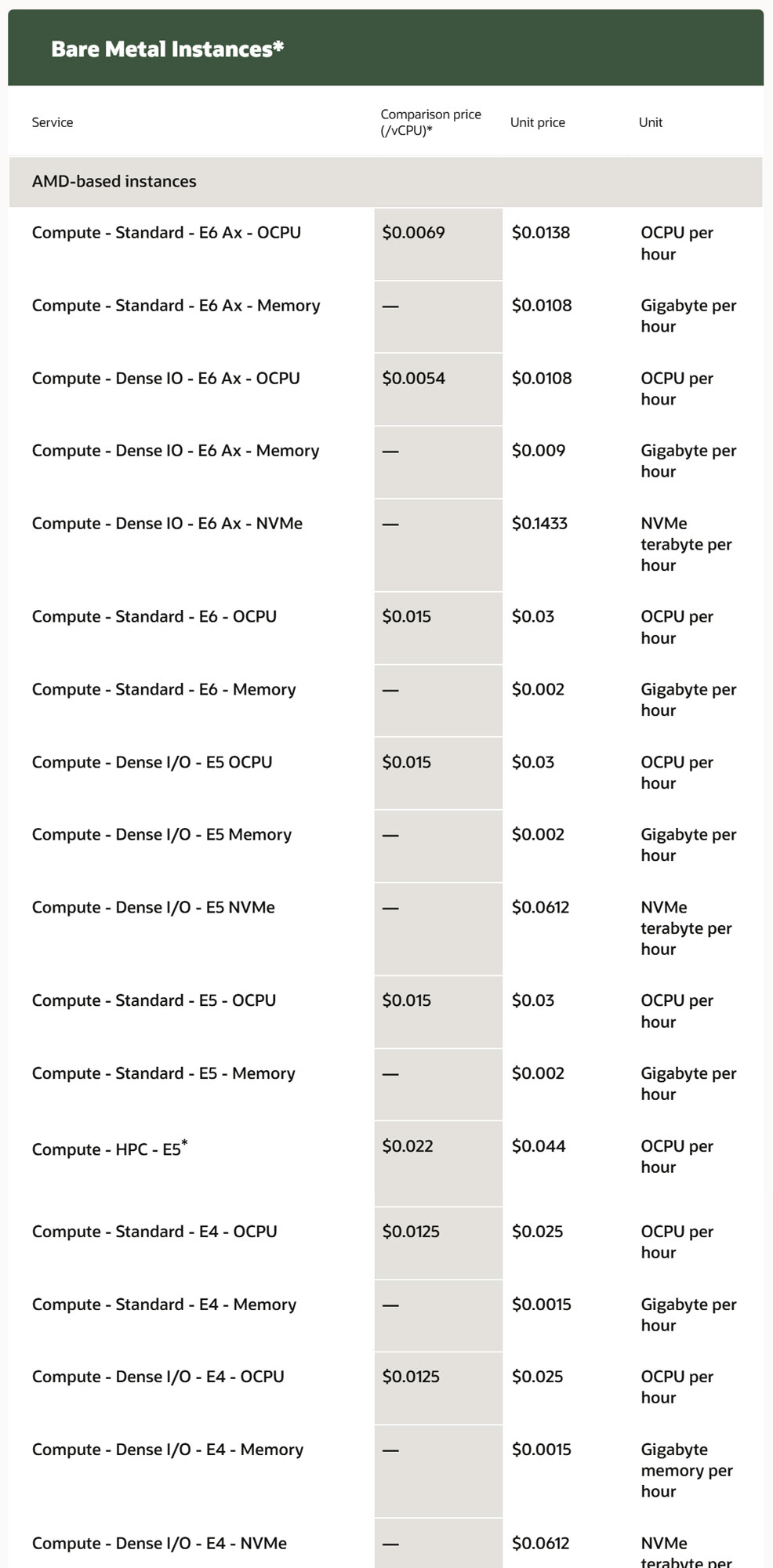
- Bare metal servers: Dedicated physical machines for enterprise, high-performance, or specialized workloads.
- GPU instances: Specialized infrastructure for AI, machine learning, rendering, and high-performance computing.
Oracle Always Free Tier
The Always Free tier is the main reason Oracle Cloud appears in so many VPS and self-hosting discussions. Oracle’s free resources can be far more powerful than the small free instances offered by most other cloud providers.
The headline free compute allocation is the Ampere A1 Flex allowance. Oracle describes this as a monthly pool of Arm-based compute and memory that can be used as one larger VM or split across smaller instances, subject to service limits and capacity. In practical terms, users often think of it as up to 4 OCPUs and 24 GB RAM of Arm compute. Oracle also offers small AMD micro instances as part of Always Free, though these are much more limited.
The free storage and bandwidth allowances are also important. The 200 GB block storage allocation is generous enough for several boot volumes or a modest self-hosted server environment, and the 10 TB/month outbound data transfer allowance is dramatically higher than what many cloud providers include for free.
Paid Compute Pricing
Oracle paid compute is typically priced by OCPU-hour and memory-hour, rather than as a simple fixed monthly VPS bundle. This means you pay for the CPU and RAM allocation you choose, along with storage, load balancers, public IP resources, and other services as applicable.
For value-focused VPS buyers, the Arm-based A1 pricing is especially attractive. AMD-based flexible shapes cost more, but they provide x86 compatibility and are still competitive against many major cloud providers. The tradeoff is that Oracle’s billing model requires more attention than a simple “$6/month VPS” plan. You need to understand what is free, what is billable, and how storage, networking, snapshots, public IPs, and other services are counted.
Bandwidth and Egress Value
Outbound data transfer is one of Oracle Cloud’s biggest pricing advantages. Many cloud providers make compute look cheap but charge heavily for bandwidth. Oracle’s 10 TB/month free outbound allowance gives it a major advantage for certain workloads, especially websites, media-heavy applications, mirrors, proxies, monitoring dashboards, and self-hosted services with meaningful traffic.
This does not mean every workload will be free. Users still need to watch paid resources, region-specific pricing, block storage, reserved public IPs, load balancers, backups, and non-free services. But compared with AWS, Google Cloud, and Azure, Oracle’s outbound bandwidth model is unusually friendly.
Free Tier Caveats
The Always Free tier is valuable, but it is not frictionless. The most common caveats are capacity, account review, and idle-resource policies. Many users report that Ampere A1 instances are difficult to create in some regions because free-tier capacity is unavailable. Others report that deleting a working free instance and trying to recreate it later can be risky if the region has no capacity at that moment.
Oracle also has policies for reclaiming idle Always Free compute resources. That means users should not treat a free instance as a guaranteed permanent server if it is barely used, poorly monitored, or not backed up. For any important project, you should maintain offsite backups and consider whether a paid account, paid instance, or different VPS provider is more appropriate.
Value Assessment
Oracle Cloud is one of the best-value cloud platforms for technical users. If you can use Arm-based compute, the free tier is outstanding. If you need paid x86 compute, Oracle can still be very competitive. If you need high outbound bandwidth, Oracle is especially attractive.
The value weakens for beginners. A nontechnical user may spend hours learning cloud networking, firewall rules, SSH keys, Linux administration, and billing controls before they even launch a website. For those users, a simpler VPS provider like DigitalOcean, Vultr, or Linode may be worth paying for even if Oracle is cheaper on paper.
| Plan / Resource Type | Typical Pricing Model | Key Resources | Best For |
|---|---|---|---|
| Always Free AMD Micro | Free within Always Free limits | Very small AMD-based virtual machines with limited CPU and memory | Basic Linux learning, small scripts, simple tests, very lightweight services |
| Always Free Ampere A1 Flex | Free within Always Free OCPU and memory limits | Arm-based compute allocation commonly viewed as up to 4 OCPUs and 24 GB RAM | Self-hosting, Docker, development servers, lightweight apps, homelabs, ARM-compatible workloads |
| Paid Ampere A1 Flex | OCPU-hour plus memory-hour | Low-cost Arm compute with flexible CPU and RAM sizing | Cost-sensitive production apps, containerized workloads, scale-out services |
| Paid AMD E-series Flex | OCPU-hour plus memory-hour | x86 compute with flexible CPU and RAM sizing | General VPS hosting, WordPress stacks, databases, business apps, broader software compatibility |
| Block Storage | GB-month plus performance tier costs where applicable | Boot volumes, attached block volumes, backups, snapshots | Persistent server storage, databases, application data, boot disks |
| Outbound Data Transfer | First 10 TB/month free, then paid by region | Public internet egress from OCI services | Websites, APIs, media delivery, self-hosted services with meaningful traffic |
Pricing note: Oracle Cloud can be extremely inexpensive, but it is not as simple as a fixed-price VPS. Users should review compute, storage, bandwidth, IP address, backup, database, and load balancer pricing before assuming a deployment will remain free or ultra-low-cost.
Ready to try Oracle Cloud?
Oracle Cloud is one of the most interesting options for technical users who want strong VPS resources, generous bandwidth, and a powerful free tier. Review the latest pricing and Always Free limits directly on Oracle’s site before creating production workloads.
Performance and Speed
Oracle Cloud’s performance story is strong on paper. OCI uses modern compute platforms, fast block storage options, flexible networking, and a cloud architecture designed for enterprise workloads. For VPS users, this means Oracle can deliver much more than a basic shared hosting environment. You are not buying a small slice of a crowded cPanel server; you are provisioning cloud compute with dedicated allocations of CPU, memory, storage, and network resources based on the shape you choose.
The Ampere A1 Arm instances are particularly impressive for free or low-cost workloads. Many self-hosters use them for Docker, reverse proxies, monitoring tools, development environments, private cloud services, lightweight web apps, small databases, VPNs, and automation systems. For workloads that run well on Arm, the performance-per-dollar can be excellent.
The AMD-based flexible shapes are more broadly compatible and usually the better choice for production workloads that depend on x86 packages, commercial software, control panels, or prebuilt binaries. These instances are closer to traditional cloud VPS offerings and can be configured with the CPU and RAM you need.
Performance complaints tend to cluster less around raw speed and more around availability, provisioning, and expectations. Users may be impressed when an instance is running, but frustrated when they cannot create the free shape they want, when their account is flagged, or when they discover that free-tier capacity is region-dependent. In other words, Oracle Cloud is not usually criticized because the hardware is weak. It is criticized because the platform can be difficult to access, understand, or depend on casually.
For serious hosting, the right configuration matters. A WordPress site on Oracle Cloud will perform very differently depending on whether you configure caching, database placement, object storage, backups, firewall rules, PHP workers, web server settings, and monitoring properly. Oracle gives you the infrastructure, but you are responsible for tuning the stack.
Ease of Use and Setup
Oracle Cloud is significantly more complex than a traditional web host. If you are used to buying shared hosting, logging into cPanel, clicking a WordPress installer, and managing files through a graphical file manager, OCI will feel very different. You will need to understand cloud accounts, compartments, regions, availability domains, VCNs, subnets, security rules, SSH keys, operating system images, boot volumes, instance shapes, and public IP addresses.
For experienced developers, this is manageable. For beginners, it can be intimidating. Even simple tasks like opening ports for HTTP and HTTPS require understanding Oracle networking rules and the server’s own firewall. Creating an instance is only the first step; you still need to harden the server, install a web stack, configure DNS, set up SSL, automate updates, and manage backups.
That said, Oracle has improved its onboarding, documentation, and console experience over time. The platform is not unusable; it is simply not designed like a consumer web host. It is closer to AWS or Azure than to Hostinger or Bluehost. Users who are comfortable with Linux and cloud infrastructure may find the console logical after a learning period. Users who are not technical may find it frustrating.
The most practical way to think about Oracle Cloud is this: it gives you infrastructure, not a finished hosting experience. If you want complete control and low cost, that is a strength. If you want simplicity and support, it is a weakness.
Developer and Advanced Features
Developer flexibility is one of Oracle Cloud’s strongest categories. OCI supports Linux virtual machines, Windows instances, cloud-init, SSH access, custom images, block volumes, object storage, private networks, load balancers, APIs, command-line tooling, SDKs, Terraform, Kubernetes, serverless functions, container services, databases, monitoring, logging, IAM policies, and automation workflows.
For a developer, this makes Oracle Cloud far more capable than a typical VPS provider. You can build multi-server environments, private networks, application tiers, database tiers, bastion hosts, load-balanced services, object-storage-backed applications, and CI/CD-friendly infrastructure. You can also use Oracle’s managed database products if your application depends on Oracle Database, MySQL HeatWave, PostgreSQL-compatible services, or other data platforms.
For homelab and self-hosting users, Oracle Cloud is appealing because the free resources are strong enough to run real services. Popular use cases include Docker Compose stacks, uptime monitoring, private dashboards, reverse proxy servers, small game servers, Git repositories, VPN endpoints, media-related utilities, test environments, and development sandboxes.
The Arm-based free tier adds one important limitation: not all software runs equally well on Arm. Many popular open-source tools now support Arm, and Docker images often have multi-architecture builds, but not everything does. Users should check image compatibility before assuming an application will run on A1 Flex. When compatibility matters, an AMD shape may be safer.
Overall, Oracle Cloud is much more developer-friendly than beginner-friendly. The deeper your technical background, the more attractive it becomes.
Security, SSL, and Backups
Oracle Cloud provides a strong enterprise security foundation, including identity and access management, compartments, security lists, network security groups, private networking, encryption options, vault services, monitoring, logging, policies, and compliance-oriented infrastructure. For serious organizations, OCI has a much more advanced security model than traditional shared hosting.
However, that security model also increases user responsibility. On a shared host, many server-level details are handled for you. On Oracle Cloud, you control the instance and the network rules. If you expose SSH to the public internet, forget updates, misconfigure firewall rules, skip backups, or use weak credentials, the platform will not automatically protect you from every mistake.
SSL is also different. Oracle Cloud does not automatically behave like a managed WordPress host where SSL appears as part of a hosting dashboard. You can use Let’s Encrypt, a load balancer certificate, a reverse proxy, or another certificate-management approach, but you are responsible for configuring it unless you use a managed service or third-party control panel.
Backups deserve special attention. Oracle block volumes and boot volumes can be backed up, cloned, and snapshotted, but backup policies should be configured intentionally. Free-tier users in particular should avoid treating the server as disposable unless the data is also disposable. Always maintain external backups for anything important, especially because user sentiment includes reports of account problems, instance access issues, and difficulty getting support resolution.
The platform can be very secure, but it is not automatically simple. Oracle Cloud is best for users who understand shared responsibility and are willing to configure infrastructure properly.
Customer Support
Support is one of Oracle Cloud’s most polarizing areas. Oracle is an enterprise technology company with substantial support infrastructure for paying business customers, but the experience for free-tier users, hobbyists, and small VPS-style users can be much less reassuring.
Official documentation is extensive, and there are many tutorials, community posts, Reddit threads, videos, and third-party guides explaining how to create free instances and configure servers. For users who are comfortable troubleshooting, this may be enough. For users who expect fast human support, it may not be.
Consumer sentiment is mixed. Positive users often focus on the value: they are running powerful free servers, using huge bandwidth allowances, and paying little or nothing. Negative users often focus on account lockouts, unexplained terminations, difficulty passing signup verification, difficulty provisioning Always Free instances, slow or limited support, and frustration when free resources are unavailable.
That does not mean Oracle Cloud is unreliable for everyone. Many users run OCI services successfully for long periods. But compared with simpler VPS providers, Oracle’s support experience can feel less accessible to small users. If you are running mission-critical production workloads, you should evaluate paid support, redundancy, backups, monitoring, and recovery plans rather than assuming free-tier support will be enough.
Scalability and Flexibility
Oracle Cloud is highly scalable. A user can start with a free Arm instance, move to paid Arm or AMD compute, add more storage, create private subnets, deploy load balancers, use managed databases, add object storage, deploy Kubernetes, and build multi-region or enterprise-grade environments. This is a much broader growth path than most traditional VPS hosts provide.
The Flex shape model is especially useful because users can configure CPU and RAM allocations more precisely than with fixed VPS sizes. Instead of choosing only from preset plans like 1 GB, 2 GB, 4 GB, or 8 GB, OCI lets users define resource combinations within shape limits. This can improve cost efficiency when an application needs more memory than CPU or more CPU than memory.
Oracle is also strong for database-heavy workloads, especially organizations already using Oracle Database or Oracle enterprise software. OCI was built partly to serve customers who need Oracle workloads in the cloud, so its ecosystem can be especially compelling for businesses with existing Oracle dependencies.
For ordinary website owners, scalability may be more than they need. A simple WordPress site does not necessarily benefit from the complexity of cloud-native architecture. But for developers, SaaS builders, agencies with technical staff, and infrastructure-minded users, Oracle Cloud offers a serious growth path.
Scalability takeaway: Oracle Cloud can scale far beyond a normal VPS provider. The tradeoff is complexity: users must design and manage that scalability instead of simply clicking an upgrade button in a shared hosting dashboard.
Data Centers and Global Reach
Oracle Cloud has a broad global region footprint and continues to position OCI as an enterprise-grade cloud for international workloads. Users can choose regions based on latency, compliance, availability, and service support. For VPS users, region choice matters because it affects latency, available shapes, capacity, and sometimes pricing or service availability.
The most important practical issue is that Always Free capacity is not equally available everywhere. Some users can create free Ampere A1 instances immediately, while others encounter “out of capacity” messages repeatedly. Region choice during signup can therefore matter a lot. Because Oracle accounts are tied to a home region, users should think carefully before choosing a region if their goal is to use Always Free compute.
For paid workloads, Oracle’s global infrastructure is much more flexible. Businesses can deploy near users, connect private networks, use load balancers, and build more sophisticated architectures. For hobbyists and free-tier users, the main question is simpler: can you actually create the instance shape you want in your chosen region?
Who Is Oracle Cloud Best For?
Best For
- Developers who want powerful VPS resources at very low cost
- Self-hosters and homelab users who are comfortable with Linux and SSH
- Users who want to experiment with cloud infrastructure without paying immediately
- Startups and technical teams looking for low compute and bandwidth costs
- Applications that can run efficiently on Arm-based infrastructure
- Users who need generous outbound bandwidth compared with AWS, Azure, or Google Cloud
- Database-heavy organizations already interested in Oracle’s cloud ecosystem
- Technical website owners who want cloud flexibility instead of shared hosting limitations
Not Ideal For
- Beginners who want cPanel, one-click WordPress, and simple email hosting
- Users who do not want to manage Linux servers, SSH, firewalls, or updates
- Anyone who needs guaranteed free-instance availability in a specific region
- Mission-critical projects without backups, monitoring, redundancy, or paid support
- Users who want fast, friendly consumer support for small hosting issues
- Software stacks that do not support Arm, unless using paid x86 instances
- Website owners who prefer predictable flat-rate hosting over usage-based cloud billing
Ready to try Oracle Cloud?
If you are comfortable with cloud infrastructure and want unusually strong free or low-cost VPS resources, Oracle Cloud is one of the most compelling platforms available. If you want simple website hosting, compare it carefully with easier alternatives first.
How We Evaluated Oracle Cloud
For this review, we evaluated Oracle Cloud from the perspective of a hosting buyer rather than an enterprise procurement team. That means we focused most heavily on compute instances, VPS-style hosting, the Always Free tier, paid virtual machine pricing, storage, bandwidth, ease of deployment, developer flexibility, support accessibility, and practical usability for websites and self-hosted applications.
We also considered Oracle’s official pricing and free-tier documentation, current cloud service positioning, public user discussions, Reddit sentiment, and common reports from developers and self-hosting users. Particular attention was given to the gap between Oracle Cloud’s impressive technical value and the real-world friction users may encounter with account verification, instance capacity, free-tier restrictions, cloud complexity, and support expectations.
Our scoring weighs Oracle Cloud differently from a shared hosting provider. We do not penalize it simply for lacking cPanel, because OCI is not trying to be a cPanel host. But we do account for the fact that many people comparing “Oracle VPS hosting” are looking for a practical server platform, and some will be surprised by how much cloud knowledge is required.
Scoring Breakdown
| Category | Score |
|---|---|
| Performance | 8.8/10 |
| Ease of Use | 6.9/10 |
| Pricing/Value | 9.4/10 |
| Features | 9.2/10 |
| Security/Backup | 8.4/10 |
| Support | 6.8/10 |
| Scalability | 9.0/10 |
| Overall | 8.3/10 |
Top Alternatives to Oracle Cloud
If Oracle Cloud does not seem like the right fit, you may also want to consider alternatives such as DigitalOcean, Vultr, Linode/Akamai Cloud, AWS Lightsail, Hetzner, and Google Cloud.
DigitalOcean is usually a better fit for users who want a simpler VPS experience, cleaner documentation for small developers, predictable Droplet pricing, and an easier path from basic server hosting to managed databases, Kubernetes, and app hosting. It is not usually as generous as Oracle’s free tier, but it is easier for many users to understand.
Vultr is a strong alternative for users who want simple VPS deployment, many global locations, hourly billing, and a wide range of instance types. It is especially appealing to developers who want cloud VPS flexibility without the heavier enterprise feel of Oracle, AWS, or Azure.
Linode / Akamai Cloud remains a good choice for developers who want straightforward Linux servers, predictable pricing, and a long-standing VPS-style experience. It is typically easier to use than Oracle Cloud, though it cannot match Oracle’s Always Free compute value.
AWS Lightsail is a useful alternative for users who want a simplified VPS product inside the AWS ecosystem. It is easier than full AWS EC2 but still connects to broader AWS services. It is a better beginner cloud option than OCI for many users, though Oracle can be more attractive on bandwidth and free resources.
Hetzner is one of the strongest low-cost VPS and dedicated server alternatives, especially for users comfortable with European data centers and straightforward server hosting. Hetzner often beats major cloud providers on raw price-to-performance, but it does not have the same enterprise cloud ecosystem as Oracle.
Google Cloud and AWS EC2 are better choices for users who want the deepest ecosystems, broader tutorials, mature marketplaces, and extensive managed services. They are often more expensive, especially for outbound bandwidth, but they can be easier to justify for teams already invested in those ecosystems.
Final Verdict
Oracle Cloud Infrastructure is one of the most compelling cloud VPS platforms for technical users, especially because its Always Free tier is unusually generous. The combination of Arm compute, 200 GB block storage, and high outbound bandwidth makes OCI stand out sharply against most cloud providers and traditional VPS hosts.
Its biggest strengths are value, flexibility, bandwidth pricing, enterprise-grade infrastructure, and scalability. Its biggest weaknesses are complexity, support limitations for small/free users, free-tier capacity problems, and a user experience that can feel intimidating if you expected ordinary web hosting.
For developers, Linux users, homelab builders, and technically comfortable site owners, Oracle Cloud can be excellent. You can run real workloads for little or no money, experiment with cloud infrastructure, and scale into serious infrastructure if needed. For beginners who simply want to launch a website, it is usually not the easiest choice. A traditional shared host, managed WordPress host, or simpler VPS provider will often be less frustrating.
Overall, Oracle Cloud earns a strong rating because its value is hard to ignore. But it is a platform we recommend with a clear warning: use it with backups, monitor billing, understand the free-tier limits, and do not assume that “free” means simple, guaranteed, or support-rich.
Ready to try Oracle Cloud?
If your priority is maximum cloud VPS value and you are comfortable managing your own server, Oracle Cloud deserves a close look. If your priority is simplicity, support, and a traditional hosting dashboard, compare alternatives before committing.
Frequently Asked Questions
Is Oracle Cloud good for VPS hosting?
Yes, Oracle Cloud can be excellent for VPS-style hosting, especially for developers and technical users. Its compute instances provide root access, flexible sizing, strong networking, and very competitive pricing. However, it is more complex than traditional VPS hosts such as DigitalOcean, Vultr, or Linode.
Is Oracle Cloud really free?
Oracle Cloud offers Always Free resources that can be used for an unlimited period, subject to limits, policies, and availability. The most notable free resources include eligible compute instances, block storage, and outbound bandwidth. Users should still monitor billing carefully because not every Oracle Cloud service is free.
What is included in Oracle Cloud Always Free?
Oracle’s Always Free resources include small AMD-based compute instances, an Arm-based Ampere A1 Flex compute allowance, block storage, object storage, outbound data transfer, and several other cloud services within defined limits. The Arm allocation is the main attraction for VPS users because it can provide far more CPU and memory than most free cloud tiers.
Why do Reddit users talk so much about Oracle Cloud Free Tier?
Oracle Cloud gets a lot of Reddit attention because the free tier can be extremely powerful for self-hosting. Users like the free Arm compute, large memory allocation, 200 GB block storage, and high outbound bandwidth. Complaints usually focus on signup issues, account suspensions, limited support, and difficulty creating free instances when regions are out of capacity.
Can I host WordPress on Oracle Cloud?
Yes, you can host WordPress on Oracle Cloud, but it is not as simple as using a managed WordPress host. You will need to configure the server, web stack, database, firewall rules, SSL, backups, updates, and security yourself unless you use a marketplace image, control panel, or managed service.
Does Oracle Cloud include cPanel?
No, Oracle Cloud does not include cPanel by default. You can install a control panel yourself on a compatible virtual machine, but licensing, configuration, security, and maintenance are your responsibility.
Is Oracle Cloud better than DigitalOcean?
Oracle Cloud is often better for raw free-tier value, bandwidth allowance, and enterprise cloud capabilities. DigitalOcean is usually better for simplicity, beginner-friendliness, tutorials, and predictable small-server hosting. The better choice depends on whether you value cost and power or ease of use.
Is Oracle Cloud safe for production websites?
Oracle Cloud can absolutely run production websites, but users should treat it like serious cloud infrastructure. That means using backups, monitoring, security updates, least-privilege access, firewall rules, and redundancy where appropriate. We would not recommend relying on a free-tier instance alone for mission-critical production hosting.
What are the biggest downsides of Oracle Cloud?
The biggest downsides are complexity, limited support for free or small users, free-tier capacity shortages, account-review complaints, and the need to manage your own server environment. Oracle Cloud is powerful, but it is not the easiest hosting platform.
Who should choose Oracle Cloud?
Oracle Cloud is best for developers, self-hosters, Linux users, startups, and technically comfortable website owners who want strong compute resources and low pricing. Beginners who want a simple hosting dashboard, email hosting, cPanel, or hands-on support should consider more traditional hosting providers.
Editorial note: Cloud plans, pricing, free-tier limits, support policies, and availability can change over time. Before signing up, always confirm the latest details directly on Oracle’s site.